








April 19 2026 - 8:00am
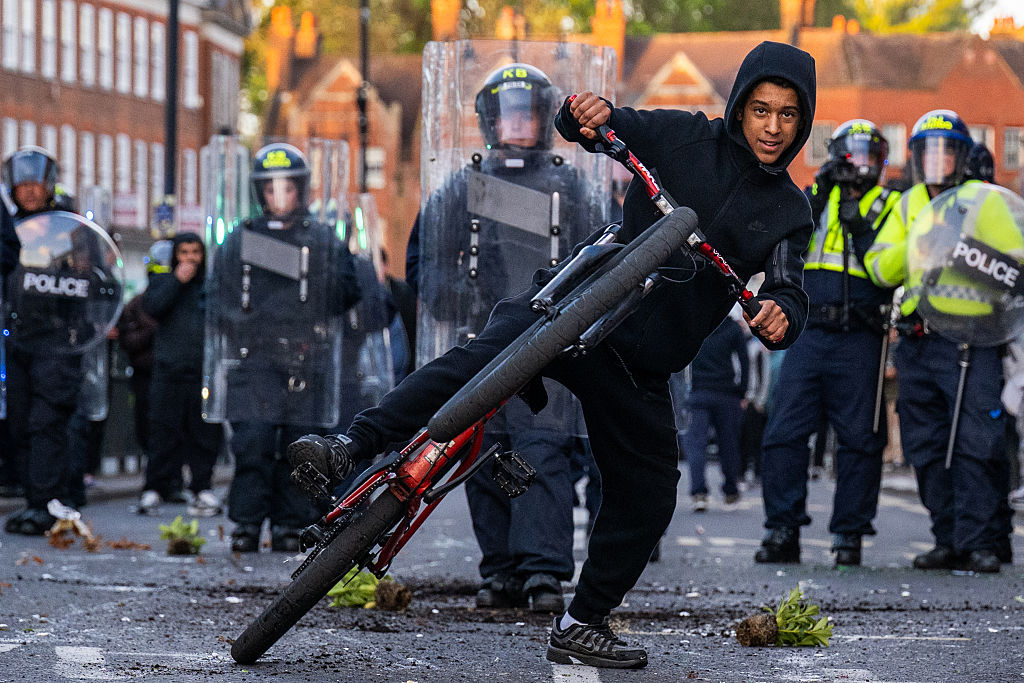
Surrey Police’s investigation of an alleged rape in Epsom, a commuter town to the south of London, provides a masterclass in how not to manage a 21st-century information vacuum. Reports of a gang rape, in a churchyard near a local nightclub, led to rumors that the suspects were immigrants or asylum seekers. Inevitably, allegations emerged that police officers were suppressing details. Surrey’s lethargic comms response then invited comparisons to Merseyside Police’s much-criticized reaction to the 2024 disorder in Southport. As tensions mounted, there were a series of protests in Epsom this week. The police response was to deploy officers in riot gear, leading to allegations of two-tier policing. Why, critics asked, didn’t the police deal with pro-Palestine protesters as robustly?
On Friday, Surrey Police announced, somewhat ambiguously, that “to date, we have not found any evidence of the offence as reported but the investigation is ongoing.” The force did, however, rule out the involvement of asylum seekers. By then, online narratives had already been established and unevidenced information passed off as fact. Operational decisions made by Surrey might well have been procedurally appropriate, but in such a politically febrile environment any “failure to explain” augurs trouble.
The Epsom affair reflects a wider collapse of public trust in the police, especially around issues such as race. The white majority outside of the UK’s larger cities now responds to official police sources in much the same way as black and other minority communities did in Eighties Toxteth or Tottenham. Most people also view the police as a hegemon, not a patchwork of 43 forces of different sizes and policing styles. Surrey’s failures, then, are seen as the UK’s, a development which will not be lost on other chief constables this weekend.
Surrey has a relatively small force of around 2,300 officers. It’s a minnow compared to the neighboring Metropolitan Police. The force’s management teams and communications staff will be less experienced in dealing with the 24/7 controversy barrage their London-based colleagues face, or with near-spontaneous demonstrations. A panicky command team fearing serious public disorder is almost certainly the reason Surrey officers appeared heavy-handed in their riot gear, a point soon picked up on by critics. This fed accusations of two-tier policing, whereby white, working-class crowds are treated more robustly than Left-wing or minority groups.
Police advocates might well point out that comparing Surrey’s overreaction to other events is unfair, to which a fair reply is “tough”. UK policing, thanks to its politically supine command class, has made its bed over the past few years. Now it must lie in it.
Also significant is the unusual statement issued by Surrey Police: “we have not found any evidence of the offence as reported.” Does this mean the reports issued by the force, or unverified internet rumor? Of course, allegations of sexual offenses must be treated with utmost sensitivity. The victim and her family would understandably bridle at personal details being circulated to assuage an online mob. Surrey Police, clearly, failed to adequately explain this point. Then there’s another taboo subject for officers: what if the allegations were false, disputed or misreported? Surrey’s statement certainly smacks of strategic ambiguity. There are more political sensitivities at play, not least the policy that all victims must be believed. This is now deeply embedded in policing, though roughly 4% of rape allegations are identified as false.
The Epsom case offers an unwelcome smorgasbord of culture-war issues for beleaguered police forces: race, immigration, sexual offenses, and trust in police and mainstream media sources. The organizers of the Epsom demonstrations were no doubt delighted that Surrey Police fell into the trap of sending officers in riot gear, feeding a new cycle of cynicism, outrage and mistrust. Nearly two years after the Southport riots, too many senior officers still behave like rabbits caught in headlights when it comes to politically sensitive issues. Until forces commit to transparent communications strategies, and are prepared to speak occasionally uncomfortable truths, similar scenarios will smolder. Then one, like Southport, will combust again.
Join the discussion
Join like minded readers that support our journalism by becoming a paid subscriber
To join the discussion in the comments, become a paid subscriber.
Join like minded readers that support our journalism, read unlimited articles and enjoy other subscriber-only benefits.
Subscribe