




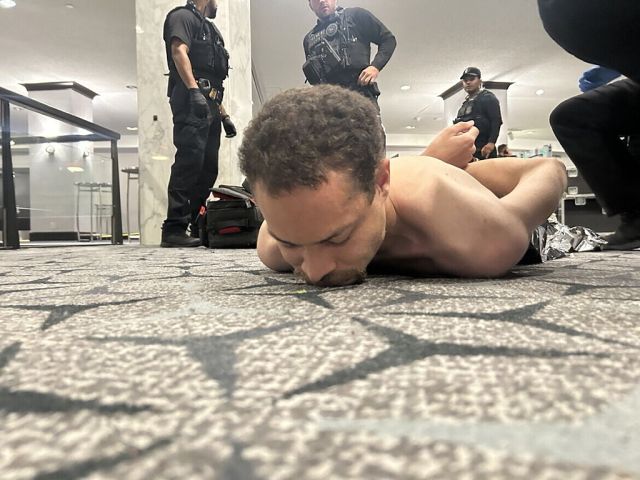
President Trump posted this photo of Cole Tomas Allen to Truth Social. Credit: US President Trump via Truth Social/Anadolu via Getty Images)





Spectacular events — such as this weekend’s attempted assassination of President Trump and his Cabinet in Washington — can tempt us into thinking that ours is an unprecedented moment: uniquely turbulent, uniquely violent. The slightest friendship with a history book, however, gives the lie to such presentism. Case in point: from Hamilton’s death-by-duel to Lincoln’s demise to the JFK assassination, political violence has run parallel to American constitutional stability.
Just because some things are historical constants, however, doesn’t mean their essential characteristics remain unchanged. These shift in tandem with broader material and ideological transformations. It’s remarkable, for example, that Cole Tomas Allen, Trump’s latest would-be killer, is a member of the professional class pursuing an essentially moralistic (and cranky, Epstein-tinged) vendetta, untethered from any larger project of mass social change.
Allen, in other words, embodies the collapse of grand narratives that the French postmodern theorist Jean-Francois Lyotard identified as the defining aspect of the postmodern condition (in a 1979 book of that title). Allen would kill not in order to open a new political horizon — but to purify himself from political contamination: “I am no longer willing to permit a pedophile, rapist, and traitor to coat my hands with his crimes,” as his manifesto put it.
“Postmodernism” is a relic from earlier rounds of the culture war. On the Right, the term was only barely understood, with many conservative critics mistaking Left theorists’ diagnosis of the condition for an endorsement. “Everything I don’t like is postmodern” was a feature of much conservative (and liberal) discourse in the 1980s and ’90s. Among Left academe, meanwhile, the term soon faded, as other progressive concerns occupied the foreground.
Yet if the postmodernism debates were often inane, Lyotard and his heirs described a real shift of immense significance: namely, the incredulous reaction that, beginning in the latter third of the 20th century, greeted universal accounts of the human condition that once explained and inspired social change. The classic examples include Enlightenment liberalism, scientific Positivism, Freudian psychoanalysis, and, of course, Marxism and dialectical materialism.
Some thinkers cheered the demise of the grand narratives, viewing them as supplying legitimacy to existing power structures and ultimately as untenable. Yet their loss entailed a price. Among the casualties was the sense of optimistic futurity that attended the modernist project. In different ways, the proponents of modernist systems like Marxism displaced man from the central position he’d occupied in classical and medieval cosmology.
At the same time, the likes of Comte, Freud, and Marx claimed to have discovered new foundations for human freedom. To be a Marxist meant giving history a push toward its inevitable destination: the breaking of the capital relation, based on man’s exploitation by man, and its replacement with an abundant, classless society in which each could develop his individual capacities — what Marx, in the third volume of Capital, called “the true realm of freedom.”
After modernism, scientific and technological advancement continued apace. But this progress no longer fit into a larger emancipatory frame. If anything, the new communications technologies that would emerge by the 1990s brought about greater fragmentation, as a thousand atavisms and backward, hyper-local causes found new vitality online, and people siloed themselves in boutique communities of shared interest — and identical opinions.
In art, as the late American critic Fredric Jameson contended, modernism’s characteristic concern with time — either in anticipating the future or eulogizing the past — gave way to the spacial “flatness” and deliberate “superficiality” of pastiche. In architecture, utopian monumentality was supplanted by styles that were playful, populist, and attuned to popular culture (one influential text urged designers to learn — rather than run away — from Las Vegas).
And in the realm of political violence, we might add now, the murderous anarchist or socialist revolutionary gave way to, well, the Cole Tomas Allen type: the loner who, acting apart from any mass movement or any vision of broad emancipation, kills or tries to kill in pursuit of an essentially private or hyper-localized account of meaning — exactly the sort of knowledge that Lyotard saw replacing the grand epistemologies of Comte, Freud, Marx, etc.
This isn’t to say that all Allen-type shooters are motivated by nutty convictions or that their actions are bereft of political meaning. Some are like that, most notably John Hinkley, Jr., Ronald Reagan’s would-be assassin, who tried to imitate Taxi Driver’s Travis Bickle in a desperate bid to woo the film’s child star, Jodi Foster. The same could largely be said for Ryan Routh, Trump’s second would-be assassin, who has more than once been declared “delusional” by the mental-health system (he wanted to defend Ukraine and bring peace to Gaza and discussed Hitler in his opening statement at his trial on several serious charges).
By contrast, Allen wrote a fairly cogent manifesto, and it’s clear that he thought he was acting in line with progressive and even Christian duty. But the mere possession of political intuitions, however strongly felt, isn’t the same thing as taking up a political project of the kind that animated the 19th century and most of the 20th. When socialist revolutionaries threw the bombs that killed Tsar Alexander II, they thought they were removing an obstacle to a bright future. Ditto for Leon Czolgosz, the anarchist who assassinated President McKinley.
What about Allen? What sort of future did he think he was inaugurating in killing Trump and his senior officials? His manifesto doesn’t mention “freedom,” “equality,” “the working class,” “imperialism,” or the like. Such watchwords are only legible within a broader grand-narrative politics, one that would pit workers against bosses, the Global South against the North, the subaltern against the hegemonic, progress against reaction, and so on.
To be clear, I’m not wishing that we had killers who killed for the right reasons. Even in the age of grand narratives, terrorism as a tactic had its critics on the Left, who argued that the lone killer, whatever his motives, only ends up strengthening repressive elements in the state, doing harm to innocents, and worst of all, substituting the romance of individual heroics for collective action and mass mobilization.
The point is to merely register the poverty of a post-grand-narrative, postmodern age. And to wonder why it is that Allen-type killers predominate in it.
One of the supposedly failed grand narratives, Marxism, could offer an answer. It has to do with Allen’s class position (and that of others like him, such as Luigi Mangione, the Marylander accused of killing UnitedHealthCare CEO Brian Thompson). Both Allen and Mangione attended prestigious schools — Caltech and Penn, respectively — and belonged to an increasingly stressed and downwardly mobile professional class.
Professionals don’t own the bulk of assets like the bourgeoisie; but nor are they proletarians, barely reproducing themselves with hourly wages. Professionals occupy an in-between position, one that came to mediate between the two dynamic classes — capital and labor — under the New Deal order (and social democracy in Europe). Twentieth-century professionals both oversaw the labor process and attended to its ideological upkeep.
Indeed, the “late capitalism” in the subtitle of Jameson’s book, Postmodernism: or, the Cultural Logic of Late Capitalism, refers precisely to these kinds of midcentury orders, in which the brute competitive capitalism of the 19th century gave way to something more stable and managed, and managers eclipsed the bourgeoisie in influence. The neoliberal turn — the sharp deregulation of the market system launched in the ’70s — didn’t lessen the importance of the professionals’ functions (mediation, symbolic upkeep, etc.), but merely shifted them to the private sector.
But now the old bourgeoisie is reasserting itself in the likes of Elon Musk, Peter Thiel, and Alex Karp. These tycoons are beginning to formulate a new grand narrative, in which they themselves figure as the master subject of history (explicitly so, in the case of defense-tech firm Palantir’s new “manifesto,” which calls on Big Tech to arm the West for a new age of perpetual war).
Arguably, the 2024 election was the story of the so-called Tech Right joining hands with the asset-poor majority to dethrone the professionals and managers who once mediated between them; automation in white-collar sectors tends toward the same result — managers and mediators gone, as rich and poor once more confront each other ever more directly.
In a materialist telling, then, the modernist-period grand narratives were a product of the heroic age of capitalism, characterized by violent class struggle — violent gyrations of the dialectic. This was snuffed out by the more bureaucratic, managed phase that followed (“late capitalism”). But now, there are signs that we are entering a second heroic age, with an aggressive bourgeoisie that is once more generating jejune grand narratives of its own (Alex Karp ain’t no Hegel).
What such a moment demands are new visions of the future and new grand narratives articulated from below, by the asset-less majority, which is beginning to discover that the tech bosses aren’t its friends. The revival of Christianity could help anchor these new narratives in ancient truths. Until then, we are likely to see more and more of the kind of random violence characteristic of stressed professionals — the screams of an increasingly irrelevant class into the void of meaning they helped create.
Sohrab Ahmari is the US editor of UnHerd. His next book, on The Triumph of Normal, is forthcoming from HarperCollins.
 SohrabAhmari