




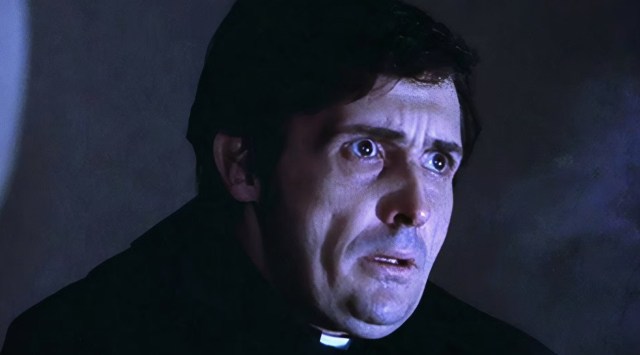
We can’t be sure if the film’s Fr. Karras (Jason Miller) ever regains his faith. Credit: Universal Pictures





In the Christian telling, Good Friday is a moment of supreme hope — the pivotal moment in salvation history, when God himself, though perfectly innocent, deigns to be crucified by his guilty creation, paying the price in grace that by right should be borne by sinful men and women. Hence, the name (Good Friday). Yet the day isn’t without its element of utter horror: not just the body horror of Christ’s torture and execution, but also the much more existentially terrifying eclipse of the good, summed up in his cry: Eli, Eli, lama sabachthani?
Today, as secularization proceeds apace, and the “quiet revival” of Christianity turns out not to have been all it was jazzed up to be, we labor under all the horror of Good Friday — the loss of the good — but taste little of the hope. Ours is a world in which it seems that God is indeed dead, even as the devil carries on.
Few cultural texts have come closer to capturing this predicament than The Exorcist, William Friedkin’s classic horror film from 1973. The movie concerns priests, the devil, and God, and thus is an apposite rewatch over the Christian high holy days, which culminate on Easter Sunday. The Exorcist puts its finger on a growing threat to the West: our consistent tendency to name evil, but not the good, a loss that is eroding us from within.
In The Exorcist, Catholic priest Father Merrin (Max von Sydow) accidentally brings an Assyrian demon, Pazuzu, back from an archaeological dig in Nineveh, Iraq, and it possesses young Regan (Linda Blair). Regan’s distraught mother Chris (Ellen Burstyn) finally consults a local priest, Father Damien Karras (Jason Miller) — and is astonished to discover that even he is skeptical of demons. In the 1970s, priests weren’t what they used to be.
This, it turns out, makes Karras an existentialist hero of our times. He is both a priest and a psychiatrist at Georgetown Medical School, and though he is losing his faith, he still has the sense of moral responsibility that accompanied it. He embodies a contemporary dilemma: we make commitments freely, as a matter of individual choice, yet in the absence of secure authority, those commitments feel anxious and fragile.
Indeed, like most of us, Karras straddles two worlds: an older world of fixed values presided over by legitimate authority — and a rational, materialist world, which, in the 1960s, and ’70s when the Exorcist was filmed, was fast turning into a therapeutic domain. The therapeutic approach of the “psy” disciplines (psychology, psychiatry, psychotherapy, and psychoanalysis) offers a softening of rational materialism, and performs a substitution of explanation for judgment. Instead of judging a person as “wicked,” these modalities will explain them as “unhappy” or “troubled.” They will ask: what wound or trauma accounts for this? This can be humane and often correct. But as explanation replaces judgment, the ability to name corruption, cruelty, and selfishness fades. We are left without the language that would help us identify what must be resisted.
This shows up clearly in The Exorcist, in which adversaries can be authoritatively demonic. Chris consults doctors and psychiatrists, who argue over the possibilities of central nervous disorders, temporal lobe epilepsy, lesions in Regan’s brain, and so on. All the while, the devil is gaining ground. He has the advantage of knowing what he is, long before others recognize the danger.
The doctors never wise up: after consulting 80 experts, Chris is told by one doctor to seek an exorcism. This is not because said doctor believes in the Catholic faith and its rituals. But because Regan thinks she is possessed, the doctor reasons, an exorcism might work through auto-suggestion. This way, the old wisdom is folded seamlessly into the therapeutic culture, a process that obscures the moral and spiritual battle actually taking place.
Father Karras eventually changes his mind on the existence of demons and together with Father Merrin does battle for Regan’s soul. However, in the symbology of the film, he is a figure of doubt, wearing a medallion of Saint Joseph, the patron saint of “people in doubt.” In one sense, the film suggests that doubt, although a key aspect of our cultural mentality, is a fatal weakness when faced with evil. In a deeper sense, it captures our cultural ambiguity. Karras comes to accept evil but still doubts the good. The exorcism works, and the demon jumps from Regan to Karras, who then jumps to his death to end the possession. But we are never given any sure indication that his faith is restored. Pazuzu reveals himself but God does not.
It would be easy to treat such narratives as relics of a more superstitious age. And yet even in a culture that increasingly explains behavior through trauma and pathology, the language of evil has not disappeared. To be sure, we are more inclined to explain individuals than to judge them. But at the level of systems, histories, and political enemies, we readily invoke evil. This is evident in official rhetoric — from Ronald Reagan’s “evil empire” to George W. Bush’s “axis of evil” — as well as in the popular imagination, which has thrilled to panics over evil, including the Satanic Panic of the 1980s, the conspiracy theories of QAnon, and the Epstein mythos. Most recently there has been chatter that the Labubu dolls resemble Pazuzu, reviving fears of possession in an otherwise secular culture.
We are never in doubt of what we are fighting against, but we rarely ask ourselves what we are fighting for.
The inability to answer this question lies at the heart of the exhaustion of the West, its crises of meaning and self-belief. The problem has been framed in terms of the decline of religion; it is, I suggest, less the need to believe in God than to believe in the good. By this, I mean the sense that there is something outside us — objectively — that sets a standard and demands to be seen and responded to. From the perspective of classical theism, the good is God, and ordinary goods are a participation in the higher Good. The Enlightenment retained part of this conviction, even as religious faith declined; moral life was still oriented toward truth, order, and hierarchy as external realities. What has changed more recently is not simply lack of belief in goodness, but the erosion of that orientation altogether. Without it, the existentialist emphasis on freedom, choice, and individual responsibility collapses into a shallow focus on success on the one hand, nihilism on the other.
In ancient Assyrian cosmology, figures such as Pazuzu occupied a strange and unstable position: they were lesser demons, invoked to ward off other, greater evils, and served a similar function as gargoyles or the “wrathful deities” in Buddhism. What is striking in Assyrian religion is not simply the proliferation of such forces, but the absence of any clear, unifying conception of the good. The result is a world structured around dangers, rather than purposes — a world, in other words, very much like our own.
For us, this brings new threats. In The Exorcist, when Merrin finds the amulet of Pazuzu, he also finds nearby a Christian medallion of Saint Joseph, an echo of the one Karras wears. In older times, the smaller, named evils protected us from ultimate Evil; but when we doubt the existence of the opposing force of good, these small evils become dangerous in their own right.
If the problem is not a lack of God, but a lack of the good, then we might turn to the philosopher and novelist Iris Murdoch, who sought a way of recovering moral reality without restoring dogma. In her landmark text The Sovereignty of the Good, Murdoch didn’t advocate attempting to go back to the days of religious fervor; instead she located the good in the everyday benevolent actions of ordinary human beings, and the sense we have that “there is more than this” when we look compassionately at people. Such moments do not have to be grand. Indeed, she insisted that such insights must remain small, almost imperceptible, in order to not become theological.
Murdoch referred to the good as something with a metaphysical position, but no fixed metaphysical form. It has no doctrine, but it can be perceived with a kind of disciplined attention in which we do not allow our egos, fears, and desires to blind us to reality. This is the opposite of the modern injunction to “be kind” and suspend judgment; judgments must be harder, sharper, and less self-flattering.
The good has slipped out of our conversations and our dramas; it goes unnamed. In The Exorcist, the frame of Christian theology allows the possibility of a literal triumph of God over Satan, by the film’s logic. But for secular audiences, the good in the film is glimpsed in small things, as Murdoch might have imagined it, and is easily missed against the backdrop of dramatic evil. We see it especially in the friendship between Karras and Father Joseph Dyer (played by an actual priest, the Rev. William O’Malley), who grasps Karras’s hand as he lies dying on the infamous Georgetown steps, offering both Last Rites (salvation, in the Catholic understanding) but also human comfort — the best we can ask for in a world without God.
The concept of the good, could, in its own quiet way, prove revolutionary in our current civilizational crisis. The virtuous person, attuned to the good, Murdoch says, looks outward at others and at the world around her, not inward, at self. She is required to be truthful and view both others and herself as they are, not as she would like them to be. Such moral practice is a skill, rather than a set of rules, and it opposes the tendencies of modern therapeutic society and very much departs from today’s ethos of non-judgmental “kindness.” Murdoch believed such forms of seeing could “unwind” a long historical process that began with the Enlightenment and eventually “sundered” truth from virtue, returning us to the great classical insight that the two belong together — indeed, that the two are the same and thus convertible.
Is any of this possible in a world where we believe in “our own truth” instead of “the truth”? Perhaps not, but if we cannot believe in the good, the unquestionable persistence of evil, both small and large, should goad us on. We know evil exists, and not only in the movies. The good does not announce itself so clearly. It has to be seen. And yet its presence is a story our culture continues to tell, even as it forgets how to name it, leaving no answer or consolation to our cry: Eli, Eli. . . .