








April 16 2026 - 10:00am
Imagine, as a thought experiment, that you are a massively corrupt Czech immigrant to the UK, bent on ensconcing yourself within the British establishment. What would be at the top of your shopping list of UK institutions? Almost certainly not a red-top tabloid. It’s an index of print’s decline that a modern-day Robert Maxwell would have no interest whatsoever in snapping up the Mirror, never mind strip-mining its assets.
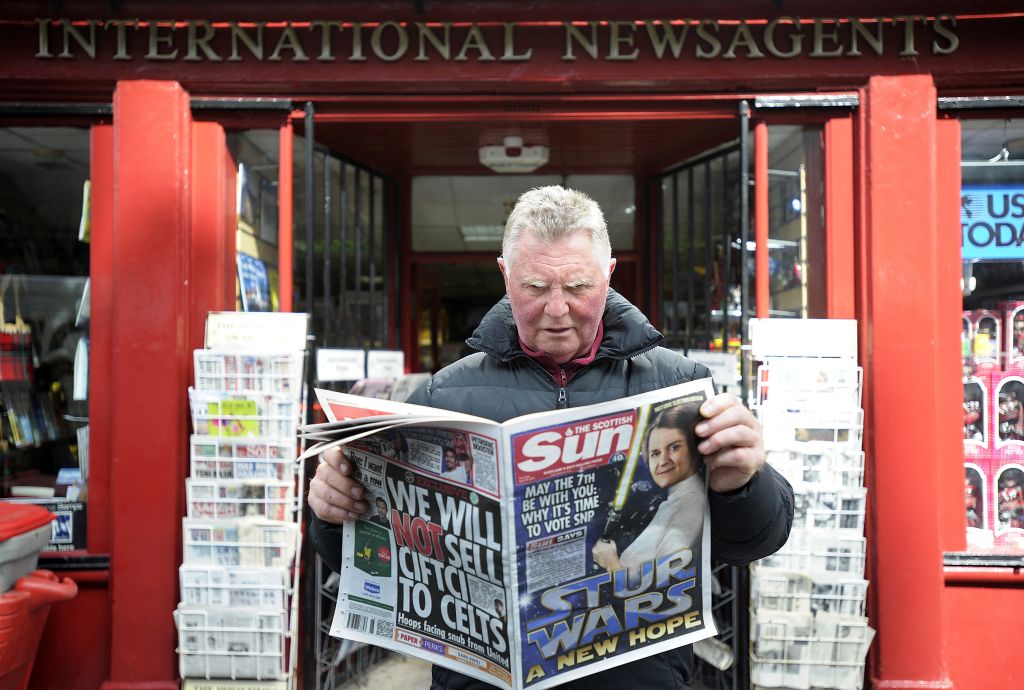
Owning a tabloid today doesn’t have the same clout. The red tops still have a huge audience, with 22.2 million adults reading the Sun last year. The previous year, however, that figure was 26.6 million. The situation is even more parlous at the Mirror, which reported a 15% drop in circulation between 2024 and 2025. A new article from the Financial Times details this declining readership, as well as even more rapid drop in profits. In the year to June 2025, the Sun reported a pre-tax loss of £53 million, following an £18 million loss the previous year. There are serious questions about whether these papers make business sense any more.
I’ve watched this decline and grieved over it. I can’t pretend to be a natural red-top reader: I’m middle-class and I have two degrees, making me what a proper tabloid hack would technically refer to as a “wanker”. But for three years at the tail end of the Nineties, I read them cover-to-cover several times a week.
I was working at a supermarket while doing my A-levels. In the windowless break room of my workplace, though, there were only two papers available to go with my cup of disgusting vending-machine vegetable soup: the Mirror and the Sun, representing both sides of the British political spectrum. So I read them. There was nothing else for me to do.
When the tabloids were in their pomp, it was easy to deride them. The Sun’s Page 3 was naff and sexist. The tabloid voice as a whole was crass and simplistic. The information-gathering methods used were — as we know thanks to the phone-hacking trials — often intrusive and sometimes illegal.
But you know what else the tabloids did? Journalism, and lots of it. Between the celebrity news and the hyperventilating scandal (and the tits), you would find out what was happening in the world. When I had my first experience in local newspapers (also RIP), the most ambitious people I shadowed were looking for a chance to join a red top. The tabloids were the top of the craft.
“It’s the Sun wot won it” was probably an unearned boast after the 1992 general election — papers follow their readers’ voting intention more than readers follow their papers’ — but politicians were answerable to these titans of the news stand. The tabloids exercised power on behalf of their readers, and they were funny while they did it.
Do supermarket break rooms still have tabloids? Probably not, and probably no one misses them: they’re all looking at their phones. The red tops today are flimsy compared to their glory days — the Mirror barely feels like a paper at all, gutted by multiple redundancies and “efficiencies” imposed by parent company Reach. As former Sun editor David Yelland argues, the whole media landscape is tabloid now, so tabloids themselves are superfluous. If they go, something goes with them: the idea that a working-class readership deserves to be informed, entertained and taken seriously.

Join the discussion
Join like minded readers that support our journalism by becoming a paid subscriber
To join the discussion in the comments, become a paid subscriber.
Join like minded readers that support our journalism, read unlimited articles and enjoy other subscriber-only benefits.
Subscribe