








April 6 2026 - 7:45pm
Last month, Bluesky CEO Jay Graber stepped down after more than four years leading the company. The board is now searching for a permanent CEO, as pressure intensifies on the platform to keep up with Elon Musk’s X. The timing is rough. What was once billed as the most credible post-Twitter alternative is now showing clear signs of stagnation.
Bluesky’s trajectory raises an uncomfortable question: is this just a temporary plateau, or the beginning of terminal decline? The early evidence points toward the latter. Stripped of the hype and headline user surges, Bluesky increasingly looks less like a breakout success and more like a case study in why ideologically homogeneous platforms struggle to sustain meaningful engagement.
Bluesky only opened to the public in February 2024, having spent a year in invite-only beta after growing out of a project originally launched by Twitter founder Jack Dorsey. The post-election exodus from X in November 2024 was supposed to be Bluesky’s moonshot moment, adding roughly 13 million users in six weeks, and then crossing 20 million by mid-November and 30 million by January 2025.
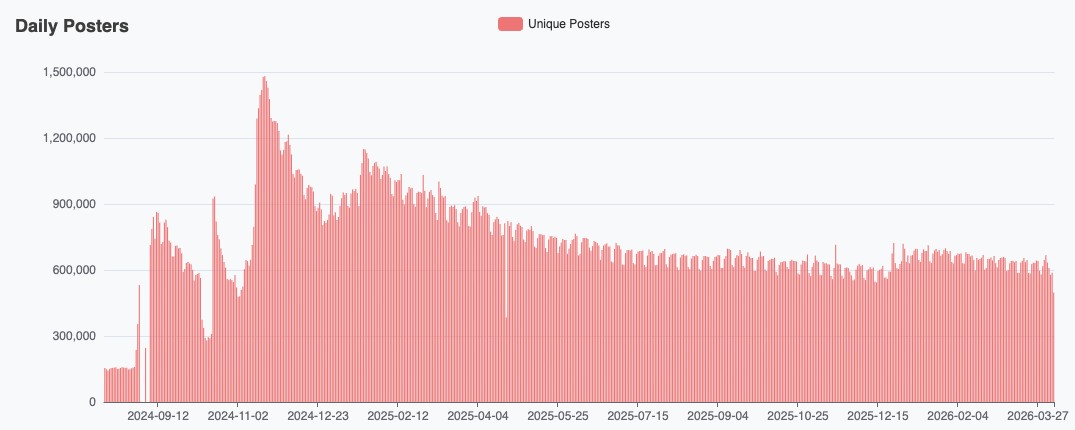
Alas, it’s now a gloomy case study in why ideological monocultures can’t sustain engagement. Over on X, a journalist recently flagged Bluesky’s engagement data. The accompanying graphs, drawn from the platform’s own public metrics tracker, tell a brutal story. Daily posters spiked to 1.5 million and now sit around 600,000. As one analysis noted, by early April 2026, average daily posters had fallen back to September 2024 levels, handing back everything the site gained since Trump’s election. To address this problem, Bluesky’s head of product released an engagement-focused 2026 roadmap in January. It promised an overhauled Discover feed, better follow recommendations, and real-time curation tools for live events, which amounts to an admission that their mechanics for finding interesting content never worked properly.
Mark Cuban, once an enthusiastic evangelist who posted nearly 2,000 times after joining in November 2024, reversed course in June 2025, writing that engagement had devolved from substantive conversations into culture war-style purity tests. It didn’t matter if users were Democrats or Left-wing; no one was safe. Take, for example, Slate‘s legal correspondent, Mark Joseph Stern, who was piled on for offering a measured legal analysis of the Supreme Court’s conversion therapy ruling. Unfortunately, his experience is not unique; researchers at the University of Zurich and Aalto University found that on the most polarized topics on Bluesky such as trans rights, dissenting opinions made up only 1-2% of users.
The obvious story here is that Bluesky is dying a slow death. The tribal approach looked logical on paper. First, you build a safe harbor for progressives alienated by Musk’s X, then let community loyalty compound. The trouble is that agreement doesn’t generate the friction social media runs on. When 98% of users share the same politics, there’s nothing left to argue about, and those controversies are what create user clicks and advertiser cash. The failures of Parler and Gab proved the same lesson from the Right.
Bluesky’s problem is simpler than its boosters would like to admit. It grew quickly on the back of a political moment, but it hasn’t figured out how to keep people talking now that moment passed. The problem for Bluesky is that it isn’t big enough to ignore engagement problems, and it isn’t distinctive enough to overcome them. Unless that changes quickly, its brief period as the heir to Twitter will look less like a turning point and more like a blip.
Oliver Bateman is a historian and journalist based in Pittsburgh. He blogs, vlogs, and podcasts at his Substack, Oliver Bateman Does the Work
 MoustacheClubUS
Join the discussion
Join like minded readers that support our journalism by becoming a paid subscriber
To join the discussion in the comments, become a paid subscriber.
Join like minded readers that support our journalism, read unlimited articles and enjoy other subscriber-only benefits.
Subscribe