




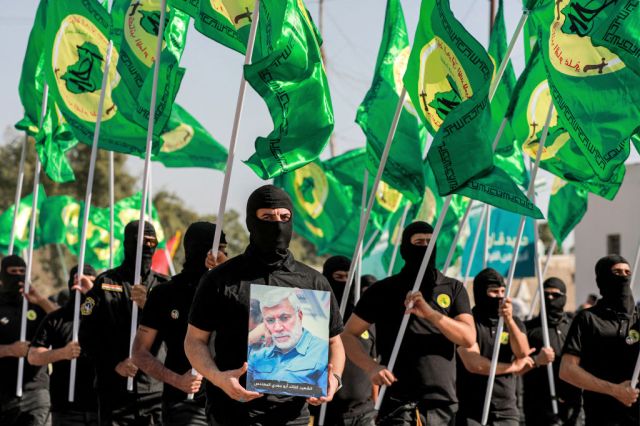
Militiamen linked to the Popular Mobilization Forces. (Murtaja Lateef/AFP)





After her base was hit by an Iranian missile, Ghazal Molan stood a chance of surviving. But the 19-year-old Iranian Kurdish fighter — exiled from her native land and now living in Iraqi Kurdistan — was repeatedly turned away by local hospitals. The doctors were afraid of reprisals by Iran’s network of allies within the fractured Iraqi state. And so, as Molan’s ambulance raced from one shuttered hospital to another, the teenager succumbed to her wounds.
Molan’s fate, and the Iranian missiles that continue to strike targets across northern Iraq, encapsulates the grave threat faced by Kurds and their political representatives. Rumored US support for a cross-border Kurdish assault on Iran has failed to materialize, leaving the Kurds exposed on the frontlines of a war they didn’t start. Three more Kurdish fighters were injured in a fresh strike just hours after Donald Trump announced the extension of a fragile ceasefire.
Yet beyond the Kurds and their unending fight for self-determination, Molan’s death also points to a broader crisis, one rapidly reaching boiling-point right across Iraq. Compared to Iran’s well-publicized ties to Hezbollah in Lebanon and the Houthis in Yemen, Tehran’s network of Iraqi Shia militias receive relatively little attention abroad. But amid missile strikes and the high-profile kidnapping of a US journalist, US-Iraqi relations are now at their lowest ebb since 2003. Just this week, Washington cut Iraq off from dollar shipments altogether, demanding its nominal partner sever ties with Tehran and arrest militia members accused of attacks on US bases. As Trump’s standoff with the Revolutionary Guards continues, his war on Iran looks set to spill over onto yet another country.
The semi-autonomous Kurdistan Region of Iraq (KRI), established following the Gulf War, has long been a loyal partner to the West. One street in the capital Erbil was recently renamed after John Major, honoring Britain’s own role in establishing the safe haven in Iraq’s mountainous north, today home to around six million Kurds. So when the American press started leaking news that the US and Israel were looking to “arm the Kurds” in the early days of the 2026 war, it seemed a repeat of that same partnership could be on the cards in neighboring Iran, itself home to some 10 million Kurds. The Islamic Republic has killed tens of thousands of its own Kurdish population over the years, including during 2022’s “Women, Life, Freedom” uprising and in response to massive protests this January.
But according to Hoshyar Siwaily, the head of foreign relations for the KRI’s governing Kurdistan Democratic Party (KDP), reports of an imminent US-backed cross-border operation were fake news. “Even when the KRI is facing continuous missile and drone attacks, from both Iran and our neighbors in Iraq, the West has not provided the KRI with the means to defend itself,” Siwaily tells UnHerd. “We’ve been asking the US and our European partners to provide us with air defense systems, which we think they would be willing to provide — but Baghdad’s position hinders that kind of direct assistance.”
US forces stationed in Erbil operate their own air-defense system at the city’s airport. That means some protection for locals; busy shopping streets are peppered with falling shrapnel more than direct missile impacts. Still, it’s better than Kurdish regions outside the capital, which have no such shield. That includes the camps housing the various exiled Iranian Kurdish parties, sheltering under the wing of their more successful Iraqi brethren, and where most of the Kurdish casualties have been concentrated.
Hassan Sharifi is a senior representative of the KDP-I, the largest and oldest Iranian Kurdish opposition party. “We don’t have any role in starting this war between Iran and Israel and the USA, and we don’t have any role in it continuing or stopping,” he says, wearing a military-green version of the traditional Kurdish cummerbund as he speaks in his party’s Erbil headquarters. “And yet Iran continues to strike us, all day every day.”
Both domestically and abroad, scapegoating the Kurds has long been an attractive option for Iran, as it fights its asymmetrical war with the West. Washington’s careless hints at a partnership between the Kurds, the US and Israel have only poured oil on the fire. Adib Khaladyan, a political representative for another Iranian-Kurdish opposition group, counts members of his own small party among the dead. “We have refrained from any attacks on Iran since 2005, but they have never ceased attacking us,” he tells UnHerd in the lobby of an Erbil hotel included on an Iranian hit list for allegedly sheltering US and Israeli intelligence agents. Khaladyan, for his part, denies this charge. “There’s no concrete evidence Israel is supporting any Iranian Kurdish party,” he says, adding that the Islamic Republic nonetheless targets Iranian Kurdish parties and the houses of their members.
In any case, decades of political exile and internal repression by Tehran mean their scope for action within Iran itself is relatively limited, with the Iraqi-Kurdish authorities pragmatically keeping their Iranian guests on a tight leash. “We are not willing to let these [opposition] political parties use Kurdistan as a base to launch their attacks against Iran,” Siwaily says, pointing to a 2023 agreement between the KRI, Baghdad and Tehran aimed at disarming the Kurdish-Iranian opposition. But though the Kurds haven’t fired a single bullet against Iran throughout the two-month conflict, the war has reached their doorstep anyway. As well as contending with over 700 Iranian strikes since the war began, Iraqi Kurds have faced fire from their Arab compatriots.
As the leading force of the Shia Muslim world, Tehran has long sought influence in majority-Shia Iraq, home to both Shia Islam’s most sacred sites and the seminaries that honed the Islamic Republic’s religious leaders. While the US was busy backing Kurdish aspirations in the north during its wars with Saddam Hussein, Iran supported militias in the Shia south. Iran-backed insurgents went on to resist the post-2003 US occupation, before growing in strength and influence as they joined the fight against ISIS. Scores of militias, grouped under the banner of the Popular Mobilisation Forces (PMF), can today field hundreds of thousands of fighters. More than that, they regularly launch missile attacks at US bases and assets across the region — including, of course, the Kurds.
Tehran has a well-known policy financing and training regional proxies like Hezbollah and the Houthis, enabling them to attack common foes in Israel and the US. But Iran’s Iraqi allies are arguably more valuable still, providing not just military cover, but billions of dollars in cash. These militias dominate Iraqi politics through the “Coordination Framework” of Shiite political parties, helping Iran achieve massive control over Iraq’s political, economic and legislative apparatus. To that extent, “militia” is a misnomer for a network that may still engage in checkpoint-level corruption at the grassroots, but which at the state level runs vast construction, agriculture, real estate and infrastructure enterprises. Especially as it struggles with sanctions and now a blockade, Iran is more reliant than ever on billions of dollars arriving from Iraq via shell companies and informal transfers, with the PMF for instance deploying a complex scheme to make $1.5 billion from Iraq’s black-market exchange rate.
While Washington and Tehran continue their will-they-won’t-they dance over a ceasefire, meanwhile, another set of highly significant negotiations is taking place in Iraq. The Baghdad political establishment is currently struggling to overcome a five-month deadlock and elect a new prime minister. A candidate elected with heavy Iranian backing has already been directly vetoed by President Trump under threat of US sanctions — but the pro-Iranian bloc is now trying to advance another pick, himself already sanctioned by Washington. US Special Envoy Tom Barrack this week stopped in Erbil before flying down to Baghdad, arriving in the capital to lobby for US interests to be respected. A senior member of the Revolutionary Guards was elsewhere in the city, making the opposite case for Iran. Hezbollah may be decimated, and Tehran in turmoil, but in Baghdad the US-Iranian struggle continues on an equal footing.
Since the 7 October attack and Israel’s bloody reprisals across the Middle East, the Iraqi front has remained relatively quiet, as Iran’s proxies concentrated on consolidating and institutionalizing their power. The PMF’s penetration of Iraq was underscored this month when they plucked US journalist Shelly Kittleson from the streets of Baghdad and fired drones at a US diplomatic convoy from within the capital. All the same, US and Israeli strikes killing scores of PMF militiamen have not yet been met with an aggressive response.
Now, however, the hour of reckoning may finally have come. This week, the US has stopped all dollar shipments to Iraq’s central bank, and suspended all security coordination with the Iraqi government. Besides the Kurds, the US has its allies in Iraq’s formal security forces. Unfortunately for Washington, the PMF is larger and better-financed than Iraq’s actual army. If, in other words, the US and Israel ramp up their strikes, this political and economic struggle could yet devolve into outright civil conflict, pitting the PMF against Iraq’s beleaguered armed forces plus Sunni and tribal armed groups. Such chaos would, of course, create room for militant Islamists of all stripes — an especially concerning scenario given the US has just airlifted nearly 6,000 ISIS detainees from Syria and deposited them into Iraqi custody.
The shock-waves would certainly extend to Kurdistan, the USA’s last solid ally in Iraq, where political parties are struggling to plot a course through a sea of historic enemies. Even the pro-Western KDP has fostered a pragmatic alliance with the pro-Iranian presidential candidate in Baghdad. Iran, for its part, continues to exert deeper influence across Iraqi-Iranian borderlands controlled by the KDP’s historic rivals in the Patriotic Union of Kurdistan (PUK). It was here that Kurdish hospitals turned away the wounded Kurdish fighter, fearing Iranian reprisals.
“Although we are partners of the USA,” says the Kurdish politician Siwaily, “we would like to stay neutral, because this war is bigger than us.” But though Trump has now extended his ceasefire deadline, missiles continue to fly over Kurdistan, and the drums of war are sounding in Baghdad. Staying neutral might well be wishful thinking.
Matt Broomfield is a freelance journalist, PhD researcher, co-founder of the Rojava Information Center, and author of Hope Without Hope: Rojava and Revolutionary Commitment (2025).
 MattBroomfield1