




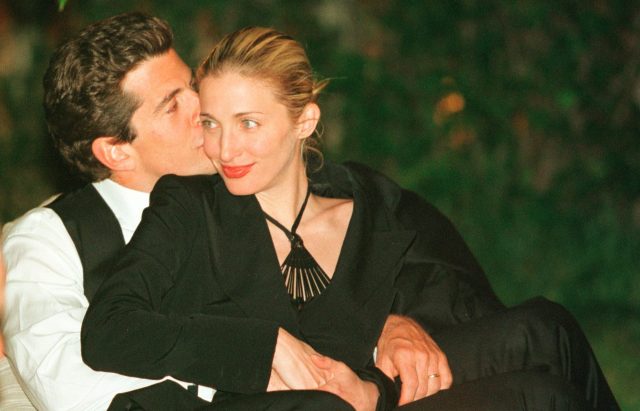
John F. Kennedy, Jr. and Carolyn Bessette at a White House dinner in 1999, two months before their death. (Tyler Mallory/ Getty)





You can’t pop to Trader Joe’s for a pint of milk these days without having to fight through squadrons of Carolyn Bessette Kennedys preening by the fridge aisle. They’re flipping their hair, chewing seductively on pens, and squinting through CBK glasses as they channel the tragic heroine du jour: star of Love Story, Ryan Murphy’s FX series on her doomed relationship with JFK Jr. Nearly three decades after the couple died in a plane crash off Martha’s Vineyard, New York is again beset by bargain-bucket Bessettes.
Influencers slouch around their kitchens pouting, strut across the road dragging small dogs or squint through small black sunglasses in their living rooms; whatever they do, they do it in medium-wash denim and try their best to look as though they’re about to leave the house for a high-powered job (j-o-b… look that word up).
The men aren’t behaving much better. Bands of bros have begun to clog up East Village bars in backwards JFK Jr Kangol caps, or skate through Midtown in suit and trench coat; some have even submitted to being “styled” by their turtlenecked girlfriends. While in 1988 People magazine was calling John John “the sexiest man alive”, today Gen Z are making edits captioned “he’s my fashion killa”, under which other Zoomers purr: “he’s so Lana Del Rey actually”. There’s even a JFK Jr lookalike contest in Washington Square Park on Sunday (Iran, if you need a target…); America’s prince, as he was known in his Nineties heyday, has been discovered by a new generation of admirers.
The Bessette/Kennedy look is Zoomer crack, but so is the lore. Son of a slain president meets a pretty Manhattan party girl — a publicist at Obsession-era Calvin Klein, no less. They meet (while he’s dating Daryl Hannah), they marry and then they die, along with Bessette’s sister, in spectacular fashion in 1999. For Americans who secretly crave royal intrigue, they always embodied something approaching their own House of Windsor. And today, as grand American dynasties make way for populist parvenus like the Trumps, the Kennedy Curse, still at work, condemns this white-bread couple to a fashion girly’s Pinterest boards, there to cycle and shout and snog forevermore. For a brief shining moment, the Kennedy clan embodied muscular, forward-leaning confidence; today the torch is carried by a worm-brained health secretary and a deeply unserious Millennial congressional candidate. It feels good to remember them in their prime.
Like Lady Di, fortunately, JFK Jr and Bessette are petrified in photogenic youth; the writers of Love Story made it clear that the parallels are baked in, directly inspired by royal blockbuster The Crown (the screenwriter Connor Hines said he’d been inspired to cover Kennedy and Bessette after watching the Netflix series). Resembling Diana too is the fey Bessette, who declined to give interviews and so was in her time known as wounded, inscrutable, the woman with “the downcast eyes”. And just like the British royals, the pair represent the faded glamor of a lost world.
For the many Zoomer fans of the series, of course, the lost world is not Camelot but a decade which even those of us who scraped 20th-century birthdays certainly cannot remember. Nineties New York is a foreign country for transplants like me, a dreamland of square jaws, land-lines and the print press. My suspicion is that the tragic hero and heroine of this tale were really quite ordinary; his pedigree and her muteness propelled a myth which would have wilted in the social-media age. His image was carefully manicured — after all he was plotting a stab at his birthright, politics — and hers was in the hands of icy Post columnists who resented her discretion.
Yet Carolyn and John’s new fans are rather the opposite. Absent their own mythos, motivation or mystique, they ape that of others. Fashion cycles may span 30 years, but the Nineties hold a particular weight in the Gen-Z imagination precisely because it was the final decade before the encroachment of the internet into the everyday. It is worth pointing out that the fantasy of the couple’s chicly opaque private lives is betrayed by the series itself: much of it seems to have been based on books written by close friends of the couple looking to make a buck in the 2000s; read a little around the subject of JFK Jr’s “charisma” and you’ll realize how many New York/Washington scenesters seem to have made a career of repeating five-minute anecdotes from 30 years ago. Sycophants circle even today, their reverence jarring in the age of nepo-baby hatred: “If there was anybody destined to be president, it was him,” a political scientist told the Guardian about spotting JFK Jr during a White House dinner. Years before social media, this couple were guinea pigs for hysterical overexposure.
For a new generation of vibe curators drooling over the couple’s battered Birkin 40s and fat striped ties, the broader resonance of what Bessette and Kennedy represented is lost — not just #couplegoals but the last gasp of American aristocracy, the great dynasties which once enjoyed such ease and prestige. These clans are now most loudly championed by Temu torchbearers like Jack Schlossberg, JFK Jr’s doltish 33-year-old nephew whose own Kennedy Curse seems to be an ambition for congressional office coupled with Brooklyn Beckham levels of attention-gobbling anti-gravitas. A social-media saddo just like his fans, Schlossberg managed to snatch a couple of headlines by lashing out at the series’ portrayal of his uncle by saying, so eloquently, that the show’s creator Murphy “looks like a thumb” and is a “bloated” “pervert”. Get that man on Capitol Hill! Were John John given Instagram and a front-facing camera, would he too have been unmasked as a shallow try-hard? One wonders whether the public’s love affair with Camelot was really a story of scarcity, of dignified distance.
Hamming up this Kennedy mystique, Murphy — he of the scandalously glossy biopics of monsters like Jeffrey Dahmer, Ed Gein and the Menendez brothers — casts JFK Jr as an Edward Cullen prototype, a boring, brooding hunk helped along by fanfic dialog. In Murphy’s hands Bessette, rehabilitated by the 2024 biography on which the series is based, is a spiky, witty city girl. What results is a kind of aristocracy drag, something for the “quiet luxury” TikTokers to get their chops around. Bessette’s style — pared-back professional minimalism — has always been her most memorable feature (perhaps because she was otherwise silent, or more likely dull); after a promotional image of the Love Story set was mocked by fashion types, Murphy brought in the costume designer Rudy Mance, who dutifully obsessed over the type of top-stitching on a Prada bag because, as Variety put it, “someone would have noticed”. Because the targeted viewer is from a generation which sees curation as a shortcut to authenticity, I have no doubt this is true — but you have to ask exactly who gives a fuck, particularly when other details seem to go so awry. It’s worth reading the invective of one former JFK Jr employee who laments that her George magazine boss is portrayed as a “pussy” with a “lisp”, “lip-quivering” and “whining” his way through the relationship like a “big baby”. Nineties aesthetics overlaid with 2020s masculinity make for a strange brew: it’s possible that Zoomer viewers would be repulsed by this family’s firm commitment to pluralism when it came to women — in which John was no exception — and so shrewd showrunners turned him into a palatably lovelorn pussio.
The show luxuriates in long-gone sexual archetypes: the muscular Brown grad chucking footballs around Central Park and the waifish blonde wilting over desks at her glossy fashion job. You’d be shocked at how Zoomettes are shrieking over John John’s chest hair; even the hair on his head, as one wistful TikTok commenter put it, is “so rare nowadays” (ubi sunt, hairlines?). Murphy asks us to imagine that 30 years ago we, too, might have been the hottest couple in the world. In reality, boyfriends have always balded, jobs have always dragged and living in the city has always meant dodging dead rats — but young women’s yearning scrubs all that from their daydream of an always-better, cooler and more authentic New York where they definitely would have swished about galas in slip dresses. It’s telling that Zoomer women are so sold on the show’s vision of Carolyn’s lifestyle: a suitor sending you roses via your secretary and leaving you gravelly voicemails is far more desirable than dodging foot-fetishists on Hinge. Murphy knows this, and so gives us full fantasy.
Daydream all you like, but please don’t bring your impersonations to the dive bar. Pity the backwards-capped imitators who will try out the Kennedy cadence on girls at The Spaniard. Nothing about John and Carolyn’s relationship is desirable: it was often grim, toxic and unfaithful — but this pair looked good together, and that alone is enough to send Gen Z rushing to a West Village pharmacy to buy tortoiseshell headbands just like poor old CBK.
Perhaps that’s the great tragedy of this pretty pairing’s demise: though they should have split up, grown haggard and morphed into the patrician Boomers they were destined to become, they were condemned to pop mythology. America no longer produces princes, so it must relentlessly reanimate them; if the greatest Kennedys had the rich ideals of Camelot, Gen Z has only the flimsy aesthetic refuge of a well-dressed couple necking around Manhattan. Before production, Murphy said the series should be a “showcase for Nineties minimalism”; what he created is really a shrine to Twenties triviality.
