




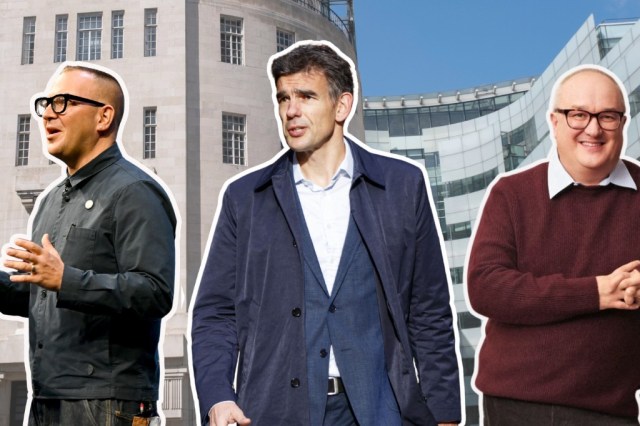
Matt Brittin, center, is tipped to lead the BBC. But should it be Doctorow, left, or Sandbrook, instead? (Getty)





The BBC is soon to announce its new director-general. Matt Brittin, a former Google executive, is tipped to succeed Tim Davie, who resigned last November. The corporation had been the subject of widespread accusations of bias, with Donald Trump among the complainants.
Be it Brittin or someone else, the new DG will face a welter of problems: not only the “metropolitan lens” acknowledged by Davie, nor Trump’s $10 billion lawsuit against the corporation, but a fundamental crisis of identity for an institution that is nearing its 100th birthday. As media evolves and politics fracture, the role of a state broadcaster becomes ever-more fraught — with the license fee an increasingly sore point for restive voters.
In what direction, then, should a new DG take the BBC? And who — in an ideal world — should that DG be? We put these questions to nine contributors and experts.
xxx
Axe Strictly, ban Rooney and go Republican
Geoff Dyer, writer
I think it was Antonio Gramsci who wrote that the battle for culture had to be the battle for the high ground. That battle is now for cultural ground that is the equivalent of the aptly named Badwater Basin in Death Valley, California, which lies almost 300 feet below sea level. So the BBC should not just raise its standards but alter them. There should be a complete abandonment of ratings as a guide to the type of programs that are made. Kenneth Clark’s Civilisation and Jacob Bronowski’s The Ascent of Man need to be held up not as relics of a lost golden age but as rallying cries for a brighter (as opposed to intellectually dimmer) future.
All things like Strictly Come Dancing, that baking show and Traitors or whatever it’s called should be axed immediately. David Attenborough is a lovely legend, of course, but it’s time he was put out to pasture along with Clare Balding. Ideas of impartiality should be changed. Reporting on Israel and Palestine should be realigned to take into account the inherent asymmetry of the conflict.
The King’s Speech should no longer be broadcast and the network should become openly republican in its reporting on the appalling spongers and welfare dependents more usually referred to as the Royal Family. Cut all the soul-destroying Christian stuff on Sundays and basically ignore Christmas. Get rid of The Archers and Desert Island Discs. No documentaries fronted by celebrities. No documentaries featuring someone who is “going on a journey” to discover anything. Wayne Rooney’s wide-screen face must never be seen again unless he’s featured in news stories about increasing face-width. News reporting must stop aspiring to cliché. Radio 3 should be unremittingly and unapologetically serious.
I’ve not given much thought to who might run the BBC but my instinctive feeling is that it should be me.
Back heavyweight programming and appoint Adam Curtis
Sarah Ditum, journalist
The BBC is a creature of 20th-century consensus politics, stranded in the post-consensus world. No wonder it seems to struggle to get anything right. As a feminist, I was on the sharp end of some of its errors about covering the trans issue. But much as it can annoy me, I love the BBC — I’d just like to be able to love it more. I want it to do more of the big stuff, and more of the small stuff.
By “small stuff” I mean local news: one of the worst calls of the Davie regime was the savaging of local radio, which leaves many places essentially unreported given the demise of local press. The new DG should reverse that as a matter of urgency. If public service means anything, surely it’s this.
By “big stuff” I mean flagship arts, culture and science documentaries. The BBC’s own podcast data (especially the success of In Our Time) shows that there’s an audience for heavyweight factual shows. Stop treating TV audiences like morons (cough — Civilisations: Rise and Fall — cough) and they might be coaxed back from YouTube. Oh, and more Traitors please.
To undertake this mission, you need someone who knows the BBC but doesn’t venerate it, and who isn’t locked in the media opinion Borg but also isn’t in hock to tedious anti-wokeism. Give it to Adam Curtis: he would absolutely hate it.
Axe online news, open the archive, appoint Cory Doctorow
Aaron Bastani, UnHerd columnist
In the political imagination, spending more money on any public service is progressively-coded. Reform, meanwhile, means more market-centric thinking: private providers, outsourcing, more precarious conditions for staff.
Such a fatuous binary is why many of our most venerable institutions are failing. “Modernization” is destroying the Royal Mail, while bang-for-buck on higher healthcare spending after 2020 remains limited.
So, in changing the BBC, and renewing it for the 2030s, let us discard such thinking. Meaningful efficiencies aren’t achieved by infinite salami-slicing, but in making decisive calls on the big questions. Good strategy is as much about what an organization chooses not to do as what it pursues.
So here is my proposal. The BBC should not do online news. Why? Because the corporation should focus on audio-visual broadcast — its core offering. It should produce the best dramas, documentaries and news programs possible.
What might it do with the money saved? Open up the archive. Every episode of One Foot in the Grave. All 13 episodes of Kenneth Clarke’s Civilisation. Films like Threads and The War Game. The first Moon Landing. The corporation should be a repository for the nation’s collective memory, rather than a factory of trivia.
And who to lead the charge as Director-General? Cory Doctorow. Nobody else understands the threat of Big Tech like the visionary Canadian.
Lead by elitist example — and appoint Dominic Sandbrook
Ed West, journalist
Under the West terror, the license fee would be scrapped and a smaller BBC would be funded directly from tax. This is more practical, since many young people have no television anyway, but it would also allow the service to become more explicitly elitist in its cultural tastes.
Too much of the BBC content feels like it’s commissioned and produced by people embarrassed to be intelligent and informed. Its online features service in particular provides inane, simplistic slop, and is an embarrassment.
The BBC’s remit should be to enlighten and inform, to be intellectual but not subversive. Most of all, it should be wholesome. At a time when both fertility rates and book-reading are collapsing, it should be a trusted aide to parents of young children in raising them to have a healthy curiosity about the world. It should be the antidote to the smartphone.
The BBC is there to provide services that commercial broadcasters can’t or won’t, and one such remit should be in the promotion of art for art’s sake. It should devote energy and money to promoting classical music among young people, with televised performances of local orchestras from every town in Britain. Finally, and cost permitting, I’d want all the BBC archives available online.
As for the DG, my semi-serious suggestion would be Dominic Sandbrook, in part because he’s a Tory who is nonetheless fair-minded and not too ideological, and most of all he’s written about the cultural power of British art and appreciates what foreigners like about the country’s image. However, you’d have to pay him more than the five squillion he currently earns from podcasting, and I’d be genuinely upset if The Rest is History ended as a result. Maybe Tom and Dom could do it as a double act.
Abandon the pretense of impartiality
Peter Hitchens, columnist
I once attended a giggly, smug presentation by BBC staffers in which they mocked the idea of such a true BBC revolution. They thought that conservatives such as me wanted them to become a kind of Fox News, sucking up to Rupert Murdoch and presenting the news with lots of right-wing adjectives. They had no idea of the methods they themselves use — simple omission of what they dislike, the subtly curled lip, the change of tone of voice, the use of verbs like “claim” and “insist” to devalue the statements of those they despised, to express biases they regard as normal thought. They had no idea that third-wave feminism, or support for mass immigration, or general enthusiasm for divorce, abortion, comprehensive state schools, or a belief that crime is a disease caused by social problems, are actual contentious positions. If they encounter anyone who does not hold them, he or she is dismissed because he or she is not merely wrong but wicked.
I know all this in detail because for years I have been mounting a small social experiment. As a national newspaper columnist, I can criticize the BBC in front of a large audience. But every so often the BBC does something so outrageously wrong that I make a formal complaint, through its official system. This is a minor skill, requiring some experience and persistence. Many, who do not understand it, totally waste their time. The Corporation protects itself with a spongy bureaucratic layer, operated by the service company Capita, which absorbs most such complaints. It is only when you complain about Capita’s (almost invariably) dismissive responses that you actually deal with the Corporation, and its grandly-named Executive Complaints Unit.
Very occasionally, the ECU has to concede, but only ever on a (usually tiny) matter of fact. It then does very little to right the wrong, merely placing a notice on its website. Most who saw or heard the error will never know it happened. But where biased opinion is concerned, it simply does not give an inch. Right up there in its exalted suite of offices, the ECU cannot see the problem. It cannot. It is not that it does not recognize the legitimacy of another view, though it does not. It is that it does not recognize the existence of that other view.
I can tell you what a new Director-General could do about that. He or she would abandon the pretense of impartiality altogether. He or she would free all those staff who now give us their allegedly impartial opinions on Iran, Nigel Farage, assisted suicide or migration to express (as I do) their actual views. Presenters of current affairs, I think, should be obliged to do so, such is their power over the national conversation. So should those who commission drama, perhaps the most influential form of propaganda there is, because it does not look like propaganda. Their party affiliations, if they have them, should remain private.
Nobody should be in any way penalized for this new openness. But it would immediately be so obvious that the BBC speaks for only one part of the nation that these revelations should compel the urgent recruitment of men and women who sympathize with the other part.
And this is where my scheme fails. For where are these people? Which schools, which universities, are producing Christian conservatives, defenders of lifelong marriage, historically literate patriots, supporters of selective rigorous education, believers in the due punishment of responsible persons who prey on their neighbors?
They don’t exist. The BBC, alas, is the Revolutionary Guard Corps of our post-1960s Cultural Revolution, and its power has helped, for decades, to suppress and marginalize the very people it needs most.
Return to serious programming
Andrew Graham-Dixon, art historian
It’s bleeding obvious that they should bring back BBC4 and start making a few serious programs about interesting subjects, especially given that such programs cost virtually nothing to produce by comparison with most of what does get made and shown: one big drama or season of Strictly would fund 100 years of decent documentaries.
But there is really no point pontificating about what the BBC should or should not do. As David Attenborough kindly said to me many years ago, “You should never worry about what happens at the BBC: it is run by mad children.”
Create ‘watercooler moments’
Deborah Cohen, former BBC journalist
The BBC needs to be brave. I say this who has worked as a both staff and freelance reporter across current affairs and Newsnight for the BBC for 15 years – on some of the most contentious issues in our time, including Covid, Brexit and gender. It’s one of the toughest places to work, with constant scrutiny and criticism that can be personal and at times, coordinated.
When you’re under attack — and some of it deserved — the instinct is to retreat and to play it safe. But in my experience the biggest impact in its journalism is when it doesn’t. I’ve seen policy and opinions change because of journalism done properly.
That only happens when you follow the evidence or story without fear or favor — even, and especially, when the subject is polarizing. It means asking the tough questions, irrespective of the backlash, and not bowing to pressure to conform and succumb to groupthink.
The BBC is unique and is a global standard. We lose it at our peril. Its role is to bring complex, difficult stories to life in a way that helps people understand what’s actually at stake.
Today’s information environment is increasingly saturated with low-quality, AI-generated content, where it’s increasingly difficult to tell what’s real and what’s manipulated. In many instances we won’t know what political or commercial interests content represents. This means trust is everything and this is built on accuracy, identity, knowing who is telling you something and why.
To do that, the BBC has to own its stories. Too often, internal competition and silos mean that stories are treated as belonging to programs or departments rather than to the organization as a whole. The result is that opportunities are missed and other outlets step in and take ownership. That needs to change. When the BBC has a story, it should feel like a BBC story carried across platforms in different formats, developed properly and given the space it needs to land.
Part of the problem is structural. There is no longer an obvious home for the kind of investigations that Newsnight used to lead. Too often, the length of a program dictates the shape of the story, rather than the other way around. Digital platforms remove that constraint by offering the chance to tell stories at the right length. The BBC should be using them far more deliberately as a core part of its investigative identity to target different audiences. And crucially, the BBC shouldn’t wait for another outlet to report something before deciding it’s a “BBC story.” It should be setting the agenda not following it.
Take the Louis Theroux’s Inside the Manosphere documentary on Netflix. It filled my social media and podcast feed for days and continues to be discussed. It shows there is still a huge appetite for journalism that creates those “watercooler moments” again. Audience surveys suggest there’s appetite for documentaries.
But there’s another role too. We are living in a slurry of comment and opinion. The BBC should be a guide through that showing where the evidence lies and what is contested and why.
And it must stay impartial and visibly independent. As the lines blur elsewhere between content and commerce, whether that’s in the realm of LLMs or in the world of podcasts, and where sponsorship and editorial are increasingly intertwined, the BBC should stand apart. It should be the place people go when they want information free from financial conflicts of interest, a place where content doesn’t come with affiliate codes.
Finally, the BBC needs to think seriously about diversity. Whose perspectives are understood instinctively, and whose are missed. If the BBC is to serve the whole country, it has to reflect the whole country: not just culturally, but socially and economically too. My particular specialism (health) is filled with white middle-class men. Just over a year ago I taught at City University (now City St George’s) and students lamented the lack of women and regional accents.
Ultimately, bravery in journalism isn’t just about what you cover. It’s about who you are willing to be.
Let the new DG take risks
Steven Barnett, professor of communications
Who would want to lead an institution that is hated by most of the British press, infuriates the alt-right keyboard warriors (cheered on by Trump and Musk), and has just announced another round of cuts after losing a third of its revenue in 15 years?
Weirdly, this is precisely the time that a new leader with vision and dynamism can make their mark. Disinformation is rife, streaming content is dominated by mid-Atlantic fare aimed at global markets, local journalism’s failing business model is leaving millions in ignorance about their own communities, and the political environment is suddenly benign.
This is the moment to think creatively about how the BBC can bring public service values into the platform era, fight disinformation, invigorate local journalism, promote British creative talent, and drive investment in the creative industries across the regions.
Who could do it? Any of the frontrunners — Charlotte Moore, Jay Hunt, Alex Mahon, Jane Turton – have the experience and energy. They would need a senior journalist as a deputy overseeing news output (James Harding?). They need a new governance structure that excludes political influence (no more Robbie Gibb fiascos).
And they need a financial settlement that recognizes the BBC’s unique contribution to the UK’s economic, democratic and cultural welfare.
Immediately overhaul the complaints system
Robin Aitken, former BBC journalist
Dear Mr Brittin — if you are to be the new DG — as you settle in, can I offer some friendly advice?
Of the five Directors-General since 2000, four have left under a cloud: you can be different if you make restoring the BBC’s disastrous loss of trust your priority. Department for Culture, Media and Sport research in 2025 found that 52% didn’t believe the BBC to be impartial; if you acknowledge this and commit to rectifying it, you can be the reformer the Corporation needs.
Having been a director of the Guardian’s board is a disadvantage; right-wing voters will need reassurance that you are not “just another BBC leftie”. One thing you should do immediately is overhaul the complaints system. Between 2017 and 2025 the BBC received 2,275 387 complaints — more than 70% of them about impartiality. All complaints are initially handled internally and most are summarily dealt with; only 400 were upheld — that’s 0.0176%. An implausibly low figure. The system is a fraud; it must be replaced by an independent body staffed by people who are not Corporation stooges. That would show you are serious about impartiality.
Another thing; do not treat your critics as enemies; not all of us want the BBC destroyed – we want it to live up to its promises. Is that too much to ask?
