




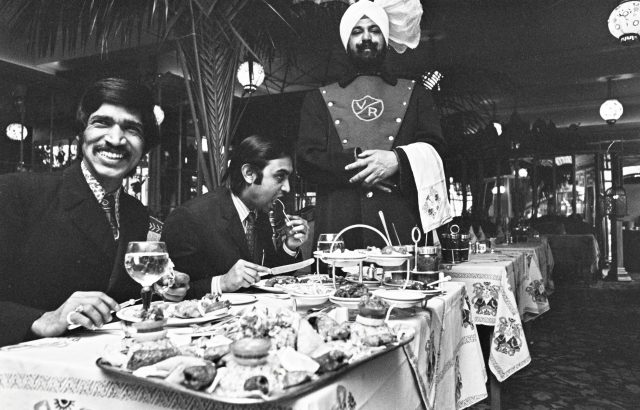
'Going for an Indian.' (Express/Getty Images)




Farewell the curry house? British palates, long marinated in cheerful provincialism, appear at last to be changing. It has become a minor truism of London life that if authenticity is what you are after, head not to the establishments that have survived three recessions and a carpet shampoo, but to the ones that opened last Friday. The newest Italian will give you echt Puglia or Calabria without apology. The newest Indian, likewise, will offer Andhra heat or Keralan pepperiness undiluted by cream. Meanwhile the old guard — the spag-bol caff and the high-street balti house — persists in its desultory dialect: Britalian here, Indo-British there, culinary Esperanto for a parochial people.
To the Indian migrant of recent vintage — such as myself — the curry house was always something of a culture shock. No such institution quite exists in India: no laminated menus promising “Madras (Hot)” as a fixed rung on the Scoville scale; no vindaloo calibrated for stag nights; no chicken tikka masala swimming in its sunset-colored gravy. That last dish, famously christened Britain’s “national dish” by the Labour Foreign Secretary Robin Cook in 2001, at the soggy zenith of the Blairite multicultural rapture, was less a testament to British cultural absorption than to a proclivity for unadventurous adaptation.
For better or worse, that Britain is on its way out. Where once Brick Lane’s neon promised a Soviet sameness, today’s openings — typically regional, not national; a touch evangelical about provenance — suggest a city that prefers its cuisines less translated. If the old curry house served up a hospitable fiction, the new arrivals dish out the real thing.
And yet, just as London acquires a taste for the truly local, one of its grandest culinary generalities approaches its centenary. This week, if fate and the facilities managers permit, the Michelin-starred Veeraswamy will turn 100. For a century now, the establishment has served mulligatawny beneath low chandeliers, its monogrammed silver and formal service staging a certain vision of Anglo-Indian continuity above Regent Street.
Mulligatawny itself — from the Tamil milagu tanni, or “pepper water” — began as a thin broth before being refashioned into one of the statelier soups of the Raj. In trendier circles in 1780s London, it was thickened with stock and meat, standardized with curry powder, and promoted to a fashionable first course. Thereafter, tins accompanied Victorian expeditions, and, on one occasion, an overgenerous cook left David Livingstone’s party incapacitated for “several days in severe suffering”. In a later age, it surfaced in Seinfeld as Kramer’s tepid libation of choice: “Yeah, it’s an Indian soup. Simmered to perfection by one of the great soup artisans in the modern era.”
Mulligatawny remains the signature dish at Veeraswamy, theatrically poured at the table from a silver tureen. Other offerings, too, flit with similar ease between the Subcontinent and the Home Counties. A “Calcutta” beetroot croquette, for instance, appears with a Stilton sauce and Bhutanese chili — the Raj rendered as canapé.
The mains, too, are curiously gentle. The spices arrive almost meekly, as though still mindful of interwar digestion. One imagines the ghost of a Twenties diner, moustache bristling, brow beading nervously at the prospect of chili. By modern standards, the seasoning is restrained to the point of bashfulness; yet there is a quiet pleasure in that restraint.
Such easy-going culinary federalism has long been the restaurant’s métier. But now, the institution faces a singularly modern demise. The Crown Estate, which owns the building, intends to refurbish Victory House — that splendid slab of Twenties Imperialist Baroque — to bring its offices up to contemporary standards. The plans involve altering the ground-floor entrance: a minor architectural adjustment, perhaps, but unfortunately the very corridor through which diners ascend to the restaurant upstairs. Once the lease expires, there will be no practical way for Veeraswamy to remain where it’s been for nearly a century.
The result has been a curious spectacle of culinary petitioning. More than 20,000 people have appealed to Charles Windsor to intervene and preserve this slice of Anglo-India. The Crown Estate, meanwhile, speaks in the antiseptic idiom of modern property management, explaining that the redevelopment is required to “bring the building up to modern standards”, and free up office space to secure long-term value. Free-market fundamentalism, in royal livery, has come at last for the chutney trays.
Founded in 1926, Veeraswamy was the brainchild of Edward Palmer, the great-grandson of an East India Company general and a Mughal princess, a lineage so operatic it sounds like something conjured up by E. M. Forster. The restaurant opened in Piccadilly Circus and has remained there ever since, stoically serving through the Blitz and Brexit. It has some claim to being Britain’s first upscale Indian restaurant: not the first curry house, since lascar sailors had been feeding Londoners since the 19th century, but the first to present Subcontinental fare with silverware and ceremony.
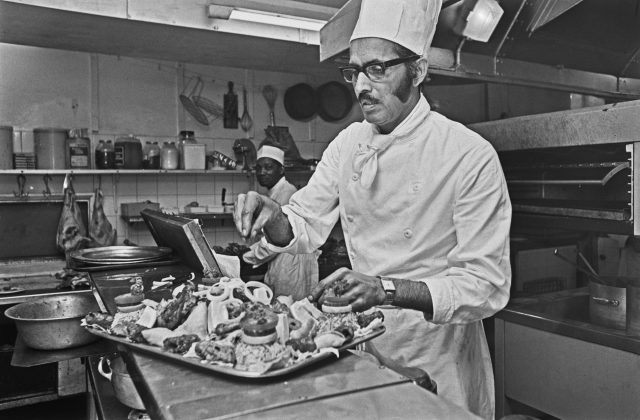
Palmer’s ambition was pedagogical. The early menu was designed to introduce Britons to Indian cooking: in a form tempered for insular palates. Royal, diplomatic, and political patronage duly followed. A Danish prince, legend has it, even helped inaugurate the great British ritual of “pints and curry” by arranging for his preferred lager, Carlsberg, to be shipped over for his visits.
The original Veeraswamy menu, as the food writer Sejal Sukhadwala notes, became the template for what would later solidify into the standard curry-house repertoire: kormas, biryanis, rogan joshes. It also came to structure expectations: poppadoms first, vindaloo for the brave, korma for the timid. The British curry, then, owes something of its grammar to this glitzy setting — aristocratic beginnings for what would become a thoroughly plebeian pleasure. There is some irony there. Curry, that workers’ favorite, once dismissed as little more than “blotting paper” food — useful chiefly for soaking up heroic quantities of beer — was in fact born in one of London’s grandest dining rooms.
The story has come full circle. When the journalist Mihir Bose first arrived in Britain in the Sixties, Indian food was regarded with something approaching suspicion. Factory colleagues in Leicester warned him not to bring his “funny-smelling” cooking into the workplace. Curry would later enjoy a quite different sort of ascendancy, becoming a firmly hoi-polloi favorite, with no pretensions to haute cuisine. Now, half a century on, it has drifted loose from its working-class associations once more. A clutch of Indian restaurants hold Michelin stars, while nothing announces bourgeois takeaway quite like Dishoom. In his memoir, Bose recalls a young fitness trainer confessing to sudden late-night cravings for curry — and refusing to believe there had ever been a time when Brits recoiled from it.
What’s more, “going for an Indian” no longer means going for a curry. If Veeraswamy once educated Londoners about Indian food, today the capital scarcely requires instruction. The city’s culinary map runs from Punjabi grills in Southall to Keralan cafés in East Ham, from Gujarati thali houses in Wembley to tasting menus in Mayfair that treat asafoetida with the reverence once reserved for truffles. The children and grandchildren of postwar migrants have moved the cuisine on. Paradoxically, post-imperial, post-Brexit Britain is more cosmopolitan, more culinarily curious, than imperial Britain ever was.
When I visited on a Thursday evening, Veeraswamy was oddly heaving. The lift kept disgorging diners in twos and fours, many of them casting the same slightly conspiratorial glance around the room. Variations of the same question drifted between tables: was this to be our last meal here? At the entrance a genial usher, splendid in durbar-kitsch regalia, greeted arrivals with the air of a man presiding over a minor pageant.
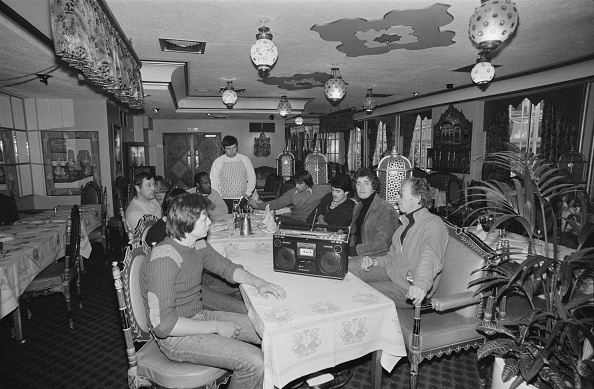
To step inside Veeraswamy today is to wander into a minor museum of late-imperial camp. The place has the air of a colonial cousin of Wiltons. One senses the regulars have been coming for decades, perhaps generations. Lights hang low over white tablecloths tended with mortuary diligence; chintz and polished silver conspire to evoke not India so much as a certain idea of India once issued by an Edwardian pen. This is not the India of Bombay or Delhi but the India of The Far Pavilions, which is to say it feels unmistakably British — certainly, a relic of Britain that has largely slipped from view.
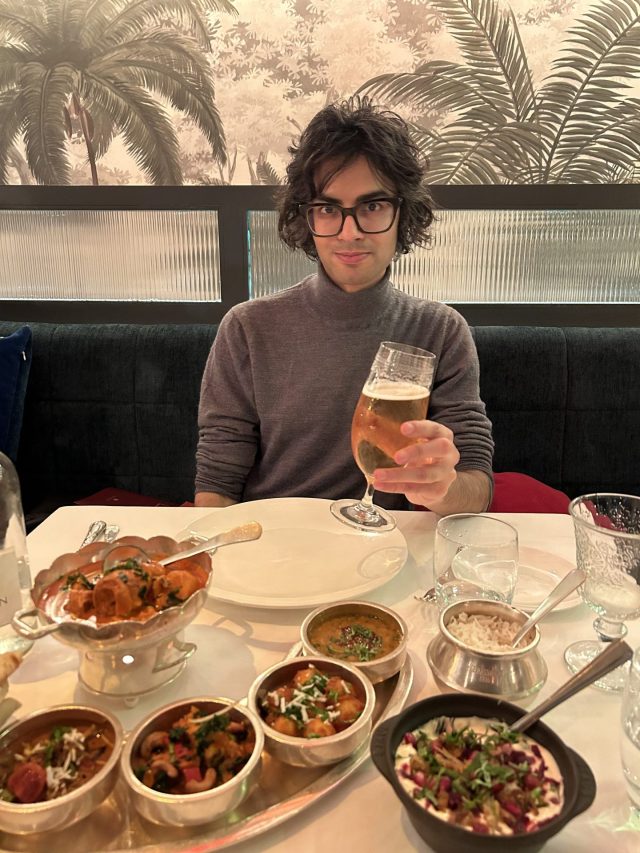
My waiter, who combined clubland bonhomie with flashes of dramatic flourish, told me business had rarely been brisker. The threat of closure has evidently sharpened appetites. People want, as he put it with a shrug, “their last mulligatawny”. There is also a final opportunity to sample the house cocktail, dating from the restaurant’s founding and simply called the 1926: an arrestingly verdant concoction, floral and faintly medicinal, like something a Raj apparatchik might once have taken to steady the nerves when the natives began entertaining ideas above their station.
There is, of course, no accounting for taste. Veeraswamy will not be to everyone’s liking. Yet establishments are not preserved because they are fashionable but because they carry institutional memory. The spectacle of campaigners beseeching the King to save their curry house, no doubt, has about it the air of an Evelyn Waugh plot twist: empire’s aftertaste petitioning empire’s heir. But one can smile at the absurdity and still feel the pathos.
If it closes, London will not starve. There are fiercer curries and cleverer chefs across the city. But a world will have vanished. It says something about the state of Britain today that empire — or at least its culinary afterlife — could survive decolonization, yet may not survive the unsentimental logic of property and profit. Neoliberalism, after a fashion, has defeated imperialism.
Pratinav Anil is the author of two bleak assessments of 20th-century Indian history. He teaches at St Edmund Hall, Oxford.
 pratinavanil
Join the discussion
Join like minded readers that support our journalism by becoming a paid subscriber
To join the discussion in the comments, become a paid subscriber.
Join like minded readers that support our journalism, read unlimited articles and enjoy other subscriber-only benefits.
Subscribe