




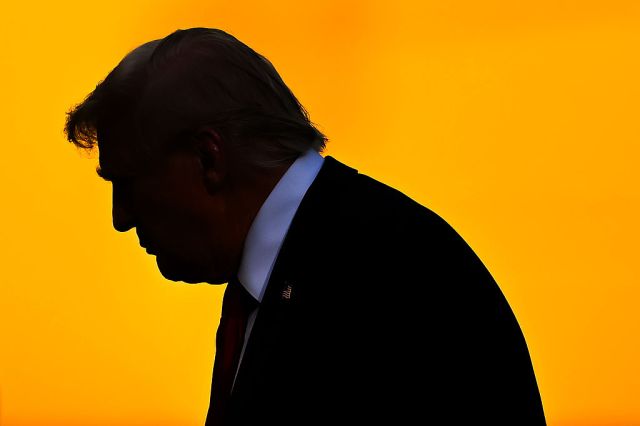
Iran trumps Russia in the President's concerns. (David Ramos/Getty)





It starts with a big bang. You’re on a roll. Then, unforeseen events intrude. You make mistakes, and get sucked into a war you can no longer control. Napoleon and Hitler did not want to fight the wars they ultimately lost, but one thing led to the other. They succumbed to the logic of war. Vietnam, Afghanistan, Ukraine — each of these was much the same. So too is Donald Trump’s war against Iran, which has turned out to be much tougher than he and his advisers imagined.
Right now, Trump has three choices. In scenario one, he sticks to his four-to-five week timetable, flattens the place, declares victory and gets out without destroying the Islamic Republic. The Strait of Hormuz would at this point not be truly secured. Scenario two is that he continues his campaign until the Strait is open, and he’s assured it’ll stay that way. That might involve using a limited number of ground troops to secure the Iranian coastline abutting the Strait. There would be no regime change in this scenario — but at least Washington would have reopened the Persian Gulf.
There’s also a third scenario: Trump concludes that, for as long as the existing Iranian regime is in power, the Strait cannot be secured. To get the job done, he must launch a full-scale invasion. Yet as Condoleezza Rice, national security advisor and later secretary of state under President Bush just reminded us, it took his administration a full year to prepare for the occupation of Iraq. There are currently no signs that an equivalent operation is being planned for Iran.
Scenario one would be the ultimate defeat, on the scale of Vietnam. It would stand as the greatest political and military misjudgment of our time — and for that reason alone, I would rule it out.
We are currently in the midst of scenario two. The difficulty commentators have during wars is that they’re not privy to classified information. Trump may have information that gives him the confidence to think America can totally destroy the Iranian regime’s military capabilities. I therefore can’t exclude the possibility that he is right, and that his critics are wrong.
History, however, would suggest otherwise. During the build up to the Iraq War, George W. Bush and Tony Blair wanted to believe the briefings they received from officials. Officials, for their part, delivered the briefings their political masters wanted to hear. I was a newspaper editor in Germany at the time, and attended one such high-level briefing. Unfortunately, the information I heard turned out to be completely wrong. The big conclusion I drew then is that privileged information doesn’t necessarily mean leaders make wise decisions.
And certainly, based on what’s happening so far in Iran, it’s clear that the Trump administration misjudged the power of asymmetric warfare. It also misjudged the changed nature of military supply chains. Twenty years ago, military power was all about weapons of mass destruction, missiles, warplanes and tanks. And, to that extent, I do believe that the US has indeed succeeded in destroying a large portion of Iran’s conventional military infrastructure.
But the regime’s most potent weapons are mines and kamikaze drones, each costing just a few tens of thousands of dollars. If one of these were to hit an oil tanker, and cause an oil spill in the Strait of Hormuz, the effect would be devastating. No ship would be able to pass until the waters are cleared. And even if the US were somehow able to reopen the Strait, it would still have to protect every single ship — whereas the Iranians only need a single successful hit to close the Strait once more.
That’s asymmetric warfare: and the Iranians are leveraging their one and only strategic advantage for all it’s worth. They have already carried out drone and missile attacks on ships on oil installations in the Gulf states, and may also have laid mines in the Strait. The strategic objective of the Revolutionary Guards is very similar to strategies employed by both Russia and Ukraine: to come out on top in a prolonged war of attrition. The Iranian calculation is that the US will ultimately fold under economic and political pressure.
That may be the best strategy available to them, but it is not guaranteed to succeed. Scenario three, a full ground invasion, still looms in the background. If chickening out is politically catastrophic for Trump, and the current air campaign fails, what else can he do but prepare for scenario three? It is not what he wanted. But at the point when he finally makes the decision, it may be the obvious thing to do. If you have no other options left, the impossible becomes the inevitable.
Clearly, this would clash with what Trump long promised: no more wars in distant lands. Nor do I doubt that he meant it when he said it. But when you’re in the hot seat in the White House, your job is to manage conflicting objectives. When faced with a choice to unseat the Revolutionary Guards in a six-months ground war, or suffer a humiliating defeat, we should not automatically assume that Trump would choose the latter.
We should also not underestimate the role of Israel. I know that many inside the Israeli government expected Trump to force regime change in Iran at some point during his second term. And now, if Trump were to chicken out without getting the job done, he’d leave Israel humiliated and exposed. To be clear, the US is clearly the senior partner in the relationship, but Israel had at least some influence in Trump’s decision to go to war. Why, then, wouldn’t Netanyahu exert similar influence in how to end the conflict?
Of course, I am not predicting anything here. Unexpected events intrude. They already have. But based on what is publicly known, and on conversations I had ahead of the invasion, I would want to keep an open mind on any of those options. And since few people expect scenario three, I would call it the “underpriced” option. It is not necessarily likely, but a lot more probable than many think. Besides, an extended air campaign and boots on the ground are hardly mutually exclusive, and could overlap for a time.
Another factor here is how the Iran war interacts with Ukraine. For Europe, the rise in oil prices that resulted from the closure of the Strait of Hormuz is a geopolitical disaster. Why? Because it destroys the continent’s strategy to starve Russia of its oil revenues. The price of Urals oil, the benchmark for the oil sold by Russia, has risen from under $40 per barrel to almost $90 — and lately peaked at over $100. In February, before the Iran war started, Russian oil tax revenues had fallen to around $4 billion per month, after oscillating between $6-10 billion per month since 2022. If Urals oil stays at this price, meanwhile, Russian oil tax revenues would jump to around $10 billion a month: enough to fund Putin’s war.
It’s obvious, then, that Europe’s strategy rested far too much on oil prices staying low, something I always thought was naive. Even before this month’s shock, Russia wasn’t running out of money, and now it definitely won’t. The truth is that Europe has no strategy for a Ukrainian victory — and never did. It’s just that now, this reality is becoming impossible to ignore.
As for the future, the oil markets are ominous. After initially taking a relatively optimistic view, they now expect a longer war. The Russians themselves believe that the oil prices will remain elevated for another year. And if Trump were to pursue his war for a longer period, he would really need to force Ukraine and Russia to cut some kind of deal. No wonder he’s already piling up pressure on the beleaguered Kyiv government. As Trump told NBC: “I’m surprised that Zelensky doesn’t want to make a deal. Tell Zelensky to make a deal because Putin’s willing to make a deal.”
Certainly, I don’t think it is possible for the West to fight two wars at once: against Russia in Ukraine and against Iran. The US is already running low on some supplies, while Ukraine itself is facing an acute shortage of air defense missiles. One war has to end for the other to proceed. And for Trump, Iran is the priority.
It would be comforting to know that a strategic operator is pulling the strings in the background, someone like Colin Powell, when he was chairman of the Joint Chiefs of Staff during the first Gulf War. Trump, unfortunately, has surrounded himself with sycophants. The image of Marco Rubio, secretary of state and national security advisor, being forced by Trump to wear shoes that are too big for him, tells us all we need to know. All I can say, then, is that the logic of war has taken over — and it’s driving America on.
