




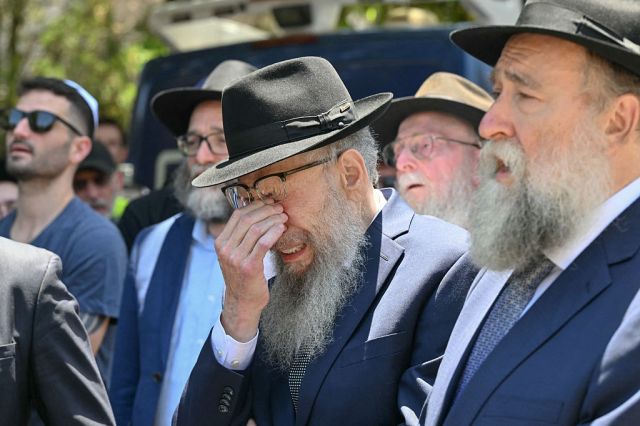
The terror attack at Bondi Beach is one of several recent acts of brutality against diaspora Jews. Saeed KHAN / AFP via Getty Images





19 March, London: two men charged with planning an attack on a synagogue. 16 March, Longueness: men found with an ISIS flag and guns plotting antisemitic attacks. 14 March, Amsterdam: bomb detonated outside a Jewish school. 13 March, Rotterdam: explosion at the synagogue gate. 12 March, Trondheim: suspects arrested outside the synagogue. 10 March, Sarcelles: 14-year-old girl beaten and hospitalized. 7 March, Liège. A bomb goes off outside a synagogue.
A war is being waged against the Jewish diaspora. It is being waged with bombs, shootings, harassment and intimidation. The attacks, and the fear of them, are a small side plot in a great Middle Eastern War. Those two men charged in London had a plan to attack a sister synagogue I sporadically attend. I feel this myself, as I push my son’s pram past the policemen at the temple gate. Yet more than fear, I feel disappointment. For if ever me and my son, or any of us who pray here, were butchered by a gunman shouting “Free Palestine”, many Western activists would equivocate, contextualize, or even say it served us right. Never mind that us diaspora Jews have no single agreed view on Gaza, the West Bank, or Benjamin Netanyahu, let alone Iran.
I am reflective of this myself. In a small synagogue, I am, to the best of my knowledge, the only person who’s had any connection to British government policymaking regarding the wars in the Middle East. As a special adviser to David Lammy when he was foreign secretary, I advised him to sanction Israeli ministers, supported his decision to recognize Palestine as a state, and was involved in a futile attempt to persuade Iran and America to make a deal.
But I am under no illusions: if my family had happened to pray at the Manchester’s Heaton Park synagogue, where Jihad al-Shamie killed two worshippers and injured three others on our holiest day of the year, and if I had been among the fallen, I would have been “contextualized” by people who call themselves anti-Zionist. The obvious distinction — that criticism of Israel’s occupation or military conduct is legitimate, indeed necessary, but holding all Jews worldwide accountable for Israel’s actions is antisemitic and targeting them nothing less than murderous — is clearly breaking down.
A line had been crossed where prominent, highly influential X accounts were unable to say, unequivocally, that targeting Jewish children in provincial Michigan was simply terrorism and utterly reprehensible.
The internet is now a front in this war on the diaspora. It has been since October 7. Israel has wrought destruction in Gaza, and the images are truly horrific. There is no denying that, and anyone who does so is wrong. But around them, a viral campaign has arisen, one which has moved well beyond criticism of the IDF. It has moved beyond a push for sanctions, beyond the desire for a two- or even one-state solution for peace. It has moved into a kind of annihilationist anti-Zionism that wishes to hurt Israel’s supporters wherever it can find them. And the place where this is most easily done is in the diaspora.
If you have spent any time on social media in the last two-and-a-half years you know this. You know about the explosive viral fame of the Hitler fan Nick Fuentes. Such is Fuentes’ popularity that the arch-conservative Rod Dreher has warned that at least a third of Republicans under 30 in DC are in thrall to him. Then there are the Talmud blood libels of Candace Owens, with an audience of 24 million across platforms, or Tucker Carlson, whose influence on the Republican base is such that Vice President Vance cannot bring himself to disavow him, despite the conspiracy theories he pushes out about Jewish groups to his equally huge audience.
You will have noticed, if you live online, the now ubiquitous semi-ironic Nazi-like language, from “The Goyim know” to “Goy-slop”, going mainstream. The nudge-nudge, wink-wink use of the term “the Epstein Class” by congressmen. Or the sudden omnipresence of the idea that America is a “colony of Israel”, riffs on which are now being pushed from the likes of Nassim Nicholas Taleb to Slavoj Žižek into their fandoms. Now that antisemitism goes viral with ease, you can spend your day scrolling through, non-stop denigration of Jewish history, from posts calling Hebrew a “fake language” to the claim that, according to spurious DNA evidence, Ashkenazim are “fake Jews.”
This kind of antisemitism has slipped into and radicalized anti-Israel protest and political movements across the West, in an age where the membrane between online hatred and real world violence is permeable. The culture war around the pickets outside Gail’s is reflective of something bigger. Instead of picketing its owners, Bain Capital, or any major private equity firm invested in the Israeli arms industry — which would hardly be unreasonable — anti-Zionist protestors have chosen to picket a bakery known to have an Israeli founder and stock Jewish-style challah bread.
Many in this movement are no longer pursuing accountability and action against the state of Israel — a ceasefire, sanctions, the ICC — all of which are all perfectly legitimate to push for. Instead, they are prosecuting a war on association, where any link, any sympathy, any connection to Israel, be it a founder or a baked good, is presented as immoral, even demonic. As Susan Abulhawa, a leading anti-Zionist, whose language proved too much even for Zohran Mamdani, put it on X: “I don’t give a shit if people collapse the distinction between Zionists and Jews.”
By effectively demanding total disavowal of the world’s only Jewish state, this campaign has ceased to merely be a rally for a free Palestine. Rather, it has become an offensive against the diaspora, from the high street bakery to the House of Lords. This poisoned discourse reached its nadir on 12 March, when a gunman arrived at a synagogue in West Bloomfield, Michigan, with the intention of massacring the 130 children there and at the school next door. But, I heard, the synagogue had the word “Israel” in its name. But the Jewish communal leadership had always supported Israel. But the Lebanese attacker — in fact known to be connected to Hezbollah — had lost family to Israeli bombs.
The Middle East war, of course, will end. Wars always do. The algorithm will move onto other things. And I do expect, when that happens, the intensity of the proxy diaspora war to slacken too. But I fear that now the seal has been broken. The effusion of Jew-hatred has reversed decades’ worth of declining antisemitism, as memories of the Holocaust fade, with large numbers of young Brits and Americans now dabbling in the taboo-busting “JQ.” This is online slang for asking the “Jewish Question” and exploring its florid antisemitic answers.
Their generation, then, is shaping up to be antisemitic. Over 25% of young Americans now hold unfavorable views of Jews; among older Americans, it’s just 5%. And in the UK, a fifth of students don’t want to houseshare with Jews.
There is evidence to suggest that the intensity of this spike, especially in the case of outright Holocaust deniers like Fuentes, may be driven by foreign powers using bot farms to rip into American cohesion. The war against the Diaspora is a tool of hostile actors in their wars on the West. The king of the “Groypers”, as his fans are known, has enjoyed a dramatically higher rate of early retweets of his X posts — this being the key to viral takeoff — than even Elon Musk. Yet, according to a 2025 report, 90% of the accounts boosting Fuentes’s early retweeters were fully anonymous, with roughly half of his retweeters coming from Pakistan, Nigeria, Malaysia and Indonesia. The tide may well, when the Democrats return, subside. But the ubiquity of online antisemitism will not.
There are the obvious reasons why. The wars in the Middle East will go on. The diaspora desperately needs them to stop but is powerless to stop them. They are neither Israeli citizens, nor are they listened to — with the exception of a few individuals. The bitter truth is that communities like mine are scorned by Netanyahu, who sees us as weaklings that he can ignore, destined to assimilate away. While at the same time, our lives will always be too connected to Israeli society, be it through family and spiritual ties, to ever be seen as not guilty in a radicalized anti-Zionist movement’s eyes.
That won’t change, but the places where the Jewish diaspora lives have already done so. Cities like New York, London and Paris now have more Muslims, more Hispanics, fewer old men like Joe Biden with a war-era fondness for Jews. In both Europe and the United States, these growing minorities are more antisemitic. They are also younger, more likely to get their news online and watch foreign TV, be it Televisa or Al Jazeera. This is the mechanism by which imported prejudice gets stirred by the footage these wars export.
But a subtler change has taken place too. Every time our civilization evolves, antisemitism, like a mutating virus, changes with it: from a religious hatred in a world of faith to an ethnic hatred in a world of nation states. Each era seems to decide anew what it cannot abide about the Jews and what respect it will accord them. And every rupture in how we communicate, from the coming of the printing press to the dawn of the radio, seems to see society’s antibodies to this virus weaken.
Suspect for being too rootless and transnational in the twentieth century; now Jews are suspect for being too rooted and tribal in the twenty-first. The truth is that we no longer really live in what you could call Western civilization: an order based around historic nations, a culture based around print, a way of life still furrowed by the old faith, with a clearly defined attitude towards Jews.
Its successor is a globalized internet civilization that plays out in viral clips and has become unmoored from old certainties. This is a world where X mega-influencers like Iain Miles Cheong and Sneako are as much players as the Archbishop of Canterbury. Everything is being relitigated. This new civilization, since its litigation is occurring via ephemeral, emotive social media posts rather than by works of sustained thought, has an oral culture rather than a literary culture. By its nature, this culture rewards hatred and anger. Which, I fear as I push my pram, will not prove kind to the Jews.
