




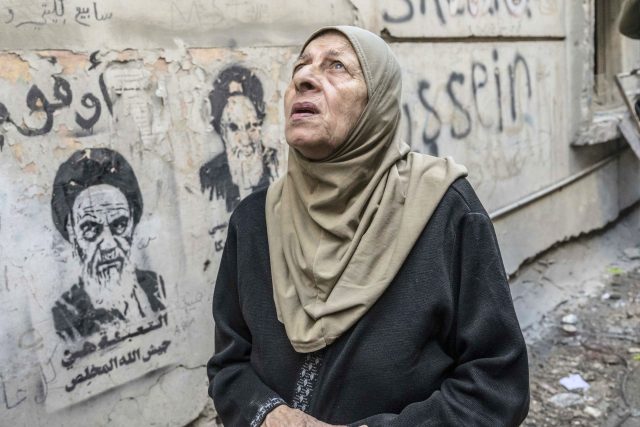
A Lebanese woman passes a portrait of Ruhollah Khomenei. (Anadolu/Getty)




Once again, I find myself caught in the conundrum of opposing an illegal war unleashed by the United States and its allies on a country whose regime I vehemently oppose. It is a thankless burden but one that Western Leftists have a duty to shoulder, lest we legitimize the regimes we oppose, both in the country being bombed and in the West.
In 1999, having previously campaigned against Slobodan Milošević’s rule, I denounced Nato’s bombing of Yugoslavia. In 2003, after two decades of campaigning against Saddam Hussein, I demonstrated against the US coalition’s invasion of Iraq. In 2011, while critical of Muammar Gaddafi’s regime, I opposed the US-led bombings of Libya that turned it into a failed state. Last year, while aghast at Bashar al-Assad’s ruthless reign, I lamented the US-Israeli machinations that turned Syria over to a former Al Qaeda operative. And now, having celebrated the “Woman, Life, Freedom” rebellion after Mahsa Amini’s death in custody, and for many years railed against the Islamic Republic’s theocracy, crony capitalism, brutality to women and minorities, I am writing these lines to condemn, with all my strength, the US-Israeli plan to devastate Iran.
This is not neutrality. This is not “both sides-ism”. This is the duty of the Western Left. When the gang ruling our neighborhood launches an unprovoked attack on a faraway gang that we also don’t approve of, killing innocent bystanders, we refuse to stay neutral or to pick a side. We call out both, but we recognize a special, overriding duty to stop our gang: because it is our taxes funding their bombs, it is our silence that grants consent, it is our governments that are doing the killing, in our name.
So, let’s take a look at our gang. The Western claim that the US and Europe, let alone Israel, want democracy, stability and normality in Iran is a fabrication. The origins of Iran’s postwar tragedy lie in the 1953 Anglo-American coup that overthrew the democratically elected government of Mohammad Mosaddegh, for his audacity to want Iranian oil for the Iranian people. It was then that the US and the UK lost any moral claim as supporters of Iranian democracy by restoring absolute power to the Shah — a venal, autocratic monarch who ran Iran as a feudal fiefdom for Western corporations. To keep him on his peacock throne, the CIA helped to establish and train the Savak, a secret police force so brutal it became a byword for torture. For 26 years, US and UK governments did what they could to deny Iranians any semblance of democracy. A long trajectory of authoritarianism triggered the 1979 revolution which toppled the Shah.
It was a broad, popular revolution that, initially, mobilized not only Islamists but also liberals, socialists, and communists. However, the secular movements which supported Ayatollah Khomeini and cheered his return from exile in Paris were unaware that Washington had aligned with the most reactionary Islamist factions once it realized the revolutionaries would win. One of the new regime’s first barbarous acts? The rounding up and summary execution of the leadership of Tudeh, the large communist party which had supported Khomeini. This mutual backscratching between Washington and the Islamic regime, during the Cold War, should give pause to Leftists today who labor under the delusion that the Islamic Republic is close to the Left’s anti-imperialist agenda and values.
There is, of course, a reason why it was fairly easy for Western Leftists to be taken in by the anti-imperialist, more populist elements of the Islamic Republic. Contradictions, in which the Left ought to luxuriate, do not come more intense than in the case of the Islamic Republic — a regime that, on the one hand, adopted anti-imperialist language as part of its overarching project to resurrect a fictitious Islamic golden age while, on the other hand, crushing the Left and its emancipatory agenda.
The confusion deepened in light of the Islamic Republic’s greatest strength. In sharp contrast to the Sunni plutocracies, the Shiite movement led by Khomeini demonstrated a certain commitment to the poor and devastated masses of the Muslim world that included not only income redistribution and, at least initially, anti-corruption drives but also genuine support for the Palestinians whom almost all Arab regimes had abandoned by then. All that offered a rare source of emancipatory hope.
It also predictably led to a head-on confrontation with the Islamic Republic’s Sunni rivals. In 1980, incited by Washington and funded by Kuwait, Saudi Arabia and the UAE, Saddam Hussein invaded Iran. If in doubt that Saddam was America’s stooge, recall what happened when, in 1987, an Iraqi fighter plane fired Exocet missiles at the USS Stark, killing 37 American sailors and wounding 21: President Reagan stated “The villain of the piece is Iran” while US diplomats flew to Baghdad to give Saddam absolution. In 1988, Saddam used chemical weapons on Iraq’s Kurdish villages, attacks the US had known about and were complicit in. Years later, after the US invasion of Iraq, a joke circulated in Washington: “How do you know that Saddam had chemical weapons?”, the White House spokesman was asked. “We kept the receipts,” he answered.
Tehran’s anti-imperialist credentials were also bolstered by Israel’s 1982 invasion of Lebanon, which gave birth to a resistance and social movement funded by Iran: Hezbollah. This allowed the Iranian regime to present itself, with some justification, as the only regional power willing and able to protect from Israeli violence against Palestinians in particular and Arabs more generally — while also providing some basic social services for the poor. Moreover, as inequality reached unprecedented heights in the region, especially after the massive increase in surplus labor globally, Iran’s appeal among the masses burgeoned. Naturally, Iran’s neighboring Gulf states were worried and thus joined forces with the United States to “contain” Iran.
By 1991, a Western family feud had led the US to invade Iraq. Saddam was incensed that Kuwait, which at the behest of Washington and the Gulf plutocracies had loaned him much of the money to wage the eight-year war against Iran, was asking for its money back — and increasing its oil output so much that Iraq’s own revenues faltered. Saddam, either misled by the Americans or, because he misunderstood them, thought he had their blessing to deal with Kuwait by invading it. Once American boots hit sacred ground in Saudi Arabia, Sunni fundamentalism led to the formation of Al Qaeda, the tragedy of the Twin Towers, and Bush the Younger’s calamitous invasion of Iraq which, in turn, begat ISIS, another Sunni terrorist movement. All these developments made the Islamic Republic look moderate and relatively progressive: a country that, while glad to support local popular resistance movements that engaged Iran’s regional enemies (in Palestine, Yemen etc.), never directly invaded any other country and which proved pivotal in the fight against Al Qaeda and, more impressively, in the elimination of ISIS.
In view of this rich, tragic history, the Islamic Republic must be understood as a powerful system born out of a decades-long crisis caused by the US and encouraged by Israel. But it is equally important to grasp its political economy which is at odds with its external anti-imperialist stance and hostile to everything the Left stands for. Since the Nineties, privatization in Iran has been in full swing, with the reformist faction envisioning foreign investment and integration into the world market (essentially the European Union and the UK) as the only vehicle for containing its crisis. At the same time, the conservative coalition under the Revolutionary Guards’ dominance established and controlled privatized enterprises, aimed at expansion into regional markets.
After Trump 1.0 ended Obama’s plan to reintegrate Iran into the Western circuits of trade and finance, the conservative faction opportunistically aligned themselves with China and, to a lesser extent, Russia. However, throughout, they have been implementing deregulation and ending subsidies for the poor, provoking spontaneous popular uprisings which demand social justice. Then, the crash of 2008, which saw China emerge as a stabilizing force at a global scale, motivated the conservative faction to turn even more toward China and Russia in the hope of circumventing US sanctions and ameliorating the tensions their own crony capitalism had caused.
Fast forward to 2022 when the killing of 17-year-old Mahsa Amini, a Sunni Kurd, ignited the “Woman, Life, Freedom” movement. Western commentators, suffering once more from a case of wishful thinking, imagined that uprising to be pro-Western. It was no such thing. Rather, it combined discontent caused, on the one hand, by rising inequality after Iran’s economy drifted toward a neoliberalism with conservative Islamic characteristics and, on the other, ethnic tensions — especially among Kurds.
That rebellion was defeated not merely by brutal suppression but, more importantly, by invoking the fear of the country’s disintegration — the prospect of Iran becoming a new Syria, or a new Libya, which Benjamin Netanyahu craves and has been trying for years to co-opt the US to bring about. That’s why the regime still enjoys continued support from a large segment of the population, including those otherwise opposed ideologically to the regime: they may hope and pray for the end of the Islamic Republic, but they also consider the disintegration of Iran a worse evil than the current regime. Fully cognizant that Trump and Netanyahu can’t and won’t bring on a stable, democratic Iran, the US-Israeli bombs that are now falling upon them result in greater toleration of the current regime — even by its opponents.
And so, here we are today: Mojtaba Khamenei, the son of Ali Khamenei, is now Iran’s new supreme leader. The US and Israel killed his father, his mother, his wife, his sister, and most probably one of his sons. The regime is brutal, unpopular with vast swaths of its own youth, and economically sclerotic. It is also a product of 70 years of Western arrogance and aggression. It is not going to be bombed away. It will not be sanctioned into moderation. What is the Left to do and say in this context?
We must, I suggest, begin by answering the liberal imperialists who ask us: “But what about the women? What about freedom?” To them I say this: the women of Iran do not need F-35 bombs dropped on them by Washington or Tel Aviv. The path to “Woman, Life, Freedom” does not run through the smoking ruins of Tehran. It runs through the defeat of the very powers that have spent 70 years ensuring Iran can never know peace or democracy. The people of Iran must first be liberated from the clasps of the hideous choice between the current regime and a fate worse than Iraq, Libya, and Syria combined.
Our job, as Western Leftists, is to act upon our governments to stop the bombing. To end the sanctions that starve the poor and enrich the regime’s smugglers. To dismantle the propaganda machine that tells us war is peace and occupation is freedom. Then, and only then, can the Iranian people, exercising their own immense power, reclaim their future from both the theocrats and their imperial enablers.
Yanis Varoufakis is an economist and former Greek Minister of Finance. He is the author of several best-selling books, most recently Technofeudalism: What killed capitalism.
 yanisvaroufakis
Join the discussion
Join like minded readers that support our journalism by becoming a paid subscriber
To join the discussion in the comments, become a paid subscriber.
Join like minded readers that support our journalism, read unlimited articles and enjoy other subscriber-only benefits.
Subscribe