




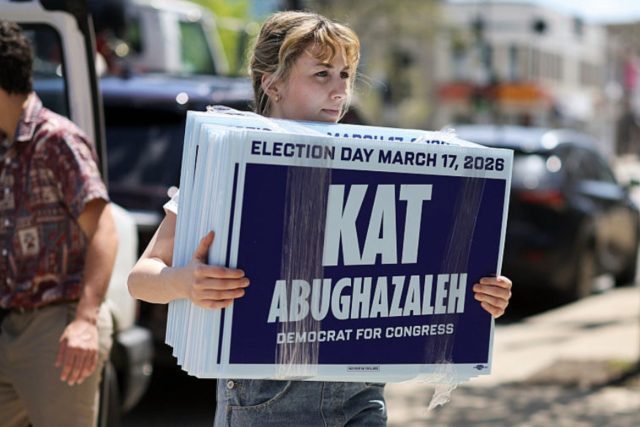
A carpetbagger candidate for Chicago. Credit: Getty




On a fall night at a dive bar in Chicago’s Wrigleyville neighborhood, a young woman in denim shorts, fishnet stockings, and a dark “Make Nazis Afraid Again” T-shirt stopped skanking long enough to climb onto the stage with an indie band called Malört & Savior. Malört, for the uninitiated, is the black-licorice-tasting liquor that functions as Chicago’s bitter rite of passage. She and the band took shots of it, and then she leaned into the mic. “Are we pissed the fuck off?” The crowd roared back on cue. “Can I get a ‘fuck ICE’? Can I get a ‘fuck Trump’?” The room obliged.
You’d be forgiven for thinking this was the frontwoman of one of the North Side’s innumerable hipster punk bands. But the woman behind the microphone was Kat Abughazaleh, and this was a campaign stop on her Illinois congressional bid. The 26-year-old political commentator now has her bright blue eyes set on turning mid-2026 into the real Brat Summer.
This isn’t a social media stunt, though it sometimes feels that way; it’s a high-stakes scramble for a rare vacancy. For the first time since 1999, Illinois’s Ninth District, which spans from the tony suburbs of the North Shore to the grit of Chicago’s 48th Ward, is an open seat following the retirement of longtime liberal lion Jan Schakowsky. Abughazaleh is now the fundraising frontrunner in a crowded Democratic primary of 15 candidates — including Evanston Mayor Daniel Biss and State Senator Laura Fine. Yet, as she outpaces the establishment in dollars — $2.7 million and counting — and digital reach, a central question looms: who exactly is Kat running for?
The elephant in the room for the Abughazaleh campaign is that Schakowsky was its reason for existing, and now that’s gone. For months, the young political influencer had framed her run as a generational uprising against a complacent incumbent, Schakowsky, now in her eighties. But then the Congresswoman announced she was retiring and not seeking re-election. It is one thing to primary a 14-term incumbent as a symbol of stagnation and another to compete in a crowded field where almost everyone is some shade of progressive.
The inconvenient truth is that Abughazaleh’s campaign feels less calibrated for the constituents of northeastern Illinois and more for the urban ultraliberals watching her TikToks from Brooklyn to Berkeley.
If Alexandria Ocasio-Cortez was the prototype for the young, female-socialist-outsider-to-Congress pipeline, Abughazaleh is AOC 2.0, recalibrated for the “Dark Woke” era of President Trump’s second term. She is younger, louder, more online (often labeled “The TikTok Candidate”), and more aggressively confrontational than the New York lawmaker, trading the optimistic hopepunk aesthetics of the late-2010s #Resistance for the anarcho-punk snarl of confrontation over coalition. That was certainly the case at the fall campaign event in Chicago, called “Punks for Progress.” At one point, a band shouted lyrics decrying American imperialism and declaring that “nothing lasts forever, even one’s country.”
Punks for Progress captures the contradictions that haunt Abughazaleh’s candidacy. Like AOC, Abughazaleh is smart and has a natural presence on camera, but the New Yorker has at least attempted the difficult pivot from activist to institutional actor; Abughazaleh appears more comfortable as a full-time antagonist. While she promotes aspects of a Bernie-style democratic-socialist program on paper, the campaign’s emotional engine isn’t policy or the can-do, indefatigable sunniness of New York Mayor Zohran Mandami. Hers is a politics of a raised fist, instead of a handshake — one that runs on an intensified opposition to Trump and to the Democrats’ perceived timidity in stopping MAGA at all costs. “It’s time to drop the excuses and grow a fucking spine,” she said of the Dems in her campaign launch video. As such, the biggest moment of her campaign was being arrested in Chicago last October on trumped-up charges of blocking an ICE vehicle.
Do the majority of voters of Illinois’s Ninth District want a true middle-finger-to-the-system candidate with no experience to represent them in Congress? Not likely. Abughazaleh is currently polling second or third, but has the highest unfavorable rating (36% favorable, compared to 31% unfavorable) according to one poll. The Ninth District is not exactly a bastion of radicalism; it’s one of the safest Democratic seats in the country, represented since before Abughazaleh was born by Schakowsky. Gerrymandering has warped it into a thin finger that stretches from Chicago’s northern lakefront to exurban McHenry County, which Trump won by five points in 2024. Along the way, the district runs through suburbs like Evanston, the unofficial capital of what locals call Lakefront Liberals, a citadel of affluent, institutional Democratic politics. Not far from Evanston lies Park Ridge, where Hillary Clinton was raised. In 2016, primary voters here favored Clinton over Bernie Sanders, a reminder that this district’s liberalism has historically been managerial rather than insurgent. That poses a twofold challenge for Abughazaleh: despite her national online profile, she remains relatively unknown on the ground, and to the extent that voters do know her, it is as an uncompromising antagonist in a district that has often preferred polished pragmatism.
It’s little wonder why she remains a relatively unknown quantity locally. While many Illinois Democrats were debating Clinton and Sanders a decade ago, Abughazaleh was in high school in Texas, endorsing Marco Rubio in her school newspaper during the Republican primary. Her political evolution since then has been swift. In college, she abandoned conservatism and moved decisively Left. By the early 2020s, she had reinvented herself as a relentless critic of Right-wing media, building a following in digital newsrooms and across social-media platforms.
As a researcher for the progressive watchdog group Media Matters in Washington, she built a sizable following while dissecting conservative media, especially Tucker Carlson, as grist for short-form videos (“I watch Tucker Carlson so you don’t have to,” the bio on her X account once read). But in 2024, after Elon Musk sued the organization over a report it released documenting anti-Semitism on X, Abughazaleh was laid off. She then continued her critiques on TikTok, YouTube, and Bluesky, making her something like a mirror image of independent conservative commentators like Carlson — but for radical liberals — with videos like “This Is What DEI Means (And Why Conservatives Get Super Racist With It).”
Abughazaleh left DC and arrived in Chicago in July 2024 alongside her boyfriend, Ben Collins, the former NBC reporter who famously pivoted to becoming the CEO of the parody news site The Onion. They took up residence in an apartment in Streeterville, a touristy neighborhood just north of the Loop, where the average two-bedroom apartment runs about $4,000 a month — notably outside the district she sought to represent.
That’s why the label “carpetbagger” keeps getting attached to her campaign. In Chicago, a city that treats your neighborhood like a personality test, geography still carries weight. You are from somewhere, or you are not. “I will vote for my dead grandmother before I vote for a 26-year-old carpetbagger influencer from Texas with zero experience who comes here to try to game the political system,” wrote one Illinois voter on Reddit.
Where Abughazaleh is most popular isn’t the Ninth District; it’s a cloud-based constituency of hyper-partisan, very-online liberals assembled in the placeless sprawl of social media. She announced her candidacy in Rolling Stone magazine, and her launch video racked up millions of views within days. The national liberal media followed with countless glowing profiles, including one in GQ that asked rhetorically: “Can Kat Abughazaleh Help Democrats Grow a Spine?” Likewise, her fundraising hauls come largely from small-dollar donors who are as likely to be in Brooklyn or Austin as in Chicago’s Wrigleyville. The comments under her videos read like a digital pep rally: You’re so brave. Drag them, queen.
But when the front-facing camera is off, Abughazaleh is prone to showing that she’s truly 26, with zero political experience, and not ready for one of the most important jobs in America. After no-showing for a campaign event in Chicago in January, she released a cringeworthy, dog-ate-my-homework statement blaming it on one of her “sleep attacks” due to narcolepsy. Imagine what she’d say if she slept through an important vote in Congress.
When the Chicago Tribune asked her to sit down for an interview with its editorial board, she refused, saying, “Because while I’m about coalition building, I want to make sure that coalition reflects my values.” It’s the kind of decision that adds to the feeling that, for Abughazaleh, unlike Schakowsky, northeastern Illinois is merely a stepping stone to somewhere bigger and better.
To complicate matters further, her main competitor is Daniel Biss, the mayor of Evanston and not exactly a corporate Democrat. In 2018, when Biss ran for governor against JB Pritzker, he was the one seen as the too-radical Left-wing candidate. He briefly selected Chicago Alderman Carlos Rosa, a Democratic Socialist, as his running mate before party pressure forced a recalibration, and his campaign events featured celebrity surrogates such as Russian protest band Pussy Riot and actor Jesse Eisenberg.
When I covered his campaign back then, Biss felt like a Midwestern echo of the Sanders wave; a bookish math professor turned progressive crusader. Since then, Biss has done something that Abughazaleh has not: he has governed. As mayor of Evanston, he has navigated the unglamorous terrain of zoning fights, public safety, and municipal budgets. In other words, the frontrunner in this race is a version of what Abughazaleh could potentially become in the 2030s.
That’s why Abughazaleh’s attacks on Biss are so absurd. In one ad, a video captures her being thrown around by an ICE agent while Biss, who also protested ICE’s presence in Chicago, spectates a couple of dozen feet away. The implication is that Biss is a lame wimp for not being cuffed by authorities. This is where Abughazaleh’s campaign becomes a revealing case study in the perverse incentives of the present moment: the edgy aesthetic, the unapologetic vulgarity, the sassy callout all read as resistance during the rise of Dark Woke.
Similar to Texas candidate Jasmine Crockett, the folk hero of viral clapbacks, Kat satisfies the Left-liberal audience’s desire to see someone speak the unspeakable in a political arena sick of the decorum theater that once defined the Democrats.
But the problem with running what’s been called “a punk rock campaign” is that punk is, by instinct, a youthful anti-authority posture, suspicious of anyone in power and reveling in defiance — a way of sneering at the powerful, rather than replacing them. It thrived on negation and defined itself by what it opposed. And eventually, it was absorbed, flattened, and resold in malls or as a soundtrack for a car commercial.
Punk is no blueprint for effectively opposing MAGA in office, much less securing earmarks for federal funds and projects in northeastern Illinois. Ironically, the Kat Abughazaleh of 2016 might have agreed. In her editorial supporting Marco Rubio for president, she warned against a Bernie presidency because “a Sanders presidential term would be constant conflict between parties with little action.”
It is a strange fate to become a harsher version of the candidate your younger self warned against.

Join the discussion
Join like minded readers that support our journalism by becoming a paid subscriber
To join the discussion in the comments, become a paid subscriber.
Join like minded readers that support our journalism, read unlimited articles and enjoy other subscriber-only benefits.
Subscribe