




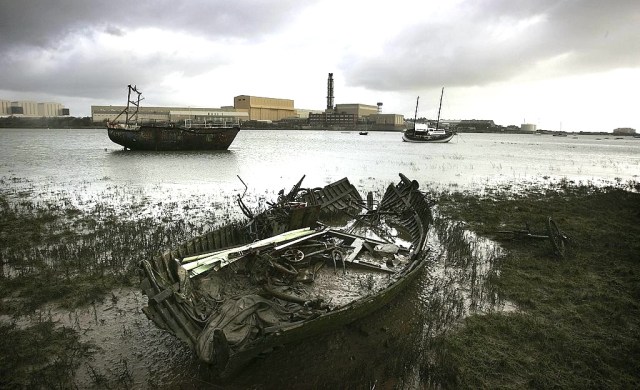
'Barrow-in-Furness is the quintessentially left-behind former boomtown.' (Christopher Furlong/ Getty)





“Barrow’s a shithole,” said the site manager. “The gulls are as big as dogs and the streets are rubbish tips and every woman has a tattoo.” When he first came to the area he lived in Barrow itself, but at the first opportunity he moved to the nearby market town of Ulverston. Not that he really lives in Ulverston. “Every Thursday I go home to Derbyshire for the weekend.” He smiled. “In three months it’ll all be over.”
I headed off for my appointment with Nathan Holmes, a Reform town councilor. We met at 10am at the Kings, across from Furness House — recognizable by its smashed windows and long-closed post office — and a statue of Sir Henry Schneider, one of the original town fathers. Inside the pub elderly punters nursed their second or third pint of the morning (the Kings keeps miraculous hours) and a lad of 15 waved at me from a window table. We introduced ourselves and Nathan explained he was in fact 29 and a famous drinker. I mentioned that some years ago, a friend of mine had been in the habit of scoring drugs in Barrow, finishing his evenings in a nightclub known as HMS Chlamydia. “It was a barge,” Nathan explained with all the authority of a seventh-generation Barrovian, “whose owner was banned from opening premises on dry land.”
Heady with the well-being that is the special gift of an Admiral Old J Pineapple with Coke and ice, Nathan and I stepped out of the Kings and into sheeting rain. As we walked, he pointed out charity shops; a pawn shop; a vaping emporium; an arts venue whose air conditioning caused an outbreak of Legionnaires’ disease in 2012, wafting the fatal bacteria over passersby and killing seven, and which is now closed permanently because of an asbestos leak; a market hall which the council shuttered on February 17 for the same reason; and a former working men’s club that was consumed by fire in 2017 but whose charred facade still stands, its garden full of refuse and its surfaces covered in graffiti (“Council stole my fukin car park”). At the “Gaza Strip”, a line of boarded up pubs, clubs and other defunct palaces of pleasure, it was time to part. Nathan extended a hand. “Welcome to Barradise.”
Barrow-in-Furness is the quintessentially left-behind former boomtown. It lies at the end of the Furness Peninsula — “Britain’s longest cul-de-sac” — at the entrance to Morecambe Bay. The town council of which Nathan Holmes is a member has few powers; important decisions are taken 34 miles and several light years away in the Lake District town of Kendal, seat of the unitary authority of Westmorland and Furness into which Barrow was unwillingly shoehorned in 2023. In fact, many Barrovians argue the town’s decline started in 1974, when it was hived off from Lancashire and incorporated into the administrative county of Cumbria (itself abolished in 2023).
Many and varied, in the declinist telling, are those responsible for the town’s current woes: successive political authorities, both Labour and Conservative, for starting development schemes that ran out of money and left unfilled holes in the town’s fabric; property speculators for buying up hundreds of houses and dividing them into bedsits, in the process preventing young Barrovians from getting onto the housing ladder; a gang of feral youths for terrorizing pensioners (when did you last see a McDonalds with a bouncer?).
It wasn’t always like this. In 1859, Henry Schneider turned Barrow into “the Chicago of the North” when he set up the world’s biggest steelworks, fed by his own iron. 12 years later, his associate James Ramsden founded the shipyard. Throw in an influx of Irish and Scottish labor and acres of brick terracing and you get the picture. Boys from the yard wed girls from the jute works and every street had a pub and a place of worship, mostly Catholic or nonconformist. “Barrow was a hive of theaters, music halls, and later, cinemas,” writes Jill Jepson in her account of the town; well into the Sixties, gates of 15,000 were not uncommon at lowly Barrow AFC. Barrovians gained a reputation for liking home so much that their idea of escape was a static caravan on the nearby dunes.
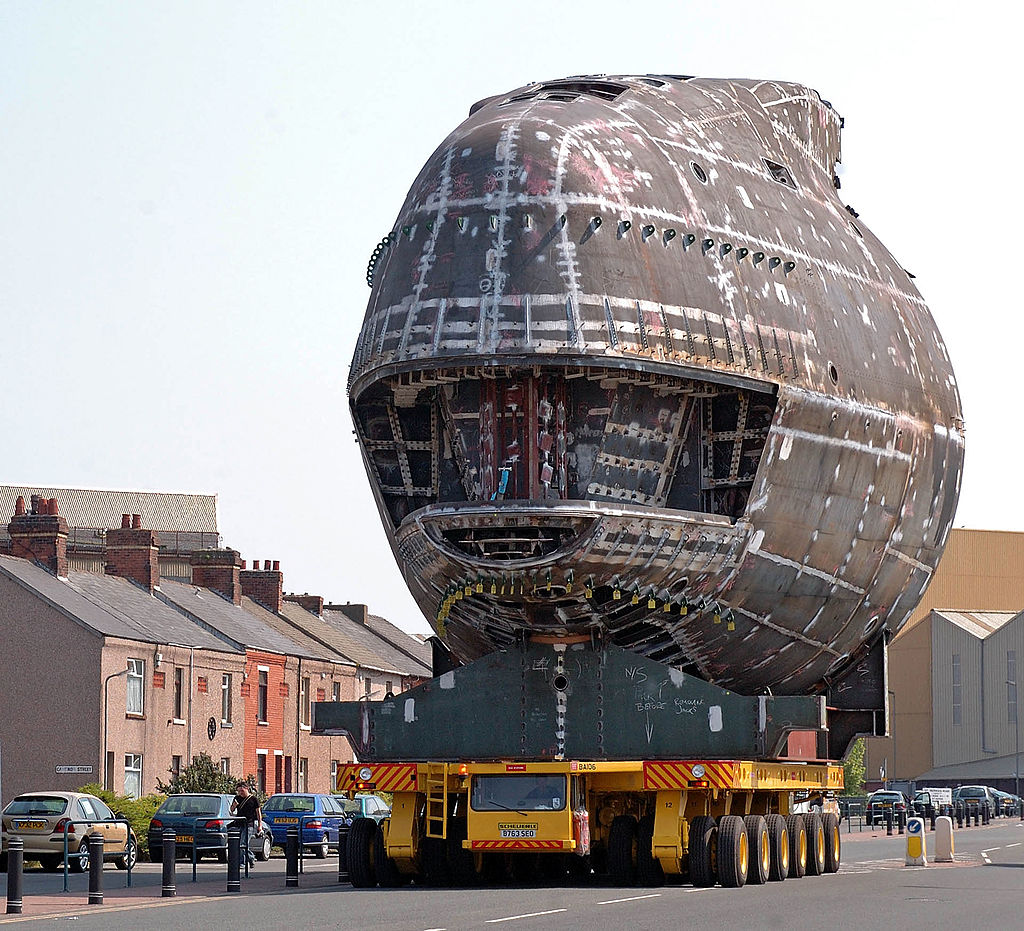
The yard specialized in warships, earning it a battering from the Luftwaffe in 1941. Postwar deindustrialization did for the steelworks while the end of the Cold War meant no more aircraft carriers to build. In the Nineties, 10,000 shipbuilding jobs were axed, with a deadly ripple effect on ancillary industries and services. The interdependence of town and yard that had sustained Barrow for most of its history was wrecked; as Derek Brook, a veteran Labour Westmorland and Furness councilor, told me, “all my friends with trades left and never came back.” The yard only escaped closure only because it had a monopoly on making nuclear submarines for the Royal Navy. Its current owner-operator is BAE Systems.
In 2014, Barrow was designated the unhappiest place in the UK. Its Covid mortality rate was among the highest nationally, and, in 2024, it came fourth in the league table of deaths from suicide, drink and drugs — the so-called “deaths of despair”. That same year, just 34% of Barrovians sitting English and Math GCSE gained a five or above, 12% below the national average. Last autumn, I visited a school in the center of town, where child poverty runs at 36%; behind each pebbledash facade might live five kids with different dads. “We don’t even think about teaching on a Monday,” the head told me. “We sit them down, give them something to eat, and look them over to see who had a difficult weekend.”
Little wonder that in the three decades to 2022, Barrow’s population fell steadily, if slowly, and now sits at 56,000. Meanwhile, BAE employees working on subs drive into town on a Monday morning, spend four nights in serviced apartments, before clogging the single-lane escape route at the end of a truncated week. Locals refer to them in a curt catch-all: “the contractors”.
In December I was among a crowd of just 2,106 that booed Barrow off the pitch following a three-nil defeat at the hands of Tranmere Rovers. That the Bluebirds are flirting with relegation from League Two may have something to do with the fact that the first team trains two hours away in Manchester, where many of the players live.
There are some new arrivals: but not to everyone’s liking. From July, the adjacent town of Dalton will host a new Muslim prayer hall. Among the allegations aired by opponents of this “mega-mosque in the Lake District” — in reality an innocuous, low-slung building well outside the national park — is that it will offer snipers an excellent vantage from which to shoot children at the neighboring primary school. Driving around Barrow with Sam Plum, the outgoing chief executive of Westmorland and Furness Council, I asked why the Union flags flying from the lamp posts were at half-mast. “They’re not,” she replied. “They’re the height of a man standing on a Transit van.”
On we drove, past the ruins of Furness Abbey, fully the equal in grandeur and romantic isolation of the more celebrated Fountains Abbey across the Pennines, and down Abbey Road, with its salubrious middle class side-streets and better-performing schools. Then we reached the waterfront, a mash-up of reclamation and demolition, sky, sea and Little Tony’s Tires, of slag piers and a notorious Glasgow-style tenement, Egerton Court, where you can pick up a rodent-infested flat at auction for £6,000. The tour ended on Walney Island, 11 miles long and nowhere more than a mile wide, a sleeping policeman of sand and marram grass guarding Barrow and its shipbuilders from the Irish Sea.
Wherever you stand in the central wards, as Jean McSorley, a historian of Barrow, told me, you can’t avoid the Shed, the headquarters of Britain’s submarine industry. The color of weathered silage and as brooding, hulk-like and tyrannical as the Ziggurat of Ur, it blocks every vista and is over the crest of every hill. In it and the surrounding assembly halls, nuclear physicists, engineers, electricians, metallurgists, coders and other specialists are engaged in an endeavor so complex that, to quote one senior naval officer, “there are stages when it’s like blacksmithing and there are stages when it’s like brain surgery.”
And this is what makes Barrow so interesting. For unlike almost every other British town with an industrial past, it also has an industrial future. A big chunk of the increased military spending that Sir Keir Starmer unveiled last year will be spent in Barrow, bolstering Britain’s fading pretensions to global significance. BAE is building four Dreadnought class nuclear-powered submarines to replace the Vanguards that entered service in the Nineties. Last September, the King was in town to welcome the newly completed HMS Agamemnon, the Navy’s seventh Astute class sub, also conferring royal status on the Port of Barrow. Yet another class of sub is being developed with the US and Australian navies.
Its order-book full to bursting, BAE has already added more jobs than it axed in the Nineties, and the workforce is expected to grow by a further 20%, or 2,500 people, over the coming decade. This number will include many Barrovian apprentices, a sign that ties between town and yard are being renewed. As Sam Plum told Patrick Cockburn of the Independent, “If you were born in Barrow today, you would know that you will be able to get a job in 18 years’ time.”
All the same, it will be harder to overcome the socio-economic chasm between the town’s two selves. That the Barrow of the Shed — that of ambition, ingenuity and a belly for the fight — breathes the same air as the villainous Egerton Court is a besetting shame. Each evening the yard releases thousands of well-paid professionals into a town center they roundly shun because the houses are rank and there is nothing to spend their money on. It’s the hairline fracture in every Dreadnought off the stocks, and the Government knows it.
In 2024, Starmer pledged £220 million over a decade to revive Barrow town center, stimulate the construction of thousands of houses, and improve people’s health and educational attainments. The goal is for BAE employees to settle in Barrow with their families, hymn the beauty of its tidal sands (a twitcher’s paradise) and contribute to the town’s rebranding as a somewhat edgy gateway to the Lake District.
Last February, Starmer appointed Simon Case, Boris Johnson’s former cabinet secretary, to be chair of Team Barrow, a public-private partnership charged with birthing the new Barradise. A year on, despite local grumbles that non-Barrovian civil servants are being paid a fortune to take forever achieving nothing, progress has been made.
In September, the University of Cumbria opened a Barrow campus offering courses in mechanical engineering and nursing, the idea being that graduates will end up in jobs in the yard or Furness General Hospital, which suffers — surprise, surprise — from acute staff shortages. (That Dalton prayer hall will serve Muslim consultants at the hospital wasn’t something young Nathan Holmes wanted to talk about). Then, in January, after a long wait, Westmorland and Furness Council announced that it had found a lead developer to build 1,350 new homes in the Barrow docklands.
Planning for the campus and the Marina Village, as the docklands scheme has been insipidly named — as if the Chicago of the North were Jersey! — predate the Starmer government. But the combined resolve of BAE and the Prime Minister, who visited Barrow last year, increased the viability of both schemes. Extra cash has also been secured for health and roads, while on the private side of the partnership emboldened construction companies have been applying for planning permits in growing numbers.
The 100-strong initial student intake at the new campus is composed mostly of locals, BAE told me. Some, in fact, are on BAE bursaries; a “significant increase in applications” bodes well for next year. Other initiatives, such as placements for pupils studying at a local technical college, a new training hub intended to increase footfall in the town center, and support for early-age book-readers in Barrow, cost the world’s sixth largest arms manufacturer little — while demonstrating that it no longer regards its social and pastoral role as stopping at the yard gates.
Peter Anstiss, the former BAE business development director and Team Barrow’s CEO, acknowledged the public’s impatience with the pace of change, telling me that an initial phase of “process” and “deep dives” will give way to one of “delivery” by “experienced individuals” enjoying enhanced freedom of maneuver. His basic point was clear: Britain doesn’t lack for innovative governance structures designed to overcome planning bottlenecks and the corseting effect of regulation. Do not be surprised if Team Barrow soon adopts one such model in the hope of moving everything along faster.
Whether that will reassure those Barrovians who are increasingly drawn to the politics of protest is unclear. Last summer’s by-elections to fill three seats on the town council resulted in all being won by Reform candidates, Nathan Holmes among them. Come May 2027, when Barrovians — in yet another political reorganization — send representatives to a new enlarged authority, and elect a mayor enjoying devolved powers from London, there is every reason, I was repeatedly told, to expect a further rebuff for the traditional parties.
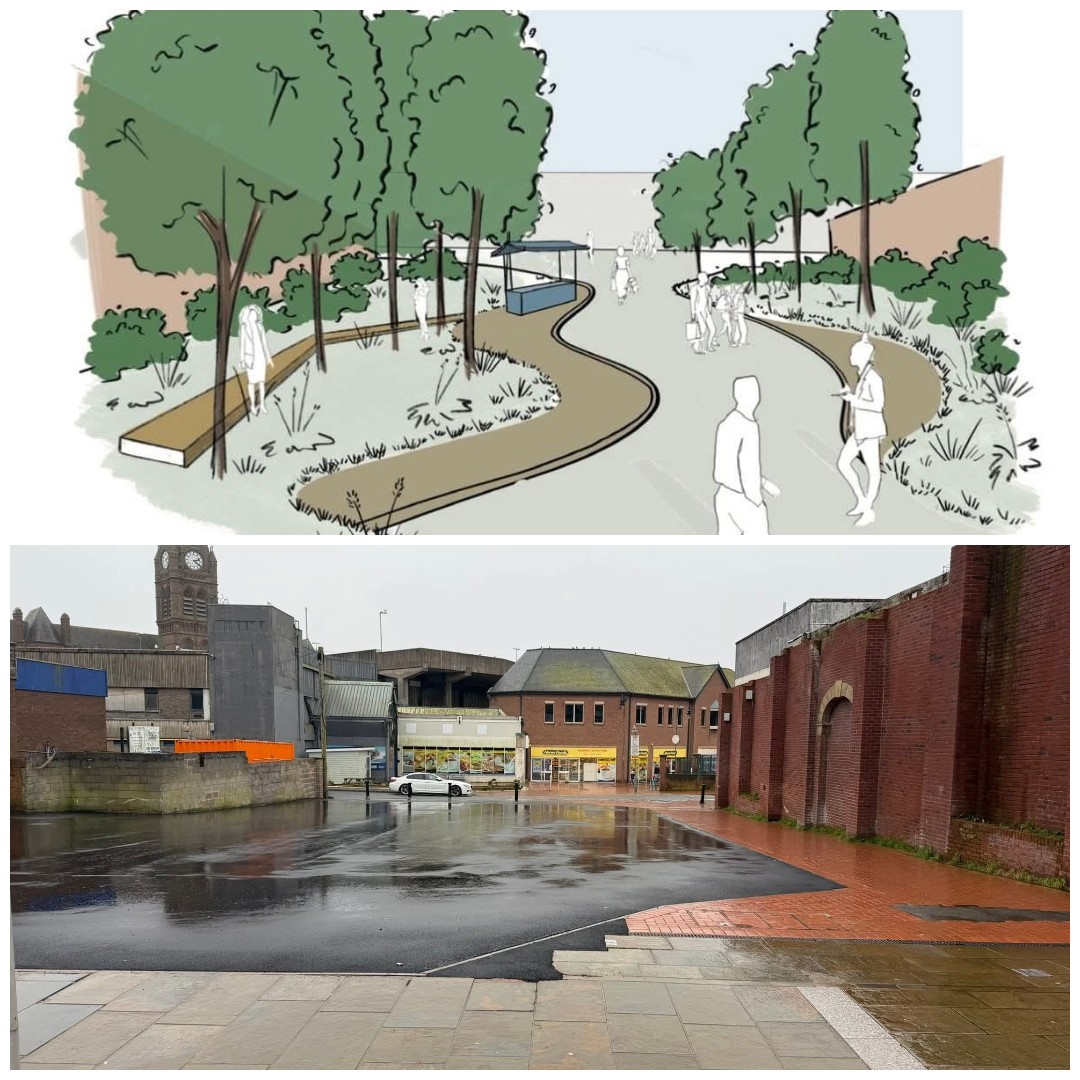
People react oddly to windfalls, and in the case of Barrow suspicions that outsiders are pulling a fast one have been sharpened by avoidable disasters like the recent closure of the market hall, which left some 70 stallholders adrift. After we met, Nathan sent me two images. The first was a “what we were promised” graphic of people going about their business in an attractively landscaped part of central Barrow. The second was a “what we receive” photograph, showing the same area as it stands, desolate, unimproved and under inches of rain. The latter, in the end, may speak more persuasively than the technocratic reasonableness of Peter Anstiss. In truth, however, Barrow is already showing signs of the long-awaited revival; it must now accelerate.