




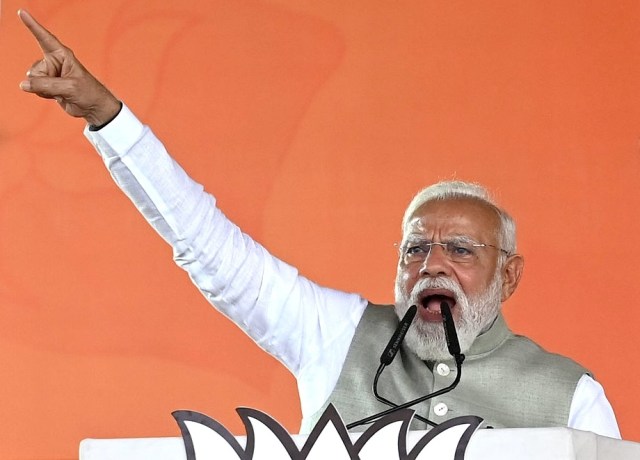
'Trump, not to put too fine a point on it, terrifies Modi.' (Samir Jana/ Getty)





At any other time, the destruction of Iran in an imperial war would have provoked uproar in New Delhi. To many Indians, Iran is roughly what England is to Americans: a source of high culture, language, and religion. Millions of people of Iranian origin call India home, and many of India’s most storied figures spoke of Iran with deep feeling. The poet Rabindranath Tagore, who bequeathed India its national anthem, traveled twice to Iran and found there a civilization that “comes nearer to us than most Asiatic countries”. Tagore was alert to the “asphyxiating domination of the mullahs”, whom he considered a threat to Iran’s “progress”, but the kinship he discerned there transcended religion. Even today, a community of Brahmins in northern India venerates Husayn ibn Ali, maintaining that its forebears fought alongside that great martyr of Shia Islam at the Battle of Karbala over 1,300 years ago.
Given the breadth and depth of this relationship, it is astonishing that India not only did not express disapproval of the bombing of Iran. For a considerable time, it refused even to acknowledge it. Nor did it make a sound when the head of a friendly sovereign state was murdered along with his family. India remained silent, too, when a children’s hospital named after Mahatma Gandhi, and located on a street bearing his name, was blown up. This puzzling muteness wasn’t just a departure from India’s long tradition of solidarity with the developing world. It was also an abdication of the de facto leadership of a large segment of the non-Western world thrust upon India by its presidency of BRICS. Every other founding member — Russia, China and Brazil — quickly denounced the war. India alone seemed to be condoning it with silence.
Then, on 4 March, an unarmed Iranian frigate sailing home after participating in a maritime exercise convened by the President of India was torpedoed by the Americans in the Indian Ocean — an area to which India claims to provide security. Yet India couldn’t muster the nerve to say a word in response. It was tiny Sri Lanka, one-50th India’s size, that activated its navy to rescue the Iranian vessel’s stricken sailors. By then, more than 80 had been killed. Colombo withstood intense American pressure to preserve and repatriate the bodies of the dead. Veterans of the Indian Navy were appalled.
When Narendra Modi — who had concluded a visit to Israel hours before the first bombs were dropped on Iran — did come around to speaking about the sanctity of sovereignty, it was in relation to the Gulf monarchies. About Iran’s trampled sovereignty, he again said nothing. The upshot was a public outcry in India at what looked like a squalid surrender to the US and Israel by a country with a long record of standing up for its interests and professed beliefs. Ordinary Indians flooded the Iranian embassy to sign the condolence book for Ayatollah Khamenei, and the Iranian mission was compelled to open a bank account to receive charitable donations from the public.
It is the sight of this outpouring of grief and comradeship that prompted Modi eventually to dispatch a senior bureaucrat to the Iranian embassy to record India’s condolences. But by then the Iranians had clearly had enough. While Tehran took great pains to display its gratitude to India and Indians, it refused to make any special concessions to Modi. When the Indian premier finally opened channels of communication with the Iranian leadership, Tehran allowed the passage of two Indian-flagged ships carrying LNG — a fraction of India’s daily needs. The message to Modi was clear: no privileges would be granted to India. New Delhi would have to negotiate the passage of every single vessel, and Iran would decide on a case-by-case basis. Sri Lanka, on the other hand, received public assurances of support from the Islamic Republic.
To liken Modi’s behavior to India’s refusal to condemn Russian aggression against Ukraine is to overlook the fact that New Delhi formally recognized the gravity of that conflict. Modi even traveled to Ukraine, and issued a public warning to Putin about the perils of making this an “era of war”. His silence on Iran is singular, and there are two reasons for it.
The first is Modi himself.
His failure to oppose the war is self-serving. Over the past decade, Modi has erected the most formidable cult of personality in the democratic world. He is the only living leader with a stadium named for him; in 2021, India’s space agency catapulted a satellite carrying his photo into space; children in state schools are forced to celebrate his birthday; villages are obliged to endure his radio broadcasts.
India’s former vice president once introduced a resolution in parliament proclaiming Modi “god’s gift to India”. Another minister hailed the “Modi Era” as the consummation of a 450-year-old prophecy.
The ruling Bharatiya Janata Party’s digital warriors, meanwhile, have toiled for years circulating fake photos of Modi surrounded by world leaders seeking his counsel or watching his speeches. They have gulled voters with absurd lies, such as the one claiming Modi was adjudged the “best prime minister” on Earth by UNESCO. The government has burned billions of rupees on public jamborees wherever Modi has gone — from Wembley Stadium to Madison Square Garden. And virtually every major news organization in India has amplified the claim that Modi is Vishwaguru: teacher to the world. The falsehoods of his sycophants have had a crazed effect on Modi himself. Last year, he told a worshipful journalist that his birth was not a “biological” event. He was supposedly sent down by some celestial force.
Nothing would threaten Modi’s meticulously crafted self-image — the globally admired messiah dispatched by god to save India from its “anti-national” Anglophone elites — more than a glib putdown from Trump. A direct insult would make Modi, a strongman, the object of derision at home. Fearing this, he has gone to extraordinary lengths to avoid his American counterpart over the past year. Last October, he even stayed away from the ASEAN summit in Kuala Lumpur, an otherwise important event, so as not to run into Trump there. Trump, not to put too fine a point on it, terrifies Modi.
This turn of events was unexpected. In Trump’s first term, Modi expended tremendous energy cultivating the American President. Modi called him “Doland, my friend”; hugged him ebulliently; and even held a rally with him, before adoring Indian-Americans, in which he effectively endorsed Trump’s re-election. There was nothing he would not do for his dear Doland. During Covid-19, Modi agreed to give away precious stocks of essential Indian medicine to the US after a phone call from Trump. He mounted an extravagant spectacle for Trump in his home state of Gujarat, and, ignoring deadly religious riots in Delhi, hosted a lavish banquet for his American guest in the Indian capital.
When Trump was re-elected in 2024, pro-Modi Indian televangelists erupted with triumphalism and schadenfreude. They declared that with Modi’s friend back in the White House, India’s adversaries were on notice and rhapsodized about the “electric” chemistry between the two men. Modi’s supporters were encouraged to believe that Trump would squeeze New Delhi’s enemies and accelerate India’s rise.
He did the opposite. Last year, when India went to war with Pakistan, Trump inserted himself into the conflict on the side of Pakistan — heralding himself as the peacemaker and demanding a Nobel Peace Prize for his accomplishment. The ceasefire, according to New Delhi, happened because Pakistan, whose military runways were cratered by India’s bombing campaign, implored its rival to stop. India’s military establishment therefore found the suggestion that Trump brokered the truce offensive, but the country’s political leadership was too timid to push back.
Trump has since repeated dozens of times the claim that he forced India and Pakistan to halt the war by threatening them with tariffs. Impatient to secure a trade deal that would grant Washington access to the most protected areas of India’s economy, he then proceeded to pronounce India’s economy “dead” and slap a 50% tariff on its exports to the United States. The levy devastated parts of the Indian economy, but Modi still didn’t react. Since India is governed by a cult, the government’s priority is to protect the cult’s master. India’s interests are secondary. Now, Trump wants demonstrations of obedience, and Modi is willing to perform national seppuku to propitiate him.
The second, supposedly respectable, reason for Modi’s unwillingness to dissent from Washington, according to his apologists in the Indian establishment anyway, is that India needs the United States to counter China. Modi’s acolytes have convinced themselves that India, aided by Washington, is destined to replace China as America’s preferred manufacturing base. Trump’s emissaries have made it plain that they have no intention of helping India realize this goal. Still, New Delhi persists with the belief that the United States is its indispensable partner. In its equation, there is no future in which India can find a modus vivendi for peaceful coexistence with Beijing. Rather than engage in intense dialogue with its neighbor next door, India’s only option apparently is to become a frontline state in Washington’s effort to contain China’s rise.
The problem with this argument is that the one party undeterred by this grand partnership is its intended target: China. Six years ago, the People’s Liberation Army seized Indian territory in Ladakh. Modi’s initial response was to go on television and claim that there were no Chinese incursions into Indian territory — even as dozens of Indian soldiers lay dead. Then, in a belated act of retaliation, Delhi introduced curbs on Chinese investments into India. But now, as a direct result of the economic difficulties into which Trump’s tariffs have plunged the country, those barriers have been removed and India is again courting Chinese investment.
In other words, then, India’s subservience to the US is as undignified as it is strategically incoherent. Its most concrete achievement is the decimation of India’s credibility in the non-Western world. Once regarded as a model of autonomy by Africa and Asia, it is now viewed as a poodle of Washington.
That, of course, still leaves unexplained India’s strange deference to Israel.
India’s embrace of Tel Aviv, which began before Modi appeared on the scene, has now become damaging. The wielders of power in New Delhi have concluded that Israel is a reliable exporter of technology and a viable destination for blue-collar workers for whom Modi has been unable to create jobs at home. Beyond this basic calculus, though, the relationship is wholly ideological. It is animated by the Hindu-nationalist reverence for a state that has battled and survived against Muslim nemeses. Israel was quick to intuit Modi’s great weakness — susceptibility to flattery — and exploit it skillfully. The Knesset recently awarded the Indian prime minister a wholly made-up prize.
Israel’s most enthusiastic supporters in India are united more than anything else by a profound hatred of Muslims, and they see in Israel a beau ideal. As the liberal Israeli newspaper Haaretz once put it, “Relations between Israel and India tend to grow stronger… when India experiences a rightward shift in anti-Muslim public opinion or in leadership”. As Israeli atrocities mounted in Gaza, the IDF’s most enthusiastic cheerleaders outside Israel were to be found in India. Last week, India imposed a roundabout ban on the screening of The Voice of Hind Rajab, an Oscar-nominated docudrama about a Palestinian girl murdered by the IDF that can lawfully be screened in Israel, on the grounds that it would “break up” India-Israel relations.
No decent Israeli can see this as a compliment. And no decent Indian can regard a friendship fueled by bigotry as a worthy cause. Beyond Hindu nationalists, Israel has no real champions in India. Two decades ago, virtually every side in India was willing more or less to work with Israel — some openly, others clandestinely. Today, however, Israel is so completely identified with the BJP that, when Modi is gone, the next government is bound to push it away.
Yet even before a political decoupling can occur, a more visceral detachment is being forced by the burdens imposed by the economic reality. The consequences of the Israeli-American war against Iran have reached India. As a poor, developing country, India is heavily dependent on imports for its most essential energy needs. More than 60% of the liquefied petroleum gas that powers Indian kitchens, as well as nearly 90% of its crude imports, come from the Persian Gulf. The closure of the Strait of Hormuz is thus a body blow to India. Airlines have introduced a fuel surcharge, farmers face the prospect of fertilizer shortages just as demand rises ahead of the planting season, while restaurants everywhere are trimming their menus or closing altogether. All the while, the lengthy lines outside gas distribution terminals evoke Ceaușescu’s Romania; at least two men have died so far in the interminable wait to refill their canisters. An exodus from town to village, redolent of the horrifying mass flight in the bleakest days of the pandemic, has begun.
On Monday, more than two weeks after the war commenced, Modi made a statement in parliament in which he told Indians to brace for a Covid-like challenge. It’s a spine-chilling thought. The pandemic was the worst humanitarian catastrophe in republican India’s history: hospitals ran without oxygen, crematoriums ran out of wood to burn the dead, bodies floated in the Ganges. Modi used the horror to solicit tax-deductible donations for an opaque trust established, he said, for the purpose of aiding “the poorest of the poor”. With a brazenness that would have made Papa Doc Duvalier blush, he christened the fund “PM CARES”.
Nearly a billion dollars flowed into it in the first week. But where has all that money gone? That question is impossible to answer because PM CARES, structured as a private trust, cannot be reviewed by the state auditor. The flagrancy of the enterprise catches the breath: while his counterparts abroad panicked and pleaded with their people, Modi cashed out. That the Indian prime minister has again invoked that horror should therefore terrify us all. Certainly, he did not equip India for this crisis: the country has oil reserves for just 10 days. And the lesson of Covid is that the prime minister — who has a habit of disappearing from view in difficult times — will not help.
Given its sheer size and human scale, India may be on its way to becoming the largest single non-hostile casualty of the war in West Asia. For all its preening proclamations of its own rise and importance on the world stage, Modi’s “New India” proved too inconsequential to influence the warmakers — and too weak, craven, and self-woundingly stupid to be spared the war’s effects.
Kapil Komireddi is the author of Malevolent Republic: A Short History of the New India (Hurst)
 kapskom