




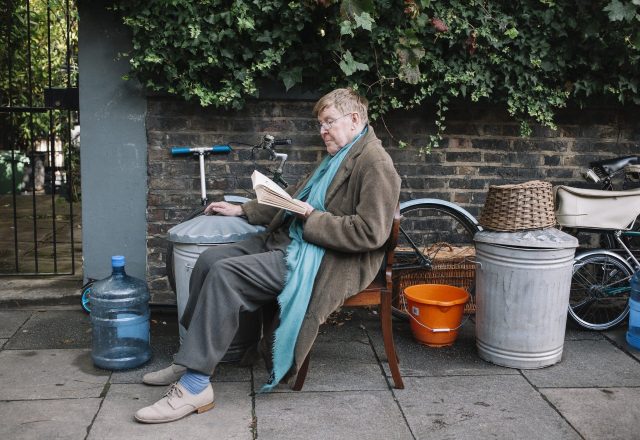
Who will speak for the English ordinary? (Nicola Dove/John Springer Collection/Getty)




If 1961 was the famous year when the old rules of British deference were ripped up, Alan Bennett played a surprisingly significant part. Now the nation’s most popular diarist-cum-sentimentalist, Bennett famously performed with Beyond The Fringe, a quartet of fresh-faced Oxbridge graduates that humiliated Harold Macmillan when the prime minister came to watch Peter Cook mock his “stupid great grin”.
But less well known is the night the Queen also turned up at the West End’s Fortune Theatre. Bennett had a routine about an old worthy being turned on by hanging and flogging, still going strong on the cusp of the Swinging Sixties. That night, when he “half-said erection” on stage, Bennett writes in his latest diaries at the age of 91, might be the most risqué performance Her Majesty ever witnessed.
Over six decades on, Alan Bennett finds himself adrift in an England without the Queen — and one seemingly in need of relief from whatever 1961 was trying to send up. Enough Said is about Britain’s last literary national treasure getting old, and with it a sense of Englishness marching to its doom. This is a country floating off into the antithesis of Bennettland, where no one knows the local vicar and his famous monologues of quiet desperation have unfurled themselves into full blown howls. His old muses, those he termed “on the edges of emotion rather than their extremes, irritation rather than anger, melancholy rather than grief” have found a new voice.
Bennett’s people — the eccentrics, the repressed, those who slipped through the cracks into bedsits and cul-de-sacs from Harrogate to Camden — are now very much at the center of national life. But in 21st century England they are set free from the fustiness of his dramas for anti-migrant marches in Essex. This is no country for Bennett’s wry world of letters to the Guardian or the sanctity of the National Theatre. Scions of England’s old artistic establishment which once embellished these manners, from Jonathan Miller to Maggie Smith, seem to pop up dead throughout Bennett’s pages with all the foreboding of bloated whales appearing on the beach.
This set of diaries — his fourth — cover the years 2016-24. And, in theory, it’s a period rife with Bennett characters. There is Theresa May, the churchgoing would-be vicar’s wife who finds herself out of her depth and preyed upon by scheming old Etonians. There is the ambitious but hopeless Ed Miliband, rollicking around Hampstead to visit his mother on his bicycle, discussing the political “mess to be cleared up” with fawning pensioners. Even the working-class autodidact Joey Barton, “the difficult and sometimes violent footballer”, would, Bennett suggests on 19 September, 2016, “make a good character for something”. Britain’s Trump, he teases us in a brief February entry of that same annus horribilis, would be Jeremy Kyle, both “fixed permanently on self-seeking”.
In other words, all the classic Bennett material is here: the petty English grotesque with all its delusions and repressions. Yet amid it all, our most famous living playwright can’t quite seem to grasp the period. Even he has lost the classic drollness of his characters: Britain in the aftermath of Brexit is comparable to “Munich in 1938”. A Sikh family having a slap-up meal in a French restaurant is a “rebuke to Farage and co”. Unlike his anti-fascist diarist forebears, Hans Fallada interned in a Nazi lunatic asylum or a suicidal Walter Benjamin in transit, Bennett spends his time hobbling around cathedrals and fawning after John Bercow on the train to Grantham.
None of this is surprising. Bennett’s career, after all, may as well be a stand-in for the increasingly faulty compass of Britain’s liberal arts establishment: abandoning nuance or subtlety in its examination of daily life for a strange blend of spleen and whimsy. Having lost the feel for his life-long theme of “ordinariness”, whether through old age or distance or both, Bennett instead lurches for clumsy civilizational themes. “I owe everything to the state”, he writes mid-lament of the Brexit years, as if the problem with modern Britain is that we’ve abandoned our loyalty to civil servants and education boards.
These days, there is comically little to prop up this gentle England that once made Bennett. There are birthday cards from Rachel Reeves, encounters with Jon Snow, a cheerful immigrant railway worker hauling Alan onto the 9:20 to Leeds (he’s as big, Bennett tells us, as Idi Amin). When these self-consciously political titbits rub up against the gaudy, rebellious reality of contemporary England, the result verges on self parody. “The Christian Science Temple on Headingley Lane in Leeds… where on one of my solitary walks aged sixteen, I decided I was gay, has now been sold to Wetherspoons.” At times there is mere surrender: when Trump is elected after Brexit, the solution Bennett discovers is “to live without news: no paper, no TV, no comment.”
Why is Alan Bennett so popular? This is a question that seems to haunt him — and, with the deference he now attracts, a sense that the Bennett of 1961 might well have hated what he’s now become. The diaries betray a painful realization he has become a sort of literary Elizabeth II, a national treasure to prop up coziness and eccentricity, those traits so lacking in the country today. Admirers from Morrissey to interlopers at Leeds station lurk like sycophantic grim reapers, vaguely aware that some monarchal entity is about to pass forever into the annals of England. About to receive a retrospective at the height of the pandemic, with a revival of his seminal 1988 series Talking Heads, he regards the whole thing as out of step with the emergency raging around him. The National Gallery, upon making him a trustee, informs Bennett almost to his horror that he is “the man on the street”.
In settling on him, Bennett seems almost to realize that England has simply run out of ideas — or people — that define what really brings it together. The irony, of course, is that Bennett himself arguably helped wreck this shared identity himself. At some point in the 21st century, he loses his touch. His “ordinariness” becomes mere twee, fawning to an increasingly tainted center-left. Typical here is The History Boys, a 2004 paean to the idea of social mobility, northern multiculturalism and working-class autodidactism and which now feels as out-of-step with the present as Goodbye Mr Chips.
Far better to look for Bennett’s talent in Talking Heads, a now unthinkable feat of pessimistic television drama. Broadcast in the dying days of Thatcherism, each night the nation tuned in to watch monologues of Chekhovian bleakness about a nation apparently on the up. The theme here is one that still endures in 21st-century Britain, one that, as Bennett puts it in the introduction to the monologues, is the “valuable lesson that life is generally something that happens elsewhere”.
Here we get Graham Whittaker, the closeted homosexual living in a carefully ordained world of Harrogate tearooms, who nearly loses his beloved mother to a local spiv. Here we get Susan, a drinker and vicar’s wife, forced into Leeds to buy her booze and who ends up having a passionate affair with the Indian shopkeeper. And then there’s Irene Raddock, who lives alone near Bradford, lamenting the changes on her roads brought about by immigration, and penning furious letters to the authorities about the strange goings on of her new neighbors — until she is arrested and sent to prison.
The details may have changed, but the themes have not: quiet loathing, paranoia, madness, the loss of control in everyday life. To draw empathy from these downward spirals is the genius Bennett once achieved. A self-confessed snob in his early years — perhaps spurred on by his father’s aspirations of moving to Guildford when he was a boy — meant Bennett became attuned to the anxieties of the English upper-working and lower-middle classes. Yet he treated them with the sort of respect deserving of sad, regular people desperate for some control in their lives. The plight of these types seems lost in the latest diaries. Instead, we are surrounded by luvvies and arse-kissers, egging on the sort of tweeness that ultimately lies at the root of England’s inability to truly understand itself.
Enough Said is haunted by these figures. Miriam Margolyes calls from Australia, concerned she’s not done justice to her performance in Lady in a Van. Bennett drolly remarks on her penchant for crudeness and swearing, criticized in his own later scripts, as if tacitly acknowledging the monster he has spawned. Then, of course, comes the pandemic, a sort of bad Bennett pastiche in the hands of his inheritors. Captain Tom, a Yorkshireman himself, beguiles the nation with an act of Herculean quirkiness. The nightly news bulges with Bennett’s daily preoccupations: immigrant care workers, bossy village hall matrons enforcing the rules.
But all this is lost on Bennett, who seems to have lost any real sense as a dramatist for the English ordinary in the 21st century. And if the writer himself seems happier wallowing in progressive abstractions, what passes for ordinariness today has been shorn of its poignancy. Instead, we have set pieces like Gogglebox, where those that lived in Bennett’s imaginary world simply gawp and point at the TV. As for the National Theatre, the Guardian, the BBC — all these are plagued by a new deference, to the Lionesses and the NHS. But who, then, will define our new English ordinary, that inchoate, irrational blend of deference to Bennett’s old Britain and its howling new anger? After all, there are still Irene Raddocks and Graham Whittakers lurking in England’s towns and villages. It’s just that no one’s there to speak for them.
Reflecting on his lewd performance before Elizabeth II, Bennett recalls his father, in his “eternal trilby and raincoat”, taking off his cap before the Queen’s motorcade in Headingley in 1966. “Where the gesture came from I can’t think,” he writes. “But somewhere, almost a surprise to himself, he was a loyal subject. And the same I suppose goes for me.” Here is the most honest admission of something his diaries never quite confront in this new England. Soon, after all, we will have lost the last English dramatist capable, perhaps, of truly understanding that conflicted emotion without condescending it.

Join the discussion
Join like minded readers that support our journalism by becoming a paid subscriber
To join the discussion in the comments, become a paid subscriber.
Join like minded readers that support our journalism, read unlimited articles and enjoy other subscriber-only benefits.
Subscribe