




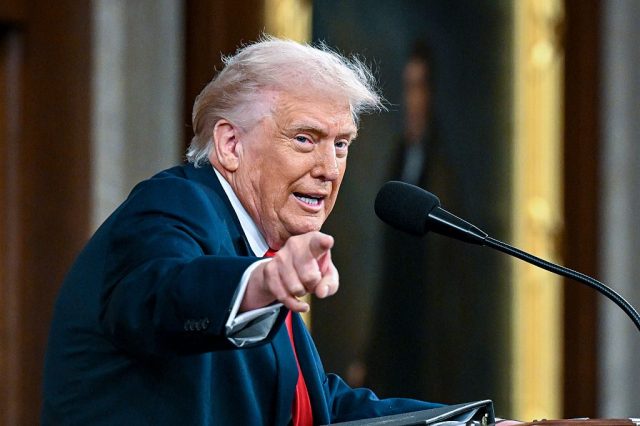
His polling is underwater on most issues. Credit: Getty




At Tuesday night’s State of the Union Address, President Trump touted an American comeback. “Tonight, after just one year,” he declared, “I can say with dignity and pride that we have achieved a transformation like no one has ever seen before, and a turnaround for the ages.” If this messaging is a preview of Trump’s midterm strategy, it could seriously backfire on the GOP. Because simply put: voters don’t agree.
Most observers understand that Trump will never be truly beloved — not in a national way as, say, Bill Clinton once was (warts and all). America in 2026 is too polarized, and Trump is too polarizing. But history proves Trump can at least be palatable, and that’s where this second presidency is flagging. It’s why the president is taking a major risk by insisting that a “transformation” has been achieved when, on his own terms, it plainly hasn’t. Not yet, anyway.
The president made big promises ahead of this second term: about bringing about a new “golden age.” For many voters — especially the working- and lower-middle-class Americans who twice sent him to the Oval Office — renewal is about the kitchen table and internal reconsolidation: a focus on repairing the domestic hearth and on helping an asset-poor majority buffeted by decades of economic insecurity (even as China and Wall Street went from strength to strength).
As one GOP strategist told me ahead of Tuesday’s address, “It will be a great speech if Wednesday morning headlines read: Trump delivered a State of the Economy address.” Trump partially delivered that. Yet his boasting was out of step with what voters are telling pollsters about how they feel — a jarring callback to the themes of stability and reconsolidation that were supposed to define the second term but were somehow forgotten along the way. Then, too, the speech highlighted the ways in which a hyperactive foreign policy is swallowing what was supposed to have been a domestic-focused populist movement.
Even under the best conditions in the past, Trump has at times managed to preside over a relatively strong economy — and still not achieved public support greater than about 50% approval, owing to the confluence of a fractured media environment and a fractured electorate. Yet the polling numbers right now are damning evidence he’s hemorrhaged much more public support than usual.
Trump entered office last winter with his highest ever approval rating, 50.4%. According to the RealClearPolitics average, his job-approval average was six points above water days after he was sworn back into the White House and stayed that way until about mid-March. By contrast, Trump enjoyed only a 0.1-point bump — a blip, really — as he took the oath in 2017, which quickly dipped to six-points underwater by late February of the same year. In other words, the second time around, he really came in about as popular with the national electorate as a figure like Trump could ever be.
So what happened? Why is it that today, supermajorities of Americans disapprove of his handling of most issues? Why is it that, according to the pollster Nate Silver, the president is underwater by double digits on all immigration, the economy, inflation, and trade?
Trump is always the same person. At no point in the last 11 years has he stopped posting crazy messages on social media, hiring weirdos, or holding wild news conferences. Yet despite these antics, there have been times when half of the public has been willing to get behind him as a norm-busting, Right-wing polemicist who is under a constant barrage from the entire political establishment.
Put another way: it was possible for Trump to have avoided his current approval hemorrhage. The very fact that Trump entered office last year with political and cultural momentum after running a hard-core populist campaign the legacy media detested is proof of this. So is Trump’s problem an excess of populism or its absence?
Trump argued in the speech that his administration is creating a world “where government answers to the people, not the powerful” and “where the interests of hard-working American citizens are always our first and ultimate concern.” He accused Democrats of “corruption that is plundering America,” adding: “From trade to health care, from energy to immigration, everything was stolen and rigged in order to drain the wealth out of the productive, hard-working people who make our country run.”
The speech was clearly designed to highlight populist policy priorities like banning “large Wall Street investment firms” from buying single-family homes, bringing back manufacturing jobs, protection from energy rate hikes caused by new data centers, banning congressional stock trading, closing the border, and deflating prescription drug prices. This was the Trump who won in 2024. But where was he for the past year or so?
A glance back at Trump’s Second Inaugural Address recalls just how intentional he was about promising strength and stability. He cast elites as destabilizing, making the argument that “a radical and corrupt establishment has extracted power and wealth from our citizens while the pillars of our society lay broken and seemingly in complete disrepair.”
That is a very particular criticism of the political class which paints it not merely as corrupt but also as chaotic. “Our sovereignty will be reclaimed. Our safety will be restored. The scales of justice will be rebalanced,” said Trump last year.
But this is not, in fact, how many voters have experienced his second presidency. Some economic metrics are moving in the right direction for him, to be sure, but voters remain unimpressed with his stewardship of the economy and trade policy. As the Supreme Court demonstrated last week, it’s the uncertainty that may be what’s harming Trump, who promised to restore stability.
The Dow is up, the Consumer Price Index is down, and tax cuts are coming. Reuters described the January jobs report as “unexpectedly strong.” But consumer confidence is now at a 12-year low. It shot up after Trump took office, then plunged to roughly the same level. The index shows confidence has declined sharply among Independents but is down even among Republicans. People report disapproval of Trump’s work on inflation and tariffs in particular.
Prices are still rising — in part due to tariffs — and every day brings a new apocalyptic warning from experts about an impending mass deletion of jobs at the hands of artificial intelligence. (Trump, meanwhile, is lavishing artificial intelligence oligarchs in praise and political favor and enriching himself and his family with laughably corrupt cryptocurrency schemes.)
The public’s dissatisfaction with Trump’s economic and tariff policies makes more sense against this backdrop. He made big promises. So if you’re a 26-year-old who heard the president on Lex Fridman’s podcast but don’t feel like he cares that you still can’t buy a home, your patience is wearing thin.
What might snap your patience altogether is Trump’s heavy focus on foreign policy, from the Iran war buildup (despite his assurances that last summer’s intervention in Israel’s 12-Day War had “obliterated” the nuclear program); to the Venezuelan regime-swap operation’ to capricious threats against Greenland and the war continuing to rage in Ukraine to, despite a promise to end it rapidly. There’s also the matter of the Epstein Files, which again featured a high-profile promise of disclosure that Trump had to be dragged kicking and screaming into making good on.
At least some of Trump’s low marks are coming from disappointed Republicans. According to Politico, new polls have picked up this trend: “In [a] CNN survey, 82% of Republicans approved of the job he was doing, down eight points from a year ago. And the Washington Post survey found that 48% of Republicans ‘approve strongly’ of his performance, down from 63% a year ago.”
Tuesday proved Trump is not throwing in the towel on populism — at least, not rhetorically — but to a lot of ordinary people, it looks chaotic and muddled, when the president promised strength and calm.
Trump now has only three years left in office so he’s likely more interested in long-term legacy building than day-to-day approval ratings. That means he’s also more willing to take risks with the hope they pay off down the road even if they feel shaky in the moment. His heavy emphasis on foreign reflects this. And in fairness, that in part explains the heavy focus on foreign policy — the domain in which most second-term presidents try to cement their legacy (it’s much easier to strike foreign agreements or start foreign wars than to deal with a recalcitrant Congress).
Still, populism has to deliver, and if you promise strength and stability, you can’t also remain popular if you’re seen as an unpredictable agent of chaos.
Perhaps that explains Trump’s repeated invocation of “1776” on Tuesday. He is, of course, pleased to be the president during the 250th anniversary of the Declaration of Independence. But nobody looks back on 1776 as a moment of calm and stability. It’s remembered as a time of enormous difficulty and uncertainty. This indeed may be Trump’s best argument, but it won’t exactly put the country at ease.

Join the discussion
Join like minded readers that support our journalism by becoming a paid subscriber
To join the discussion in the comments, become a paid subscriber.
Join like minded readers that support our journalism, read unlimited articles and enjoy other subscriber-only benefits.
Subscribe