




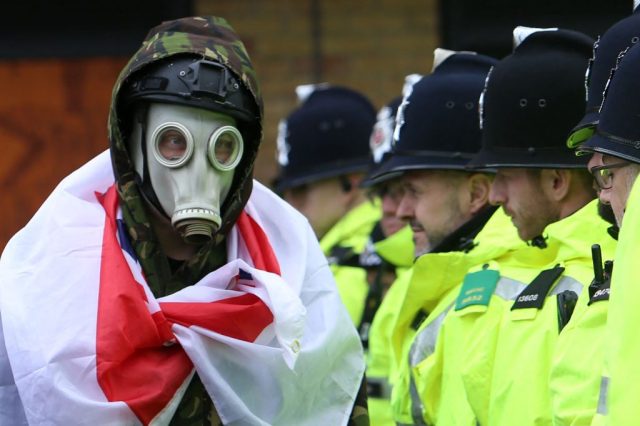
'The open society ideal slipped the bounds of any particular circumstance to become a permanent imperative' (Susannah Ireland/AFP)




In his 1945 work The Open Society and its Enemies, Karl Popper offered one of the early articulations of “the open society” as an ideal, one which gathers up some of the West’s dearest principles: universalism, toleration, cosmopolitanism, individualism. As against the chauvinism that is native to political life, the ideal of the open society announces a higher allegiance — to all mankind. Expressing independence from the cramped mindset of parochial attachments, it provides the moral basis for the West’s embrace of mass migration. There are material interests at stake on the question of how much immigration we should have, and they diverge along class lines. But the adepts of the open society describe the divergence instead along the psychological axis of open-closed, with closedness understood as a failure of moral development.
To stay on the correct end of this axis requires a person to organize his moral energies around a boutique picture of reality. It is a picture that doesn’t even try to comprehend common experience — most pointedly, the experience of receiving millions of migrants from different societies (some of them quite alien to our own), with the attendant dislocations. These include the thinning of the social fabric and a retreat into further isolation — what the sociologist Robert Putnam called “hunkering down” in his study of the effects of diversity.
The ideal of the open society doesn’t simply ignore the downsides of immigration — including rising rates of sexual violence — it gains force precisely as a principled negation of experience. It serves to coordinate elites in the epistemic equivalent of a potlatch: an Olympian disregard for social realities expresses a certain magnificence in those who are able to maintain it. Yet while a traditional potlatch is made possible only by an underlying asceticism (a nobleman must be ready to do without the fine things he destroys), the renunciation demanded by our leaders falls most heavily on those they rule. Embracing the open society is the ultimate luxury belief.
As conveyed by the latter half of Popper’s title, the idea of the “open society” is inherently polemical. It requires a foil of closedness. “In what follows,” he writes, “the magical or tribal or collectivist society will also be called the closed society, and the society in which individuals are confronted with personal decisions, the open society.” The alternative to the open society, then, is tribalism and magic, or some version of collectivist effacement of the individual. The paradigmatic activity of the open society is “personal decision”.
Popper’s original advocacy of the open society carries over to those who speak today in the idiom of universal “human rights”, as opposed to the civil or political rights that attach to citizens of a particular, bounded nation. Anything bounded is “closed”. If the mindset of human rights is given to moral militancy, Popper’s treatment helps us to see that the agenda of human rights carries with it a literal military corollary.
Given the date of publication, this military frame of mind is understandable. As Popper writes in the preface to the 1950 edition, his ideas for the book had been germinating for some time but “the final decision to write it was made in March 1938, on the day I received the news of the invasion of Austria”. Clearly, the proximate enemy of the open society that he had in mind was Naziism. That would be the “magical or tribal” enemy. But he also takes on communism, the collectivist enemy. Popper speaks for the third combatant in the conflict, which goes by the conventional title “liberal democracy”. Whatever we call it, it is the regime-type that ultimately prevailed over both adversaries in the longer conflict that began with the Anschluss in 1938 and stretched through the Cold War. Arguably it is neither democratic, in the literal sense of rule by the demos, nor liberal in the 18th-century sense of limited government. Rather, it is “open”.
What interests me is the disposition that animates the ideal of the open society. Those who share it invoke the Nazi threat ritualistically, so 1938 remains important as an emblematic moment. But the open society ideal slipped the bounds of any particular circumstance to become a permanent imperative, never satisfied so long as any concrete, circumscribed political community remains. The end of the war in no way relieved enthusiasts of the open society of their need for enemies.
Both points of polemical orientation for Popper — Nazi racialist tribalism and Marxist collectivism — are forms of human association. The remedy for both, then, is individualism. Popper seems historically obtuse, willfully so, in his failure to register the fact that there are non-malignant forms of association that can provide the basis for social order. He skips straight from the Nazi and communist threats to an equally radical counter-ideal of individualism that is meant to inoculate us against both hazards. In this, he comes across as reactive and simple-minded, unable to conceive of a social order mediating between individuals which would satisfy his ideal of openness.
I believe the problem for Popper is that any kind of order that is already established is external to individual will. (Recall that the open society is marked by “personal decision”.) The freedom of the will is compromised when it is impinged upon by binding associations, such as family or nation, that are not chosen. To be innocuous, any association must be provisional; it must be continually re-chosen on a case-by-case basis as circumstances shift. Accordingly, the open society will be one of disengaged monads who come together episodically for various forms of exchange but have no deep or abiding connection to one another.
Popper recognizes that an open society therefore tends to become one of “abstract relations”. In this he is prescient. “We can conceive of a society in which… all business is conducted by individuals in isolation who communicate by typed letters or by telegrams, and who go about in closed motor-cars. Artificial insemination would allow even propagation without a personal element.” He offers this sketch “by way of an exaggeration” in 1943, but in 2026 it seems less so.
Given this thinned-out anthropology, Popper commends economics as the proper mode of doing social theory, because it treats human actors in their abstract relations of exchange. He condemns sociology — for example, that of Durkheim — for its “dogmatic belief that society must be analyzed in terms of real social groups”. It almost sounds like the fact that they are real counts against them. We are not to dwell on the concrete differences of habit and character among different social groups. Ideally we would not even notice them, as such noticing could compromise our allegiance to the ideal of the open society and its corollary: permissive immigration policy. The open society will be a society of individuals denuded of those qualities they acquire in association, as encultured beings. Openness seems to require positing sameness, so the variety of persons and of peoples can be treated as a mass of interchangeable human resources.
Somehow, Popper and his political descendants have succeeded in attaching the word “democracy”, used as a term of approbation, to this imperative of abstraction and replaceability. A better name for it would probably be “bureaucracy”. Bureaucracy takes as its object of rule what Popper’s contemporary Robert Musil called the “Man Without Qualities”.
Popper recognizes that achieving the open society will require a vigorous imperial project. What he had in mind, writing during the war, is not fully spelled out. But arguably, today’s interventions in the internal affairs of putatively sovereign nations by the trans-national organs of openness would seem to capture the spirit of what Popper had in mind. Such organs include the European Commission, USAID and indeed George Soros’ Open Society Foundation. Whatever Popper envisioned, he was discreet enough to make his case for imperialism by historical proxy, treating the Peloponnesian War as a conflict between the open society of Athens and the closed society of Sparta.
For Popper, any criticism of Athenian imperialism can only be a cover for reaction. “Thucydides himself was an anti-democrat. This becomes clear when we consider his description of the Athenian empire, and the way it was hated by the various Greek states. Athens’ rule over its empire, he tells us, was felt to be no better than a tyranny, and all the Greek tribes were afraid of her.” But Popper, writing over two millennia after events, knows better. All people of goodwill loved being ruled by Athens. Note his pointed misapplication of the term “tribe” to any city that resisted Athens’ enlightened exactions of tribute, or its beneficent control of commerce throughout the Aegean, made possible by its naval superiority.
“[I]t is necessary, I believe, to see that tribalist exclusiveness and self-sufficiency could be superseded only by some form of imperialism. And it must be said that certain of the imperialist measures introduced by Athens were rather liberal.” One expression of Athens’ liberality that Popper points to, which anti-imperialists fail to appreciate, is Athens’ offer to the island of Samos. As reported by Thucydides, the offer was that “the Samians should be Athenians from now on; and that both cities should be one state; and that the Samians should order their internal affairs as they choose and retain their laws.” There is no contradiction here, if the Samians choose wisely — for openness.
What Thucydides says sardonically, bringing out the confluence of Athens’ high moral self-regard with her insatiable need for conquest, sounds very much like how Samantha Power or Ursula von der Leyen might scold the Hungarians today for their recalcitrant independence. But without Thucydides’ irony, of course.
Popper reads backward into the fifth century his own determination to defeat “tribalist exclusiveness”, which requires total hegemony of the enlightened. The word “tribalism” is frequently used by bien pensants to dismiss any insistence on political boundaries as provincialism; as a hangover from a less enlightened stage of human development. The political philosopher Pierre Manent pointed out that “in a deliberately provocative way, the most archaic political form, and traditionally the most despised, becomes the generic name for all political forms and human groupings”. That is, all groupings that fall short of the Universal and Homogeneous State that is to be administered by a post-political clerisy of the open-minded. The most efficient way to combat closed-mindedness is with open borders, global labor markets, and plenty of foreign interventions to keep up a steady flow of migrants and refugees. Invade the world, invite the world.
Popper argues against utopianism, because it leads to totalitarianism. Yet it does not seem to bother him that his hope for a post-political condition is itself utopian and requires a total program; an empire of openness from which no exit is to be countenanced.
Join the discussion
Join like minded readers that support our journalism by becoming a paid subscriber
To join the discussion in the comments, become a paid subscriber.
Join like minded readers that support our journalism, read unlimited articles and enjoy other subscriber-only benefits.
Subscribe