




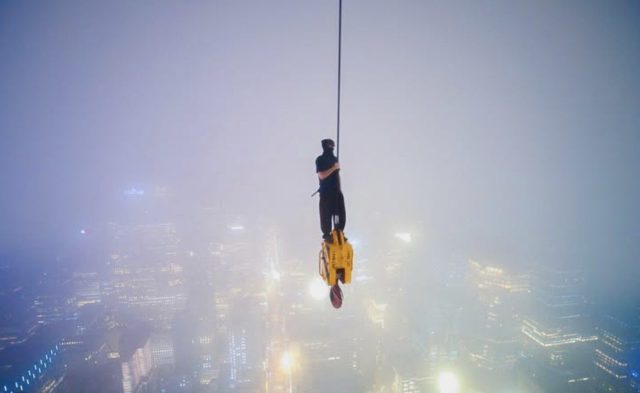
A legendary urbexer on a Manhattan construction crane. Credit: @jnkzzs





On Monday afternoon, a 16-year-old boy fell 50 feet down an internal access shaft inside one of the towers of New York City’s Queensboro Bridge, the 350-foot-tall behemoth that links East Midtown Manhattan to Long Island City, Queens. The teenaged boy was the victim of what local news sources called a “social-media challenge” or “TikTok stunt” gone awry. He’d been with a group of friends who were filming the exploit, and who fled the scene without calling for help for fear of getting arrested — though, naturally, they also immediately posted video of the accident to social media.
In one video that circulated on Instagram, the fallen teen’s foot can be seen, and a voice can be heard saying, “He dead fell.” In another video, described to UnHerd by a teen who saw it, the fallen boy “was pleading and groaning and making all these noises. You could see blood all around the shaft.”
It was only three to four hours later that news of the incident filtered out widely enough into the New York teenager ecosystem that someone — members of a group chat to which the videos had been posted, a teen familiar with the situation told UnHerd — called the police.

What transpired next was a high-wire search-and-rescue, a video of which is posted on the Citizen App Instagram page. The teen, whose limp body can be seen being lowered in a harness along what looks like a guy-line, was taken to a Gotham hospital. He reportedly has hypothermia, among other presumed injuries, and is in critical but stable condition.
Comments on the shaft-boy rescue video on the apps are predictably ghoulish, along the lines of: he got what was coming to him, lol. But both this view and the characterization of the event as a “social media stunt” miss some truths we should be more aware of about what’s going on with the kids, and why they’re pursuing the hidden-in-plain-view subculture of urbexing, short for “urban exploring.”
In brief: climbing the bridges, scaling the roofs, traversing the construction sites and exploring the abandoned buildings of our great, sweeping and majestic city is dangerous, yes, but also breathtakingly ballsy and cool. The young men doing it are demonstrating nerve, daring, incredible physical prowess and at least the raw material of manly virtue.
If you spend any time on Instagram accounts devoted to urbexing, you will soon be made aware that while the accident was a one-off, there are probably teenagers climbing the Queensboro Bridge every night. This suspicion was corroborated by two frequent urbexers I spoke with, both of whom wished to remain anonymous. (What they do is illegal, since it requires them to trespass, break and enter, and often vandalize property in the process.)
The Queensboro Bridge is the easiest of Manhattan’s major bridges to access, my sources said, precisely because of the convenient interior ladder in the towers. Both told me they’ve climbed that bridge repeatedly, and one had recently had a scare from running into another group of kids (“going up to smoke a big blunt”), coming in as he and his friends were going out. The same source, a 14-year-old public high-school student from Brooklyn, had climbed the Manhattan Bridge early Monday morning, the same day as the other teenager fell.
Urbexing is attractive, the 14-year-old told me, because the city is like a wilderness and can be explored with the nearly unlimited potential of public transportation. He likes it because “you see the city in a way most people never do.” Most people, in his view, never see most of the city — they don’t see its bridge stanchions and scaffoldings, its hoppable fences and poppable doors, its unguarded lobbies, its construction sites and roofs. This teen provided me with a Google document he’s compiling on the practice, which he hopes (somewhat naively) to someday use as the basis for a college-admissions essay.
“Urban exploring,” the essay reads, “is a diverse community of people who illegally trespass and explore rooftops, subways, abandoned buildings, and city facilities.” To do it, “one must find a spot they want to hit” and find a way to enter and exit. “Many different entrance methods require climbing, crawling, running, pretending to be someone you’re not, deceiving, and more rigorous tactics.…”
The other teen, a 17-year-old public-school student from Manhattan, told me that he’d gotten into urbexing when he was 12 years old, starting with what he called “local abandoned spots” that are easy targets, like “the abandoned school in the East Village, right around Tompkins [Square Park] and whatnot,” and then moving on to spots that are “harder to access.”
The 17-year-old described the appeal of urbexing. Above all, he said, it’s about the rush. “A lot of things in today’s day and age are so dull,” he said. He has been admitted to college, and says that “getting good grades is a necessity.” However, he feels that his mental acuity, even more than his physical strength, has been enhanced by pushing himself consistently through fear and danger. “I’m aware that my body is physically capable of doing all the things I want to do,” he says, “but it comes down to a mental thing … you have to believe you can do it.”
The fear, he said, becomes “an enjoyment factor.” And learning to master it teaches you “to be peaceful and stay in control in tense situations.” He acknowledged that urbexing is dangerous but explained that part of his self-training is to be “alert,” aware of the boundaries of risk, and careful to avoid them. (Both teens I spoke with eschew train-surfing as too dangerous, though these are also popular forms of urbexing. Sixteen teens have died trying to ride the top of moving trains in New York City since 2023, ten of them boys.)
And there’s also the sheer glory of it, visible in the photos and videos, terrifying and illegal as they are. The 17-year-old told me that if he lived in the countryside, he’d climb mountains, trees, “everything.” The 14-year-old described the views from the bridges and roofs he’s explored as “so beautiful.”
Maybe what these boys are doing is stupid, but it stops seeming entirely so when you listen to their reasoning. Young men have always sought to hone themselves with risk and challenge — and that’s a good thing. The bravery of the bonehead demographic has been useful to the rest of us, too. Hunting a mammoth? Stupid. The first man to set off in a flimsy little piece of wood to see what was on the other side of an unknown body of water? Very stupid. Obediently marching off to war? Fighting fires? Noble, but “stupid.”
In an urban nanny-state where most aspects of a young man’s existence are ruthlessly circumscribed, it begins to seem admirable that some find a way to encounter real danger. As a parent, I don’t want my child to urbex, but sometimes I believe that it’s a better choice for boys than sitting at home isolated, playing video games or obediently feeding AI-slop assignments into the AI-slop machine. Boys, especially, have had their language, their behavior, the way they play, and the way they move their bodies ruthlessly policed since earliest childhood, both at home and at school. So on the glittering tops of skyscrapers, and on cranes of midtown, and on the bridges and in the tunnels, some are slipping the leash.
One of the cruel comments on the video about the 16-year-old who fell on Monday suggests putting young men on actual leashes. User @mz_petty_cashflowlanez epitomizes the safetyist mentality with the remark that “maybe adult leashes are needed at this point. An AirTag in clothes could save lives.” Her justification is that “people are dying” because of the ambulances delayed “on these type [sic] of calls.” The contempt for youth and masculinity is staggering.
What happened on the bridge on Monday was a tragedy, of course. My 17-year-old source, who was of the opinion that the ladder where the accident occurred is “not hard at all,” also remarked that on Monday, the weather was “wet, sunny, and all the snow is melting … it’s possible that if your hands were cold, you could lose your grip and you just fall.” He also pointed out that, especially with train-surfing deaths, the role of drugs has been underreported. “A lot of those kids have carts [electric weed pens] on them,” he told me. “I’m convinced a lot of the people who fall are also extremely fried.” Most people, he thinks, really shouldn’t urbex.

Worse, though, in his mind, is the group of teens on Monday who left their friend and didn’t call the police. The New York social-media urbex ecosystem has turned against them. “Those people that did that aren’t respected at all anymore,” the 17-year-old told me, adding that they’re being doxxed on many accounts, and it’s not difficult to find out their names. One Instagram post on a video that has now been deleted read: “Whoever leaves their manz deserves to rot, hope y’all get charged to the fullest extent and rot in prison y’all.”
“If you put yourself in that position, you would always want someone to help you,” the 17-year-old said.
He’s right, and it’s a reminder that, while the raw young-man energy that makes these stunts possible is admirable, it’s also a force that needs to be shaped and trained, ideally by adults and other men. In our rush as a culture to limit danger, we’ve also limited the possibilities for the kind of character formation that might have helped the boys in the access shaft on Monday be better men about it. But in a world where risk is forced underground (or very far above it), they’re on their own in the wild landscape, loving it until they aren’t anymore, and climbing until they fall, maybe with an easily obtained weed “cart” in their pocket.
We give them little to do that’s either worthwhile or commensurate with their physical and moral abilities, so they do this. They deserve better.
