




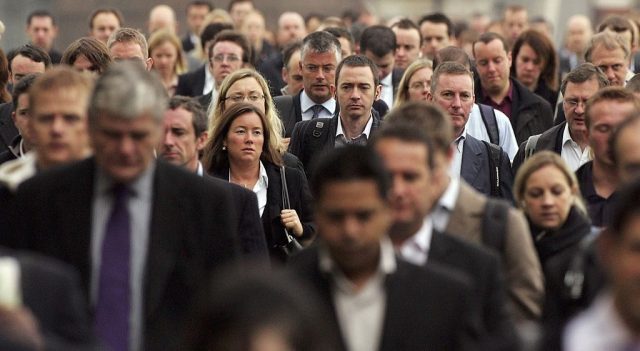
An adjustment in worker expectations is overdue. Credit: Getty





Will AI mean mass unemployment for the middle class? The question is wrongly phrased. In the United States and similar advanced industrial democracies there are two middle classes — the upper middle class and the lower middle class (called “the middle class” and “the working class” respectively, in the UK). The upper middle classes are more likely to suffer job destruction by AI than the lower middle classes — but this is not the sweeping problem we think it is.
Since the mid-20th century Americans have distinguished the “upper middle class” from the “lower middle class.” We can think of these as two lifestyle packages, combining certain jobs, certain homes and neighborhoods, and certain family structures.
The upper-middle-class lifestyle package has three elements: a well-paying job that requires a college diploma, preferably in a large, high-status institution, along with a trophy house in a prestigious neighborhood that functions both as a display room for fancy furniture and a speculative asset. Another part of the upper-middle-class package has been the ability of affluent professionals to delegate care for children and elderly relatives to servants or paid employees of institutions (public, private, or nonprofit).
Contrast this with the lower-middle-class lifestyle package: a decently-paid job that requires only a high school diploma or some additional training and sometimes a bachelor’s degree; a house that is productive; and reliance for care-giving chiefly on family members, supplemented sometimes by neighbors or friends. The productive household might generate some income by being the site of a small business or, with the help of appliances, allow residents to substitute unpaid DIY labor for market transactions, by building, fixing and refitting at home.
The mass middle class that was created in the United States after World War II was a mass lower middle class, not a mass upper middle class. There were various paths of entry into the mass lower middle class, whose members included unionized workers, prosperous skilled artisans, minor functionaries, small business owners and even well-off family farmers.
Neither a college education nor a professional career was required for entrance into the mass lower middle class, between 1945 and the 1980s. In 1960, only 7.7% of Americans had bachelor’s or higher degrees; by 1980, around the time I graduated with a BA, the number was still only 16.2%.
Between World War II and the last quarter of the 20th century, most Americans graduated from high school and went to work and got married and had children. Being part of the middle class was defined not by educational or job status, but by a certain material standard of living, like having a family home, at least one car, and a television that received the three commercial network channels (created in 1970, PBS was limited to big cities and college towns).
Beginning in the Reagan and Clinton years, however, the American Dream was redefined to mean achieving the lifestyle of the small upper middle class — not the super rich, but the most affluent lawyers, doctors, bank executives, corporate executives, and tenured professors. We were supposed to believe that their affluence was the result of their superior skill and merit-accruing academic labor, as measured by tests and rewarded with graduate and professional degrees. And it was true that brain power counted for something. But just as important was the success of the legal, medical, and academic professions a century ago in the 1900s in creating professional associations like the American Bar Association (ABA) and American Medical Association (AMA), which captured occupational licensing in their fields and created cartels that protect their members from fee-lowering competition.
We were also supposed to believe that upward mobility was achievable en masse, through a college diploma. By the 1990s, politicians, corporate executives, nonprofit reformers, and self-interested academic bureaucrats united behind this message. And Americans listened. The number with a BA or higher has exploded from 16.2% in 1980 to 38.7% in 2024. In some European countries the college-graduate share of the population is even higher.
But the higher-ed industry was “talking its book,” i.e. painting a biased and overly rosy picture, when it sought to expand the number of applicants. And business leaders were pretending that stagnant wages were the result of inadequate education and insufficient skills on the part of workers, rather than the offshoring of industry, the flooding of the labor market with cheap immigrant labor, and the near-annihilation of private-sector labor unions. For their part, politicians of all persuasions found that encouraging more Americans to go to college cost little and avoided controversy.
The result of this massive and ill-advised expansion of higher education in the last half century has not been upward mobility, but too many college graduates chasing too few well-paid professional jobs. In 2025, only 19.3% of job postings in the US required a bachelor’s degree or higher, at a time when those qualifications are possessed by around 40% of the population. According to the St. Louis Fed, a year after graduation, 52% of Americans with college degrees are employed in occupations which do not require their degrees; the number after 10 years is 45%. For around half or more of college graduates, then, investing in a college diploma has been a bad decision.
What about the second part of the upper-middle-class lifestyle package — the big trophy house in a prestigious neighborhood? There are plenty of modest houses in unfashionable neighborhoods, cities, and regions. But the Starbucks barista with a useless degree in communications or marketing wants to live in a hip neighborhood in New York or San Francisco or Austin, not in a tract-home neighborhood in Cleveland, Ohio.
The final element of the upper-middle-class lifestyle package is outsourcing the caretaking and domestic roles to unrelated paid caregivers. The rich have always been able to afford to hand off their children and elderly to be looked after by servants or other paid non-relatives, and to delegate household chores to other servants and service workers. Today, however, there’s a “care crisis” in the form of college-educated professionals who belong to two-earner couples, who can’t afford private child care and private schooling. The rich can afford to be generous to Mary Poppins or Jeeves. But the struggling two-earner professional couple typically relies on poorly-paid, largely immigrant female labor to look after the children and keep the house or condo clean.
The point is this: half or more of the college-educated professionals in the US belong to a pseudo-upper middle class, a knock-off version of the actual professional-managerial elite. These wannabes and also-rans have worthless diplomas and jobs which, however honorable in themselves, do not allow them to purchase the homes and lifestyles of which they dream. They have champagne tastes on beer budgets.
This ersatz upper middle class has been overbuilt from the late 20th century until the present. It was unsustainable and bound to collapse. By automating a lot of “knowledge jobs,” AI may accelerate the inevitable contraction. But the decline was bound to come at some point even without AI.
If the half-century experiment in creating a mass upper middle class of college-educated professionals has failed in the US and similar democracies, what is the condition of the mass lower middle class? Current data prove that lower-middle-class neighborhoods and lifestyles, far from being gone with the wind, continue to be as distinct from the professional class as they are numerically significant.
Working-class people of all races are still more likely to be family caregivers or to rely on family caregivers than to rely on paid nannies or institutions. They are likely to live in multigenerational families, a trend that is growing. They have side-hustles and run home-business — in fact half of small businesses are run from a home or began there. And working-class and low-income people are more likely to engage in home improvement projects than the affluent, who hire specialized workers instead. According to a survey last October, more than half of American parents said they would make Halloween costumes for their children from scratch, while four in ten — presumably more upscale — said they would buy them.
For members of today’s bloated and unsustainable college-educated professional class who identify their own real or desired lifestyles with success, all of these traits of what I am calling the lower middle class represent the failure of American society. How terrible, that some children receive low-quality day-care from grandparents or aunts or uncles, instead of from an immigrant nanny or corporate daycare workers or public school teachers. How tragic, to think that some middle-aged people must let elderly parents live with them because they can’t afford to warehouse them until they need round-the-clock nursing care in an expensive, high-quality retirement community. It’s a national disgrace that some high-school graduates still run some small businesses out of their homes, when they might have been salaried college-educated professionals with their own cubicles in office buildings somewhere. Imagine, there are still Americans so deprived that they make the costumes that their children wear at Halloween, instead of buying them in stores.
But the lower middle class may have the last laugh. AI may well wipe out whole chunks of the upper middle class. But innovative technologies may not only spare many people in the lower middle class, they might also empower some.
Computers soon may be able to write wills and diagnose patients and grade papers, causing a mass extinction event for lawyers and doctors and professors. But it will be some time before physical robots are able to replace the “essential workers” who were lauded during the COVID pandemic — nurses, caregivers, first responders, police officers, public and private utility engineers and mechanics.
If you are an executive vice-president of a firm whose work consists largely of convening meetings and sending emails, you may soon find yourself the victim of technological unemployment. But if you run a cookie-baking business from your home, you can already do much of your accounting and tax work with software, while reaching a large client base online. Advances in AI will only accelerate these possibilities.
If you are a middle manager in a large corporation, your job may vanish when many of those you supervise are replaced by computer programs. But if you like to tinker in your garage, instead of doing woodwork with old-fashioned tools you may be able to use 3-D printing and other advanced technologies to make toys, models, artwork, dishes and cutlery, household furniture, musical instruments, and even functional drones.
If you are a banker who evaluates loan applications, you may be replaced by bots that do the same job in less time and without human error. But if you want to rent out a spare bedroom, or rent an unneeded space in your two-car garage, you can do so with the help of Airbnb or other online services.
If you are an academic who specializes in researching archives, your occupation may not be long for this world. But if you want to home-school your children, technology will permit them to take virtual classes, listen to virtual lectures, and have access to first-rate libraries, while learning social skills by playing with neighborhood kids.
If your job as an insurance company apparatchik is to boost company profits by denying coverage to your company’s paying clients, software can cheat sick people just as well. Meanwhile, telemedicine for doctors’ appointments, home visits by nurses, and home-based monitors connected to hospital or medical practice computers might allow your ailing, elderly parent to live with you in your home, instead of being committed to impersonal institutional care.
The obstacles to many of these classic lower-middle-class activities are not technological but legal. Many technology-enabled opportunities can be realized only by loosening or repealing restrictive local government and zoning regulations that bar businesses from being run out of homes, ban accessory dwelling units (ADUs) or “granny flats,” and prevent homeowners from renting rooms to non-relatives.
Today’s YIMBY (Yes in My Back Yard) movement mostly represents the interests of greedy real-estate developers who want to plop down apartments in desirable single-family neighborhoods, and of social-climbing, childless singles willing to be packed like sardines in hip neighborhoods if they can enjoy a cool urban consumer experience in their 20s. What is needed is not replacing single-family neighborhoods with blocks of apartment buildings, but rather eliminating restrictions which prevent sterile, snooty upper-middle-class neighborhoods from being converted into dynamic lower-middle-class neighborhoods, with home businesses and garage craftshops and maybe the occasional chicken in the backyard.
Needless to say, property owners in upper-middle-class neighborhoods would fight these reforms. But there are not enough affluent young professionals in the next generation who can afford the upper-middle-class lifestyle, and there would not be even if the progress of AI turns out to be exaggerated. It is conceivable, of course, that sufficiently advanced technology might lead to truly widespread unemployment or lower wages in most occupations and income levels. But the idea that there is a binary choice between a well-paid job and a universal dole reflects the bias of the professional class.
In a lower middle class or working household, there may be multiple streams of income. There are full-time jobs for some members of the family, side hustles, and rental income, to say nothing of DIY projects that save money, compared to purchases of finished goods or labor. Meanwhile, government may also subsidize a multigenerational household in the form of child allowances and Social Security, as well as means-tested in-kind benefits like food stamps if necessary. In the event of a true robotic jobs apocalypse, it would be easier to incrementally increase these existing government cash and in-kind subsidies to households, in addition to their other income streams, than to provide everyone with a cash stipend or “universal capitalist” investments in stocks and bonds like Tony Blair’s failed “baby bonds” and the doomed-to-fail “Trump Accounts.”
In hindsight, the US and similar industrial democracies took a wrong turn after the 1970s when “middle class” was redefined to mean “upper middle class” rather than “lower middle class.” There is no reason why the post-1945 lower middle class, rather than the college-educated professional class, could not have continued to define the middle class to this day. The silicon chip did not force Western democracies to shower expensive college diplomas on great numbers of citizens who got jobs that do not require them. The internet did not compel people to aspire to move from lively, eclectic lower-middle-class neighborhoods to sterile upscale bedroom communities policed by authoritarian homeowners’ associations. Satellite telephony did not persuade people to equate social status with sitting in an office cubicle emailing memos instead of running a business from the garage or doing DIY projects at home. The idea that from the age of 18 until death in old age, the members of a multigenerational family should all have separate homes was not suggested by a computer program. Far from being determined by technology or economic trends, the failed experiment in ballooning the upper middle class in the last half century was the result of changing fashions, misguided reforms, and the self-aggrandizement of professionals as a group.
Having spent portions of my life in both the lower middle class and the upper middle class, I find the lower-middle-class environment more … well, more human. Born in 1962, I spent the first year of my life in a classic lower-middle-class, blue-collar neighborhood on the east side of Austin, Texas, which has now been gentrified beyond recognition. As an infant I lived with my parents in a studio apartment atop the detached garage behind the small house of my widowed paternal grandmother, a bank teller who made additional income by renting one of the two bedrooms in her home to female University of Texas students. My college-educated parents later moved the family to suburban houses, first in South Austin and then in West Austin. But our family spent a lot of time with my grandmother in East Austin and I lived with her as an undergraduate at UT-Austin.
My grandmother’s lower-middle-class neighborhood was like a tropical savanna teeming with wildlife, compared to the Arctic sterility of a professional-class suburb. One of my grandmother’s neighbors, a high school teacher, spent hours with the woodworking equipment in his garage. Another neighbor was a black lay preacher who supported his prison ministry by mowing lawns. A few doors down was a ladies’ “beauty parlor,” possibly unlicensed, that was operated by yet another neighbor out of her small home. Around the corner was a small grocery store owned by a relative, and one block away was a service station owned by a family friend, where I spent pleasant hours as a child watching garage mechanics repair cars, as my paternal grandfather, who died before I was born, had done. Two blocks away was the black-owned and staffed barbershop where my father in the 1960s took me on occasion to get my Bart Simpson-like buzz cut.
If there was a homeowners association with restrictive rules in my grandmother’s lower-middle-class neighborhood, it was moribund in the 1960s and 1970s. People ran nursery schools out of their homes and rented rooms and put up cars on concrete blocks in the front yard and kept hens and crowing roosters decades before hipsters embraced backyard poultry. In an elite Austin suburb, if you ran a business out of your home or rented a spare bedroom, your neighbors, obsessed with possible declines in the value of their trophy houses as a result of the “wrong sort” coming in and out of the neighborhood, might sue you.
I for one will not lament the shrinking of the oversized upper middle class in relation to the lower middle class. When vacant downtown office towers are detonated and depopulated, university campuses are rented or sold off, and pretentious McMansions rot in the rain for want of buyers, humble lower-middle-class neighborhoods and their denizens will survive — and perhaps even flourish, with the help of advanced technology.