




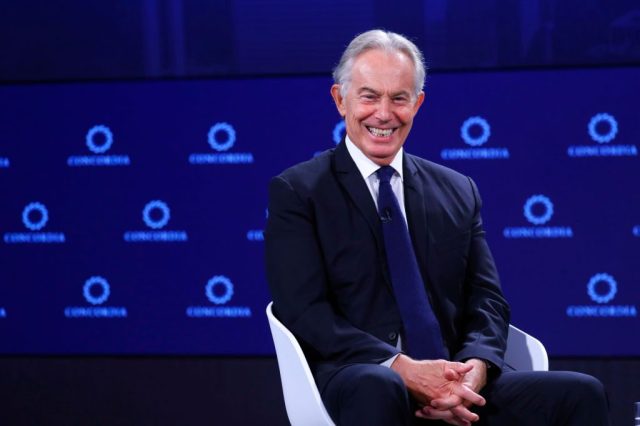
'He seems to think it a happy accident that his interpretation of the Bible has also brought him close to unfeasible wealth and power.' (John Lamparski/Getty Concordia Summit)




At the beginning of the new Tony Blair documentary on Channel 4, Jeremy Corbyn describes its subject as a “man in denial”. This might seem rich coming from the person also known as Magic Grandpa — but as I watched I began to think he had a point. Any viewer hoping for honest introspection will be disappointed. These days Tony Blair seems to have all the expansive openness of Keir Starmer.
It isn’t just his stubborn refusal to accept that he made a disastrous call about Iraq. In general, the man renowned for his likability comes across as brittle and defensive, with an air of irritable weariness in having to explain anything at all. Clips inserted from early in his premiership, reminding us of the Bambi phase — prolonged eye contact, suppressed mirth hovering at the edges of his mouth, a look of being slightly aroused by the attention — only underline his rather hunted look now.
He tells director Michael Waldman he has no interest in psychoanalyzing himself. He professes bafflement about “why anyone would be interested in doing a programme on me”, almost as if, had he not won three consecutive elections for Labour, normalized technocratic managerialism across the UK, and had a seismic influence on the shape of the Middle East, Gordon Brown would have done it all instead. But an explanation for the reticence emerges towards the end of the second episode, when Waldman presses the 72-year-old to be honest about his flaws. Blair says it would not be “very wise as a politician” to admit to any. Protesting, Waldman points out: “You’re no longer a politician!” Blair makes it clear he does not consider himself in retirement.
It is a reminder that his position is not exactly that of a pensioner summoned from the greenhouse to the rare excitement of a television studio. Thanks to his not-for-profit organization — the Tony Blair Institute for Global Change (TBI) — he is still in the thick of things. And presumably the last thing his stellar client list or billionaire investors want to hear is frank soul-searching about the past.
His policy unit attempts to set the agenda for national governments — including our own — on things like AI investment, digital passports, and climate policy. Meanwhile the consultancy wing of the TBI advises foreign leaders and CEOs about how to be more effective. As “executive chairman”, Blair gets a virtual red box every morning, takes private jets to Davos, and has phone chats with presidents. He will soon be attending the inaugural meeting of Trump’s “board of peace”. A confident brand image must be maintained.
With Blair, it’s always all about the future and there is never much point looking back. Luckily for viewers, other interviewees are willing to fill in the psychic gaps. A couple of the women talking to camera seem particularly immune to the Blair charisma. Perhaps surprisingly, one of these women is his wife. “Tony being a very charming person, I think he can often make people think they hear what they want to hear,” Cherie pronounces, with the air of someone who had been there and got the T-shirt. At the end of series, she sums up with brutal finality: “He is an amazing politician. As a husband and a human being, that’s a rather different matter, but that’s really between me and him”.
Clare Short is also perspicuous on her former boss — a “smoothie”. While great strengths lay in his charm and communication skills, “his weakness was the lack of deep thinking, knowledge of history… I think he wants to be a big thinker but that’s not what he is.” Nevertheless, former Cabinet Secretary Richard Wilson suggests this could sometimes be an advantage, allowing him to “solve problems which had defeated everybody else”. On approaching the Good Friday Agreement negotiations, Blair is said to have told Wilson: “I don’t need to know the history, I’m better off if I don’t know the history. You watch, it’ll work”. And it did.
The main thing Blair seems to have grasped about history is that — as he keeps saying — it “goes on for a long time”. He thinks that eventually, the populist revolt against his legacy will fail. “People in these last years have moved against some of the things I stood for… globalization… Britain being in Europe, liberal interventionism… but I remain committed to those things,” he says. “People will come in time to realize there are merits in the position I took”. He clearly sees himself as playing the long game. This might lead one to wonder: who does he assume is keeping the score?
As is well known, he doesn’t believe in Left versus Right, preferring to talk about right versus wrong instead. For some commentators, this makes him “post-ideological”, again making him sound like the prototype for Starmer. But this is to underestimate Blair’s Christianity — or at least, so the documentary has it. The Third Way was really God’s Way all along.
The religion theme emerges in the second episode. His friend Anji Hunter talks of spotting a bible in his undergraduate rooms at Oxford. Blair himself remembers a close friend he made there, an Australian priest called Peter Thomson: “Peter was probably the single biggest influence in my life … I still think about him virtually every day”. We see a clip from an interview with Thomson from 1996, anticipating Private Eye by a year or two, saying his friend “could have easily gone into the church”.
Blair tells Waldman that his intense discussions with Thomson meant “my Christianity and my politics were linked”. Cherie Blair talks of how the vision of “Christ as a radical… who fought for what was right, was something that very much appealed to Tony”. The huge window frames flanking Blair’s chair suddenly look like crosses.
For the novelist Robert Harris, Blair’s belief that “there was a battle for good and evil” made him dangerous as a leader, because “the world doesn’t really divide in that Manichean way”. He partly attributes Blair’s foolish obsession with intervening in Iraq to this presumption; a point which, if made seriously, seems absurd. It is not the mere belief that there is a line between good and evil that invites catastrophe, but hubris about where exactly the line is and what should be done about it. In other words, Blair’s errors stemmed not so much from his Christianity, but rather from his God complex. Or as Northern Ireland Secretary Mo Mowlam once famously put it: “the trouble with Tony is that he thinks he’s fucking Jesus”.
His favorite film, he tells Waldman, is Schindler’s List, because it shows that “you cannot be a bystander… you owe some responsibility to the bigger world”. When ordinary people say things like this, they mean volunteering or making cakes for coffee mornings, but a globalizer tends to think in global terms. Blair’s continuing obsession with the world stage, combined with his apparently scant awareness of any surrounding complexity, is certainly a worry. For he is now unconstrained by democratic processes, cabinet members, or the adversarial parliamentary system. He is therefore much freer to pursue his idiosyncratic vision of the good.
His technocratic bent makes him susceptible to the idea of technology as a benevolent force — a simplistic fairytale told by friendly billionaires looking for credibility and influence. The TBI gets millions in funding from Oracle boss Larry Ellison; indeed, one recent report described the institute as a “sales and lobbying operation” for the multinational tech company. Whether or not this is true, Blair and his employees are now messianic about AI, advocating its use in developing countries, England’s schools, and the NHS, to name just a few places. And there seems to be little sustained consideration of the downsides.
What this has to do with religion is unclear. In the early days, New Labour sounded a lot like Blue Labour does now, which is to say vaguely Judeo-Christian, with an emphasis on individual realizing his better nature in a community. In 1994, Blair himself said that “the individual does best in a strong and decent community of people with principles and standards, and common aims and values”. Over Labour’s time in power, this fairly thick vision of human nature thinned out, placing ever more emphasis on individualism, choice, and the ability to efficiently harness technological “progress” to one’s private ends. At the TBI, the communitarian element appears to have vanished altogether. How are we supposed to develop common aims and values with other people when our main interlocutors are personalized robots telling us only what we want to hear?
Equally, the supposedly important idea of seeking “radical” change in the name of social justice tends to disappear at convenient moments. Instead, Blair urges us to treat technology as a galloping horse we can only harness, not repel. This is how he always frames political decisions he finds exciting, as somehow outside the sphere of human decision-making altogether. European integration, globalization, and now AI: such things are as inevitable as the weather. The actual weather, on the other hand, can be altered by more efficient carbon dioxide removal — and the TBI have a policy briefing on it.
I don’t doubt that Blair is sincere in his beliefs. But he seems to think it a happy accident that his interpretation of the Bible has also brought him close to unfeasible wealth and power. Jesus may have been a radical about social justice, but he was also a figure of huge ambition who sought global relevance. If Blair was able to be honest with himself, he might admit he likes the second part too. It must be quite exhausting to suppress the suspicion about himself. No wonder he no longer seems to like interviewers.

Join the discussion
Join like minded readers that support our journalism by becoming a paid subscriber
To join the discussion in the comments, become a paid subscriber.
Join like minded readers that support our journalism, read unlimited articles and enjoy other subscriber-only benefits.
Subscribe