




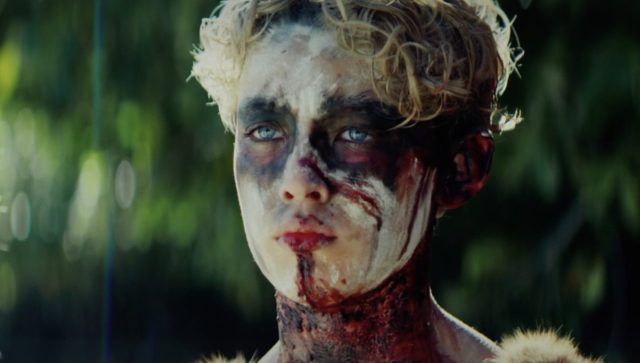
'Jack, the proto-fascist character in Golding’s version, is a hangover from this stiff-upper-lip heritage' (Lord of the Flies, BBC)





William Golding’s Lord of the Flies, currently being dramatized on BBC television, is a novel with a hidden thesis. Like several of Golding’s other novels, it is really about the Fall. A bunch of well-mannered schoolboys end up on a remote Pacific island as the result of an air crash and gradually lapse into savagery. It’s as though the angelic little Oliver Twist were to end up as a drug trafficker. Golding was an Anglican who had been a naval officer in the Second World War, and had witnessed enough horrors to spend the rest of his life reflecting on the darkness of the human heart. The book is an implicit polemic against dewy-eyed believers in progress, reason and the achievements of civilization. It’s a cold-eyed critique of humanism, with its faith in the innate goodness of men and women.
The novel is also a covert assault on ruling-class British ideology. Among other things, it’s a dark parody of R. M. Ballantyne’s Victorian classic Coral Island, in which a group of marooned children manage to pull through by sheer public-school spirit and backbone. Jack, the proto-fascist character in Golding’s version, is a hangover from this stiff-upper-lip heritage, but is one of the first of the boys to surrender to barbarism. Golding saw himself as something of an outsider in British middle-class society and was plagued by feelings of social inferiority. For all its literary renown, Lord of the Flies is an act of revenge on the Establishment.
The anti-humanist thesis which shapes the novel is familiar enough. Human beings are in the grip of dark, primordial powers which a skin-deep civilization is too feeble to restrain. Once that civilized veneer cracks, these malevolent forces will break through and play havoc with our moral idealism. Civilization is just a sublimated form of savagery. All this is a rather vulgarized version of Sigmund Freud’s view of the relation between ego and unconscious. But it’s also an outlook deeply influenced by the history of British imperialism, which involved a confrontation between so-called civilization and so-called barbarism. The most subversive moment in that history is recorded in Joseph Conrad’s Heart of Darkness, in which the imperialists find a mirror of themselves in the so-called natives. The Other turns out to be as close as breathing. The stiff upper lip is a shield against the fact that there’s something sinisterly attractive about the chaos and bloodlust which the “natives” supposedly represent. Mrs Moore, the sensitive, humane middle-aged woman at the centre of E.M. Forster’s A Passage to India, feels the vibrations of meaninglessness emanating from the Marabar Caves and loses her grip on life. Joseph Conrad, a naval officer like Golding, speaks in his novel Nostromo of the imperial project as being as pointless as trying to plow the sea. At the very moment when the colonialists need a robust identity in order to impose some order on a resentful population, they are overwhelmed by a sense of cosmic futility. They can only accomplish this project if they are far from home, but being far from home is also what can sap their faith in the enterprise.
This happens in a different way in Lord of the Flies. The terrifying beast which the boys fear is real enough, but it’s inside them, not out in the ocean or deep in the jungle. In promoting its bleak case about humanity, however, the novel stacks the cards in one flagrantly obvious way. The idea is to show that men and women will quickly revert to primitivism if the pressures on them are sufficiently powerful. But Golding’s characters are not men and women but children. And since children are only semi-civilized in any case, it’s no great surprise that they should take to sticking pigs and smashing each other’s glasses. Boys (even choirboys) will be boys. They will also be adults, but they aren’t yet. What if Golding had put the members of a Yorkshire brass band or a bunch of chartered accountants on the island? There’s no assurance that they would have behaved impeccably, but it’s unlikely that they would have torn themselves apart with such alacrity.
Novelists quite often stack the cards to ensure the results they want. Take, for example, George Orwell’s Animal Farm, a satire of Stalinism. The book shows how swiftly the project of building socialism succumbs to a brutal authoritarianism; but to illustrate the point it uses farm animals, and farm animals aren’t remarkable for their ability to engage in complex social or political operations, any more than children are. If you set your case up in a particular way, the conclusions you’re looking for will fall obediently out the other end.
Golding’s novel is an example of what one might call the Room 101 syndrome. In Orwell’s 1984, Room 101 is where you confront what you fear most, and how you cope with this terror is the ultimate test of who you are. The hero has an understandable aversion to having rats burrow through his cheeks, and breaks under this hideous prospect. He cries out to his torturers to do it to his partner instead, and the guilt of this betrayal destroys him. But why should how you act in a moment of extremity be taken to define who you are? A lot of us would betray anyone at all to avoid our tongue being chewed by rodents, including the odd babe-in-arms, but to claim that this reveals our “real” self is absurd. The extreme doesn’t necessarily define the norm. The belief that to press someone to their limit is to discover who they are goes hand-in-hand with the equally dubious claim that everyday existence is inherently inauthentic. Once you peel it away, you reveal the real thing. Once you put children in a situation where there are no civilized restraints, you find out how uncivilly unrestrained they are.
Jack Thorne’s vividly imaginative recreation of the book for television deletes its religious dimension. The dead parachutist on the islands, presumably the pilot of the doomed aircraft, is referred to in the novel as “a dead man on a hill”, a reference to Calvary, and the role of the child Simon (Simon Peter, Jesus’s right-hand man) is to bring the good news that there’s nothing to fear about it. Instead, he is murdered for his pains, as indeed was Simon Peter. Christianity, however, doesn’t maintain that human beings are irretrievably corrupt, whatever Golding may think. It rejects both the bright-eyed progressive view that we’re naturally selfless and compassionate, but also the sour-faced reactionary case that we’re a bunch of deep-dyed villains who can be saved only by a gratuitous act of divine grace.
It isn’t, however, a question of steering judiciously between these two different viewpoints. It’s rather a matter of grasping that they’re opposite aspects of a single situation. The very powers which allow us to forge genuine progress (healing the sick, feeding the hungry, and so on) are also the powers which enable us to commit genocide. It’s the self-contradictions of the human species which are at stake here. Because we have bodies of a certain kind (laboring, communicative, cooperative, and so on) we can develop technologies far beyond the capability of squirrels. This is why squirrels have no National Health Service, as far as we can tell. But it’s also why they can’t stockpile nuclear weapons. They can’t send vital resources (sacks of nuts, etc.) to less privileged squirrels overseas, but neither can they run secret torture facilities like the CIA.
The liberal tends to hold that once we’re allowed to be free, our better natures will flourish; the conservative believes that only by the strict application of order and discipline can anything morally valuable be squeezed out of our selfish, indolent make-up. Christianity is both a great deal more pessimistic than the liberal and considerably more optimistic than the conservative. The doctrine of the Fall, which has nothing to do with a divinely prohibited apple, suggests that we’re in a sorry mess, as a quick glance around the globe might confirm; but the Christian Gospel also holds that we have a capacity for self-transformation, and that if only we can let go of the present there’s a glorious future in store for us. It isn’t, however, attainable without passing through loss, deprivation, suffering and death, if only in symbolic terms.
For some progressive thinkers, neither world wars were supposed to happen. They seemed to be inexplicable disruptions of a history which had been marching upwards and onwards at least from the Victorian era, or even from the 18th-century Enlightenment. Charles Dickens may have scourged the evils of his age, but he thought it vastly superior to any previous phase of history. For some conservative thinkers, the Holocaust is eloquent testimony to the callowness of this vision of progress. Today, we are fearful about our future, but we tend not to ask whether a species capable of such atrocities really deserves to survive. If it’s finally wiped out by climate catastrophe or nuclear war, might not this simply amount to getting its comeuppance?
We should recall, however, that if a lot of men and women spent their time planning and executing the Holocaust, a lot of others gave their lives to bring the Nazi regime to an end. Besides, if Lord of the Flies is a parable of the darkness of the human heart, then it could give comfort to the malign forces its author fought against a few years before he came to write it. If violence and cruelty are built into our natures, then it might be that our responsibility for torture and murder is diminished. We are, after all, only being faithful to the kind of animals we are. But the Second World War wasn’t the result of human nature. It was the consequence of a complex set of historical factors, any one of which could have been different. There may have been no need for William Golding to give his crew orders to fire on the enemy. And if there hadn’t been, he may not have written the novel now showing on television.