




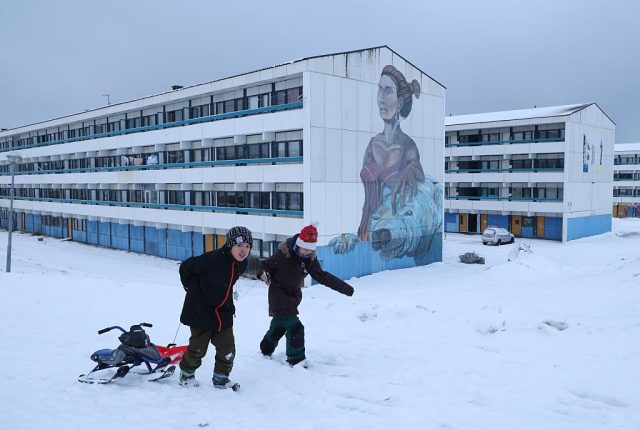
Nuuk, Greenland. (Credit: Sean Gallup/Getty)




On the outskirts of Nuuk, just beyond the airport, a solitary ski slope rises from the scrub and rock. Two button lifts hang motionless in the pale Arctic light. There are no lines outside the corrugated-metal base hut that looks more like a storage shed than the gateway to winter leisure. No fancy restaurants and no sports shops.
It’s not trying to be an Alpine fantasy, and the locals love it. A driver who takes me up there tells me his son used to spend spare afternoons on the hill. Not this year, though, it’s been too warm. They’re waiting for snow.
The silent emptiness up the mountain contrasted strongly with the hubbub below, where a media circus had descended. But even as the world was sent into wild panic over Trump’s fantasy invasion, Nuuk showed little sign of alarm.
This remote, immense, frozen island has become a key locus in the grand narrative about the changing world order. When something is far enough away, too little known, you can make up almost any reality about it and sell it to millions. Distance can be an accelerant for fiction.
In 1991, during the American-led assault on Iraq, the French philosopher Jean Baudrillard wrote a series of essays later collected as The Gulf War Did Not Take Place. He did not deny the bombs or the deaths. His argument was more unsettling: for much of the world, he insisted, the war existed primarily as a media event. The continuous stream of briefings, graphics, satellite images, and missile-camera footage created a self-contained spectacle.
It is hard not to reach the same conclusion about Greenland. The territory is unusually vulnerable to projection. It is geographically enormous and demographically tiny; an Arctic blank space on the map with just enough geopolitical significance to attract big fantasies. It was effectively a closed country until 1953, with a Danish-Norwegian trade monopoly restricting access and prohibiting tourism. As a result, Greenlanders had limited contact with other people beyond the colonists and their systems. Authority and power were concentrated in Copenhagen.
Yet the Second World War opened Greenland up to a degree. American military bases appeared along the coast, and Greenlanders ordered items through major American mail-order firms. Radio broadcasts and newspapers emerged. A growing American presence also increased pressure on Denmark to invest more heavily in Greenland’s development. The result was rapid modernization, which delivered remarkable new amenities even as it triggered a deep cultural disruption for the indigenous Inuit community.
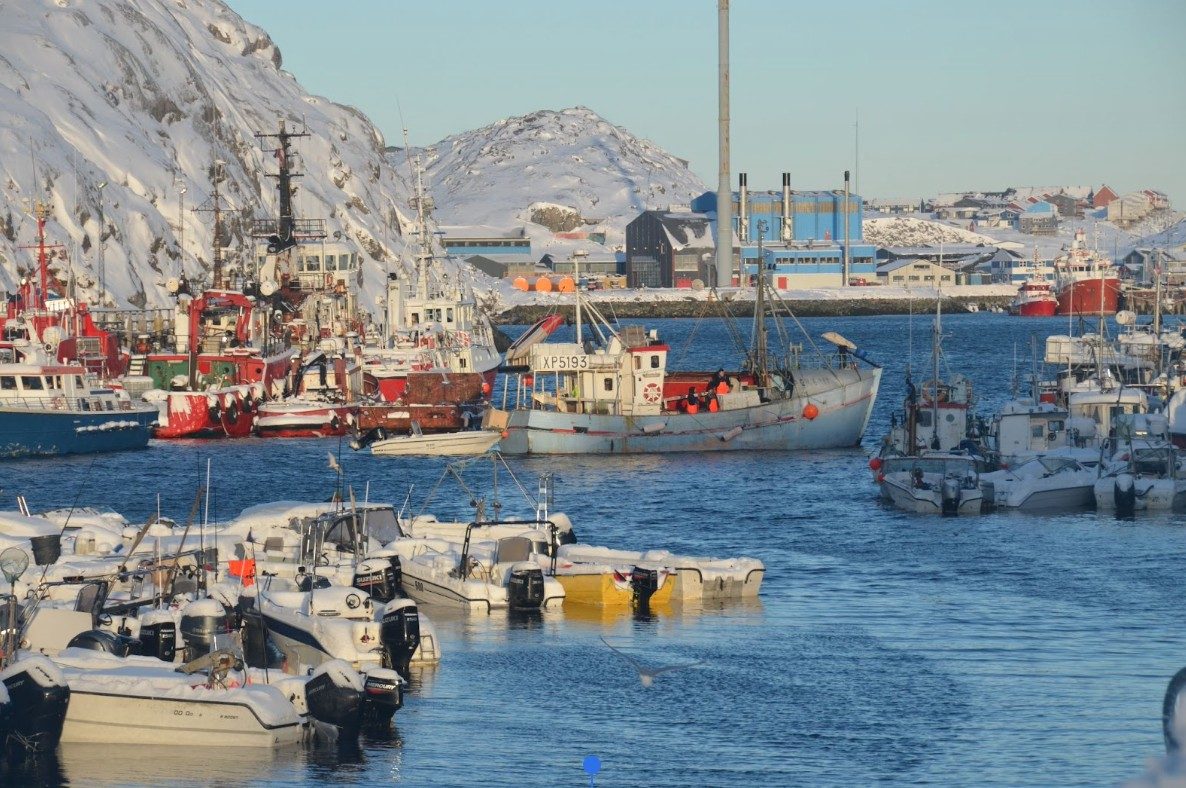
A visit to a small Nuuk supermarket depicts the reality of the island: inside, aisles are packed with exotic goods, all of it, with the possible exception of fish, imported via Denmark. For while Greenland enjoys a certain autonomy, it does so alongside a dependency on Copenhagen for logistics and economic support — annual subsidies are around 4.3 billion Danish kroner, roughly £500 million.
But Greenland’s valiant attempts to turn political autonomy into practical control over its own development are strangled by the long arm of bureaucracy. The island’s grandest project — a mega school — is the most frustrating example of its unshakeable subservience.
Locals talk about the school with a mixture of anger and embarrassment. Impressive and imposing, the beautiful modern building has so far cost around €80 million. It has been in the works for nearly a decade but is unusable because it failed to account properly for European regulation.
In a place this small, a school is more than just a school. It is a declaration about the future: we will grow; we will educate; we will be a substantial community. That Greenlanders want such a school speaks to the positive vision many have of their country: a belief in modern infrastructure, in institutions, in a place that doesn’t have to apologize for being small.
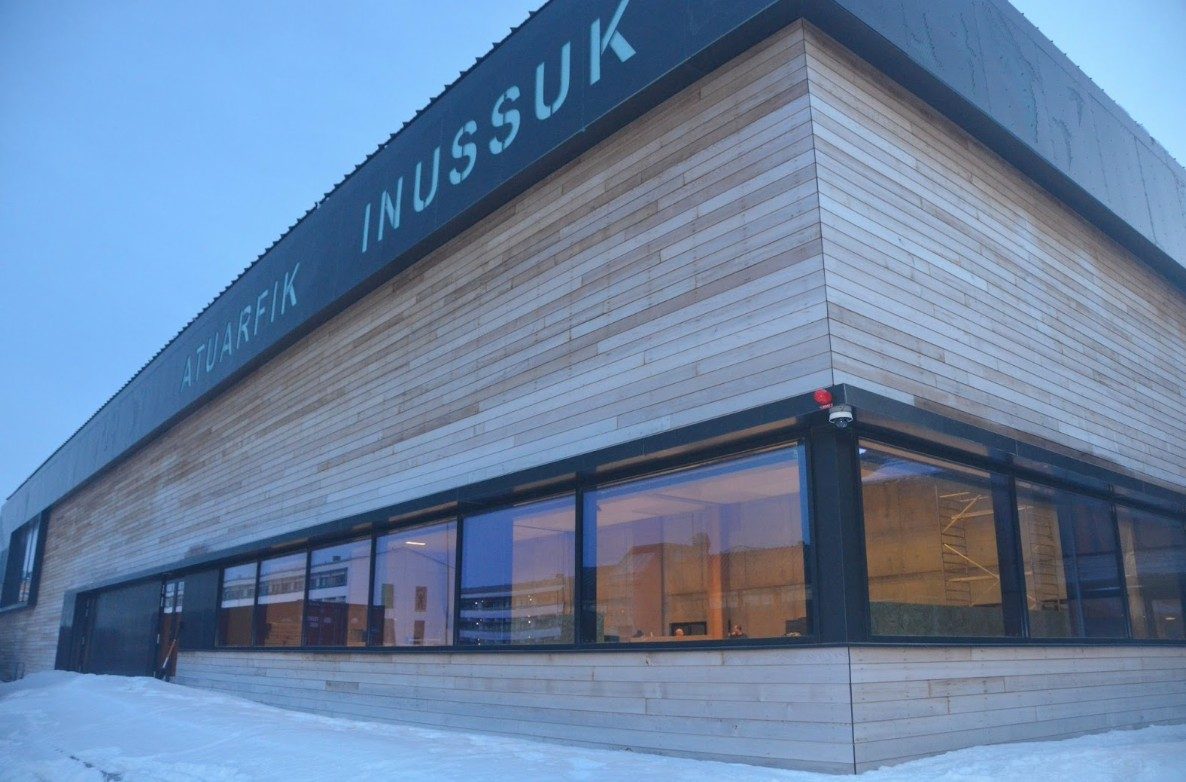
But the fact that it stands as uselessly as the ski slope — its corridors and classrooms ghostly and empty — feeds an alternative, darker local narrative: that Greenland lacks not ambition but capacity; its systems can’t reliably deliver. Self-rule, which Greenland has had since 2009, might seem empowering on paper, but this power is now in the hands of a people with little governance experience. The potential for mismanagement is writ large in the school with no children.
The problem lies in the country’s economic history. As one economist tells me, Denmark is often described as “socialistic” but it thrives because it maintains a workable tension: public planning and welfare on one side, market dynamics and private capital on the other. In Greenland, though, some of Denmark’s more rigidly socialistic impulses were exported — and the island became, at times, a kind of petri dish for technocratic social engineering in ways Denmark itself was not. The result is an economy that grows, but not in a way that consistently translates into opportunity. It lacks the instincts of an advanced market-led economy.
The fragility shows up in the data. Economists expect GDP to grow by just 0.5% in 2025 — barely above the pandemic year of 2020. The slowdown reflects reduced activity on major airport construction projects and weaker shrimp catches, one of Greenland’s main export earners. Cod fishing has helped cushion exports, but the broader picture is of an economy struggling to generate new engines of growth.
Long seen as a future pillar, the tourism industry has been expanding, and publicity from Donald Trump has certainly helped. But Greenland has a short summer and capacity is already near its ceiling. The Economic Council notes that without more flights, hotels, and infrastructure, tourism cannot significantly lift national output. Mining, often presented politically as a path to greater economic independence, remains largely at the exploration stage, with only limited extraction underway. You can see why Trump’s economic approach might appear more compelling to some.
Whether or not you accept his framing, the outcome is visible on Nuuk’s streets: a town where the state is present and functional, and yet certain people remain invisible.
One morning, I see a man sprawled across the steps of a nearby shop. He looks unconscious. He is not dressed for the cold. While two locals hover nearby, uncertain what to do, another outsider and I intervene. We call for help. An ambulance arrives within minutes. The paramedics are calm, unflustered. They lift him onto a stretcher with the practiced composure of people who have done this before. It’s unclear, however, if he’s a victim of substance abuse or a stroke.
The high rates of alcohol dependency and domestic violence compared with other Nordic societies are often linked to the speed with which traditional subsistence communities were pushed into a cash economy and urban housing within a single generation. To be homeless here, in a place where the welfare state reaches so far and winter temperatures can descend regularly to as low as -20°C, feels almost unfathomable. Several people talk to me about what they call a “left-behind” Greenland: people who did not find a foothold in the new economy that followed modernization.
But Greenland’s darkest secret is the degree to which gambling addiction is soaring across the country. Even under Danish regulatory oversight, public-health data suggests problematic gambling affects up to 22% of men and 18% of women — markedly higher than in Scandinavia. Researchers and social workers link this to a mix of factors: rapid modernization that disrupted traditional social structures, long winters and geographic isolation, high unemployment or underemployment in some communities, and the normalization of state-run lotteries that are easily accessible even in small settlements.
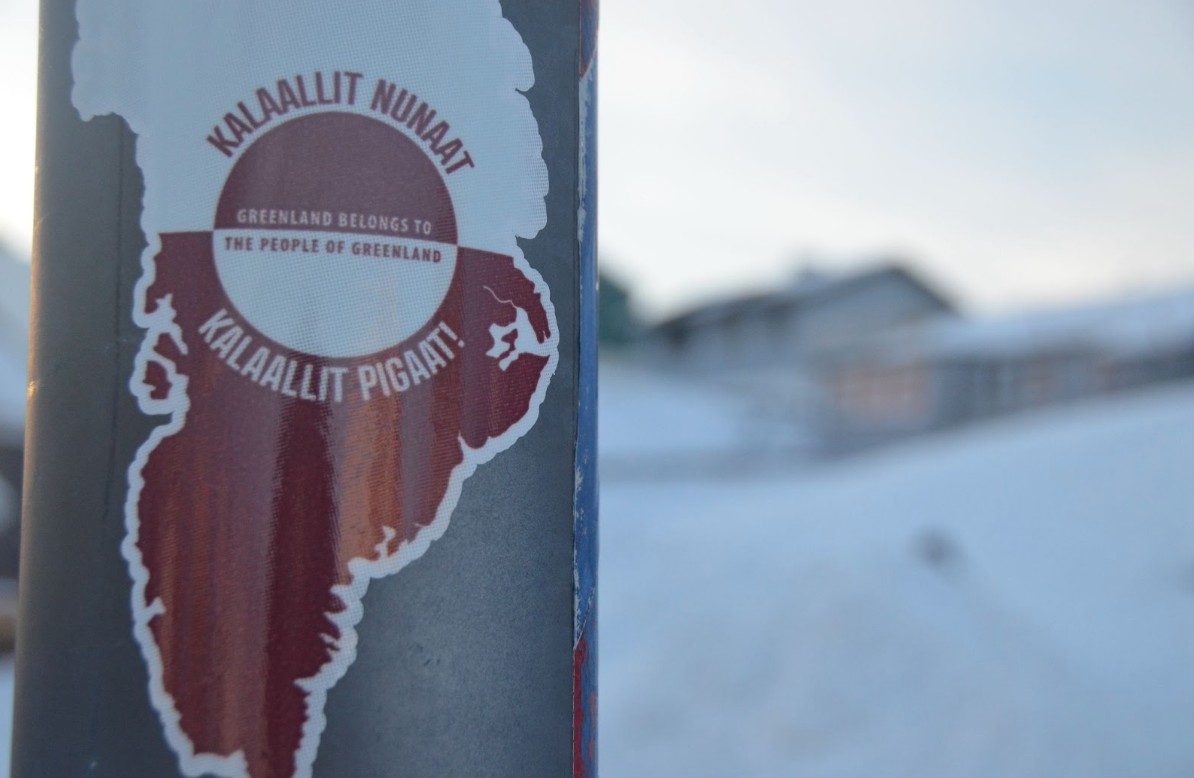
It should come as no surprise that the voters drawn to the most populist pro-independence rhetoric often come from communities that feel they have gained little from the Danish-funded system — or feel diminished by their dependence on it. The appeal is less ideological than emotional.
Representatives of the Inuit Circumpolar Council, which advocates for the communities across the Arctic, frame the debate not simply as one of national romanticism but of Indigenous rights and dignity. They argue that Greenland’s economy was built in ways that prioritized administrative integration over local ownership, leaving communities reliant on Danish funding yet with limited authority over how development unfolds.
“We do not wish to debate which state is better or worse to live in or is a better or worse coloniser,” Sara Olsvig, the Council’s chair, told the press the week I was there. “Rather, we want to debate how we improve Inuit lives, livelihoods, wellbeing, and self-determination across all our regions.”
In that sense, Greenland’s homeless problem and the stalled mega school are not separate stories. They are different sides of the same political coin: a society whose strategic value is rising on the world stage, even as everyday foundations — schools, healthcare, stability — lag behind. The consequences ripple outward: household debt, family strain, and pressure on already fragile social systems.
In this context, it’s not hard to see why Trump’s provocative post in 2019, a picture of a gold-tinted and Trump-branded tower block on the icy Greenland rock, and the caption “I promise not to do this to Greenland”, landed so badly. Critics suspected he was hiding his intentions in plain sight. John Bolton even said it out loud: Trump really did want to build a casino on the territory. The problem wasn’t that it sounded ridiculous, but that it was so plausible. After all, the US had done it before. Indigenous land rights and self-sovereignty in North America have long been entangled with outside interests seeking legal gray zones for gaming empires, with lasting social costs for locals.
The idea that a newly independent Greenland might be steered toward becoming a new offshore Las Vegas or tax haven, welcoming spivs and speculators as fiscal saviors, would follow a well-worn pattern where small jurisdictions push to monetize sovereignty when other economic levers are weak.
In theory, the country’s harsh and expansive terrain, small population, and still-developing regulatory capacity make it highly susceptible to taking shortcuts to economic independence. Moreover, everyone knows Trump’s transactional approach to geopolitics often mirrors his business career: places are assets and leverage is value. The President’s renewed interest in the island is, understandably, stirring fears that Greenlanders may be taken down this darker path.
The risk for Greenland, in that case, is not annexation in the literal sense, but a subtler dynamic in which investment flows become tied to extraction rights, special zones, or deregulated sectors that promise revenue quickly but leave long-term governance burdens at home. The risk, in other words, is of following Iceland’s pre-2008 trajectory, when financial growth outstripped supervisory capacity, and the eventual crash forced the state into years of crisis management rather than easy prosperity.
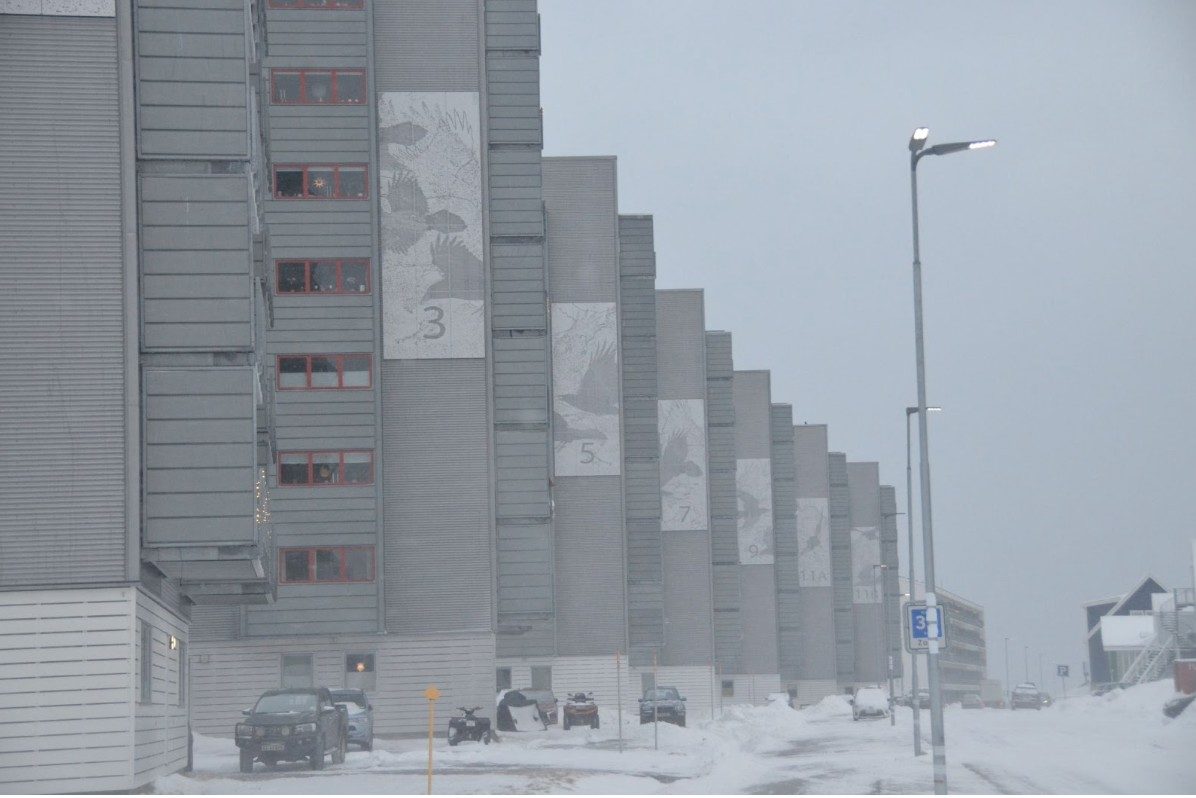
That returns us to the tendency to see Greenland as a strategic object rather than a people. In reality, Nuuk is a place where teenagers play Xbox and kids sledge in the afternoon, where the built environment is utilitarian — blocks and functional forms — and where the weather still dictates the day much more so than ideology.
Even the politics, so often flattened into “independence versus Denmark versus America”, is more pragmatic than outsiders want. People argue, certainly. The independence question is real. There is resentment toward Denmark and a clear historical sensitivity about its rule. But there is also fear about what might happen without Danish subsidies and institutional scaffolding. Alongside populist independence parties whose energy draws significantly from those who feel left behind, there are “remainer” Greenlanders, culturally closer to Denmark, cautious about abrupt rupture. But across the spectrum, what I hear most often is that Greenlanders just want better lives, respect, agency, and investment that works — ideally on their terms, not others’.
Such pragmatism has deep roots in Greenland. Long before Washington, Copenhagen, or Beijing took an interest, the Inuits here believed that there was Sila, the visible world, and Silap Aappaa, the invisible one that shapes it. The words blur weather, mind, and world to create a single idea of balance. The Inuits believe Sila is damaged when the rules and taboos that govern balance in the world are broken.
The ancient concept offers a generous frame for Nuuk’s current social contradictions: modern Greenland is negotiating a new equilibrium between visible systems — Danish welfare structures, European regulations, global supply chains — and less visible forces: cultural memory, historical trauma, spiritual inheritance. Walking through town, past the closed school, the supermarket, the frigid harbor, it is hard not to see Greenland through that Inuit lens.
Greenland’s geography places it between key powers at a uniquely sensitive time. It feels like this island is destined to address a disrupted system by emphasizing rebalancing. Global powers should be mindful that avoiding a catastrophic rupture of the world order probably begins not with buying Greenland, but with allowing Greenland to find that equilibrium within itself.
Join the discussion
Join like minded readers that support our journalism by becoming a paid subscriber
To join the discussion in the comments, become a paid subscriber.
Join like minded readers that support our journalism, read unlimited articles and enjoy other subscriber-only benefits.
Subscribe