








February 24, 2026 - 12:30pm
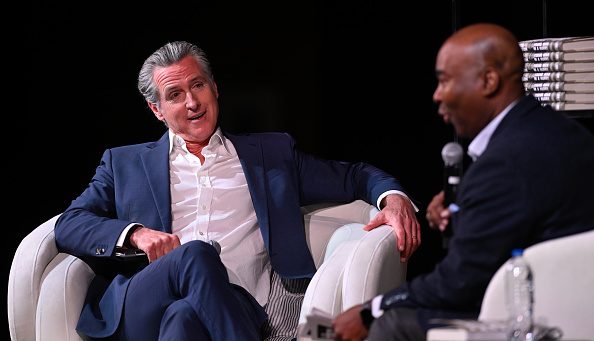
California Governor Gavin Newsom’s casual reference to his low SAT score has stirred predictable outrage, with some accusing him of racism. Speaking to Atlanta Mayor Andre Dickens — who is black — on Sunday, Newsom said that he was a “960 SAT guy” and that “you’ve never seen me read a speech because I cannot read a speech.” He added: “I’m not trying to impress you. I’m just trying to impress upon you I’m like you. I’m not better than you.”
Was he signaling to black voters skeptical of standardized testing, or to white working-class voters resentful of coastal credentialism? That parsing misses a larger question. What, exactly, should a senior Democratic figure affirm about merit and achievement? Regrettably, Newsom’s implicit answer falls short of the mark.
Let me begin with this distinction. There is a “thin” meritocracy and a “thick” one. A thin meritocracy focuses narrowly on neutral rules, blind grading and using the same standards for all. In college admissions, one’s SAT score figures prominently in that assessment. A thick meritocracy adheres to those neutral standards but also worries about the formation of merit — about the schools, families, neighborhoods, and networks that cultivate the capacities we later reward. The thin view says: judge fairly. The thick view says: while judging fairly, do not be indifferent to how people become able to compete. A serious democracy needs both.
But it also needs something else: a clear moral stance that academic excellence is not an embarrassment. Newsom’s obviously performative remarks about his poor SAT scores betray a failure to adequately appreciate this latter point. It comes off as calculating and manipulative.
There is an irony in powerful officeholders performing ordinariness. To govern California — or to aspire to govern the nation — is not to be “just like an ordinary guy”. It is to exercise judgment over budgets larger than those of many countries, to navigate institutional complexity, to make decisions under uncertainty with consequences for millions. Doing this well requires intellectual ability. We do not entrust such authority to people because they are average. We entrust it to them because we believe them to be exceptional.
Democratic equality does not require that we pretend such excellence is suspect. Rather, it requires us to ensure that access to excellence is not monopolized by birth or caste. That is, democratic equality requires a “thickening” of meritocracy, not an abandonment of it.
In recent years, meritocratic language has come under moral pressure. Critics rightly observe that inherited advantage can masquerade as earned virtue. Elite parents buy enrichment; their networks reproduce themselves; thin procedural fairness can legitimate deep structural inequality. All true. But the remedy for these pathologies is not to wink at low standards or to treat mediocre performance as a badge of authenticity. The remedy is to democratize the processes which promote human achievement — to broaden the pipeline of preparation while keeping measures of achievement like the SAT meaningful.
When a leader jokes about a poor test score to signal relatability, he is trading on anti-elitist sentiments. The message is subtle but real: don’t worry, I’m not one of those high-scoring strivers. Yet the same leader relies on experts, credentials, and institutional competence every day. The performance flatters the public while quietly affirming the very hierarchies it disavows.
Worse, such signaling can have downstream effects. In communities where disciplined striving is fragile, where schools are weak and horizons are narrow, cultural cues matter. If our political class treats academic performance as incidental — as something to chuckle about rather than to cultivate for all — that signal will not land evenly across the social landscape.
A mature democratic rhetoric would sound different. It would say: I struggled, I learned, I grew. It would affirm that standards matter, that disciplined effort is honorable, and that excellence in public service is indispensable. And it would couple that affirmation with a commitment to widen the conditions under which such excellence can be achieved.
Democracy levels opportunity, not aspiration. We are to be equal as citizens, not identical in accomplishment. A republic confident in itself need not sneer at achievement to honor the dignity of ordinary people. It should instead insist that excellence be worthy of trust — even as it is made more broadly attainable.

Join the discussion
Join like minded readers that support our journalism by becoming a paid subscriber
To join the discussion in the comments, become a paid subscriber.
Join like minded readers that support our journalism, read unlimited articles and enjoy other subscriber-only benefits.
Subscribe