




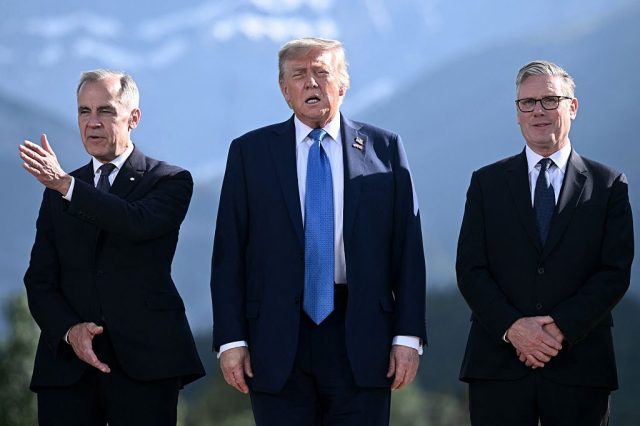
'This is not sovereignty. It is the performance of sovereignty while accepting subordination.' (Credit: Brendan Smialowski / AFP via Getty Images)




In 2018, during a stopover in Vancouver, the chief financial officer of Huawei, Meng Wanzhou, was detained by Canadian border agents following an extradition order from the FBI. She was placed under house arrest in British Columbia, anticipating transferal to the United States, where she would face charges linked to Huawei’s business dealings in Iran.
Wanzhou, known as the “Princess of Huawei”, also happened to be the favorite daughter of Ren Zhengfei, the telecom giant’s founder. So Canada had detained, and the US intended to prosecute, the heir apparent to China’s most successful technology firm. As her lawyer argued, the then president Donald Trump’s attitude to Wanzhou was “the very definition of ransom”; her freedom would only come as part of an economic deal.
But then, in 2021, Washington dropped the case. Bail restrictions were lifted and a saga which began under the Trump administration ended under Joe Biden. The arrest and detention of a senior Chinese executive had gone hand-in-hand with escalating sanctions on several Chinese technology firms and export controls on advanced microprocessors. The political implications couldn’t be clearer: one part of America’s political class made it personal, another had walked things back.
Five years on, Canada’s relationship with Washington and Beijing has flipped. Last week, Mark Carney paid the first visit to China by a Canadian prime minister in a decade and tariffs on Chinese electric vehicles, a symbol of the country’s technological rise, were reduced from 100% to just 6%. In return, China reduced tariffs on canola oil — a $4 billion market — as well as on a host of other Canadian agricultural products. Travel between the two countries will also become visa-free. Most important of all, Carney views the deal as a boon to domestic manufacturing, driving “considerable” Chinese joint-venture investment in Canada. Unlike its neighbor to the south, Canada has no domestic car industry. Its new partnership with Beijing could change that — besides bringing cheap EVs to the masses.
“We’re recalibrating Canada’s relationship with China, strategically, pragmatically, and decisively,” Carney wrote on X last week. Despite his understated delivery, it is now clear that those words marked a significant change: Canada was positioning itself as the first G7 economy to seize the opportunities and mitigate the risks of a post‑Trump world. Those hazards became starker in the intervening days, as Trump ramped up his rhetoric on the seizure of Greenland. But the Canadian PM’s intent only clarified as Europe panicked. “Middle powers must act together,” Carney said in his barnstorming speech at Davos on Tuesday, “because if we’re not at the table, we’re on the menu.” Unlike the empty grandstanding of Barack Obama, or the rambling theatrics of Trump, his speech was deeply significant — acknowledging the falsehoods that underpinned a now-dissolving world order, while emphasizing the need to build a new era of co-operation.
This shift has never been more urgent. The American President sees the globe in tripartite terms, with Russia and China as fellow apex players to the US — albeit of lesser standing — each deserving their own spheres of influence. Hence his argument for acquiring Greenland, reiterated yesterday, was made in hemispheric terms — this is our continent. He insisted that Canada, and Europe, wouldn’t even exist had it not been for America’s war effort eight decades ago. For middle powers such as Canada, as well as South Korea, the UK, France, and Germany, this poses a challenge: their economic models and diverse security frameworks have long relied on a globalized order that the White House seems intent on discarding.
Carney’s speech was a muscular response to that challenge. “Great powers can afford for now to go it alone. They have the market size, the military capacity and the leverage to dictate terms. Middle powers do not.” In other words, the West’s future — beyond Washington, and particularly for Canada and the nations of Europe — depends on collaboration. Alone, neither Canada, nor any European country rivals Russia, China or the United States. Together, however, they wield remarkable economic — and to a lesser extent, military — clout. Carney was calling forth a formidable fourth force on the world stage.
“When we only negotiate bilaterally with a hegemon,” Carney declared, “we negotiate from weakness. We accept what’s offered. We compete with each other to be the most accommodating.” “This is not sovereignty,” he continued, “it’s the performance of sovereignty while accepting subordination.” Unfortunately, this aptly describes No. 10’s strategy since Trump’s return to the Oval Office. Starmer’s plan to protect British interests was to send the President signed letters from the King, and elevate a close friend of Jeffrey Epstein to the role of Washington ambassador. At no point has the British Government considered anything beyond meek genuflection.
Lofty rhetoric is usually just that — pieties untethered from reality. But in Carney’s case, words are matched with action. Between finalizing the China agreement and speaking at Davos, he also secured a strategic partnership with Qatar. Next: free-trade deals with India, the South-East Asian trade bloc ASEAN, and the South American equivalent, Mercosur.
Who could have imagined that the world’s most polite, apologetic people (yes, even more so than the English) would be the ones fomenting geopolitical upheaval? But if this strategy is bold, it is also pragmatic. After all, China and Russia, faced with measures designed to damage their economies, still generated growth and found new markets. Beijing, despite US import tariffs exceeding 50%, not to mention sanctions and export blocks intended to cripple its leading tech firms, managed to shift its export focus and achieve a record trade surplus of $1.2 trillion, even as exports to America fell by 20%. Russia, having lost access to most of Europe’s energy market after its invasion of Ukraine, pivoted East — and saw growth of 8% in two years.
To those two civilizational powers who turned on a geopolitical sixpence, we can now add the home of ice hockey and maple syrup. Crucially, though, Carney is offering a blueprint that extends beyond Canada’s borders, and its success depends on his country not acting alone. Others appear to be with him already. Emmanuel Macron followed the Canadian’s lead, openly inviting Chinese investment “in some key sectors” to drive growth and facilitate technology transfer. More than vacuous aviator-clad posturing, his speech reflected a long-standing French proclivity for technological autonomy that reaches back to Charles De Gaulle, not to mention that China is a leading market for the country’s luxury brands. In a striking reversal of the early 21st-century status quo, Europeans are now seeking partnerships with Chinese firms — on European soil — to tap their capital and expertise.
So where on earth is Britain in all of this? On paper, we are a leading contender to help catapult the middle powers to a new world order. London is a tier-one global city; we have a permanent seat on the UN security council; we are one of only two European nuclear powers, albeit with missiles leased from the US; and, in finance, AI and the creative industries, the country remains a global force. But Britain isn’t even at Carney’s table, as Keir Starmer scrambles for crumbs at Trump’s feet. Perhaps he lacks the political experience of Carney, or the braggadocio of Macron. But while both accusations contain an element of truth, the key reason is structural. Britain’s political class is more firmly committed to Atlanticism than anyone else, propped up as we are by the crutch of American imperium.
Remember, Britain does not have an independent nuclear deterrent without the consent of Washington. The country’s model of being a center for globalized professional services is more exposed to the peccadillos of this White House than anyone else’s. Ours is the least sovereign of the middle powers. While Zack Polanski recently called for a British departure from Nato, and the expulsion of the 12,000 US troops stationed in the country, a US reckoning might be delivered in response: America is hardwired through Britain, literally, from payment systems to servers, production and work platforms. The global economy, as Carney reminded us in his speech, has been weaponized to suit the interests of Washington. Now imagine the hardships for British business without Visa, Stripe, Google, Meta, Amazon, Microsoft or Apple. Even minor friction with any one of these would come at immense cost to the economy. And what of Britain’s great power characteristics, if not status, without Trident or Five Eyes? A hard break with the US-led order would hurt Britain more than anyone.
It might be painful, but there is no alternative. Trump’s argument to annex Greenland is that Denmark cannot defend such a large territory from Russia or China. Isn’t the same true of the Falklands? Or the British Antarctic Territory? Or Bermuda? What if Trump, or a like-minded successor, unilaterally decides to suspend collaboration on Trident? A French politician once declared it unwise for Europeans to base their security on swing voters in Wisconsin every four years. Why is it any different for us?
Britain, just like Canada, has no choice but to pursue sovereignty through cooperation with other middle powers, becoming that fourth force in global politics — by following the Carney Doctrine. But we can only do this if we can deepen our technological autonomy and improve our infrastructure.
Could we come to an arrangement with China, like Carney? While Starmer is unlikely to ask Huawei to return to the UK and repair the damage inflicted after we banned the company in 2020, an element of cooperation with Beijing could be useful. Why not also harness some of their expertise in high-speed rail or nuclear power? How else can we hope to wean ourselves off America? Of course a measure of autonomy is lost in any transaction with a major power — whether China, Russia or the US. But the former, for now, seems like the most pragmatic option if Britain hopes to reindustrialize.
Alas, Britain’s political elite are terrified of conducting diplomacy like Carney. Economic integration with Europe, and military dependence on Nato and the United States, has atrophied the basic skills of government, which is in large part why the prospect of Brexit terrified them so. Just as the country of Boulton & Watt now manufactures vanishingly little, the nation of Lord Palmerston is unable to secure itself a place in an emerging global order. This is less an issue of competence than a reflection of the fact that nobody in mainstream politics has thought about it for more than a generation. After all, they entered politics during the End of History. Carney’s admission that the “rules-based international order” was a convenient lie will horrify many of his British peers who all own DVD box sets of the West Wing, listen religiously to the Rest Is Politics and worship at the Atlanticist altar.
And yet, despite our precarious situation and inadequate elite, Britain remains a prominent middle power. If any country should be attempting to restore the sovereignty of the wider West, it is us. We shouldn’t think twice about joining France and Canada as a midwife to a world order beyond MAGA, Moscow and Beijing.
“We have no eternal allies, and we have no perpetual enemies,” declared Palmerston in 1848, addressing the Commons about Britain’s response to events on the continent. “Our interests are eternal and perpetual, and those interests it is our duty to follow.” The same is true today regarding a “special relationship” which has left Britain beleaguered. If Canada’s Prime Minister recognizes that, why can’t our own?
Aaron Bastani is the co-founder of Novara Media, and the author of Fully Automated Luxury Communism.
 AaronBastani
Join the discussion
Join like minded readers that support our journalism by becoming a paid subscriber
To join the discussion in the comments, become a paid subscriber.
Join like minded readers that support our journalism, read unlimited articles and enjoy other subscriber-only benefits.
Subscribe