




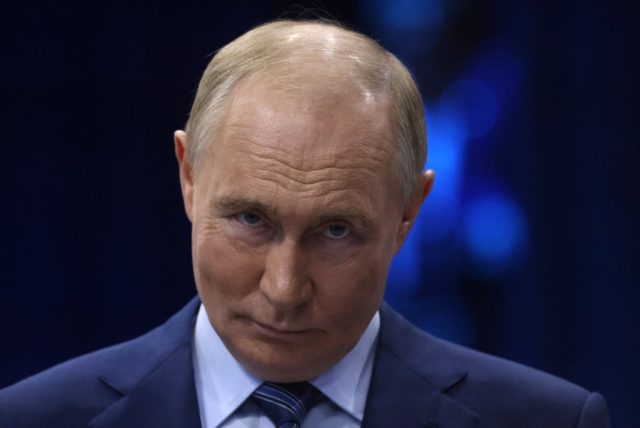
Putin: emboldened.(Contributor/Getty)




The year 2026 could be the first in my life which holds the non-trivial probability of a broader war in Europe: and the risks have just increased. Donald Trump’s incursion into Venezuela, and the arrest of Nicolás Maduro, is the clearest evidence yet that geopolitics has reverted to the Cold War doctrine of spheres of influence. For the US, their priority is the Western Hemisphere. China’s sphere extends to Taiwan, and Russia’s to Ukraine and other parts of the former Soviet Union. With America’s attention elsewhere, and Putin emboldened, the chances are rising that this war will continue.
During the Cold War of my youth, there was always potential for accidental conflict. But America and the Soviet Union were both run by people who were working hard to prevent that from happening. Even in the tensest of crises, diplomacy prevailed.
Things are totally different now. On both sides of the Atlantic, in Russia and across Western Europe, I see a rhetorical readiness for armed conflict on a never before seen scale. “Russia has brought war back to Europe,” said Mark Rutte, the Nato secretary general recently, adding that “ we must be prepared for the scale of war our grandparents and great-grandparents endured.” Meanwhile, the UK’s Air Chief Marshal Sir Richard Knighton said the situation was more dangerous than at any time during his career: “Sons and daughters. Colleagues. Veterans… will all have a role to play, to build, to serve, and if necessary, to fight,” he said. For his part, the head of Germany’s Federal Intelligence Agency has warned that Russia could attack Europe before the end of the decade.
If this war with Russia were to happen, it won’t only be because Trump has motivated Putin, it will also be because we have allowed the situation in Ukraine to spiral out of control. Our support has been a catalog of misjudgments. When everybody draped themselves in the Ukrainian flag in 2022, so-called experts were spectacularly gung-ho about Kyiv’s eventual victory. Retired generals competed with predictions of how fast Ukraine would get the job done — two weeks, speculated one. Well, we are now nearly four years into the conflict and as members of the so-called “coalition of the willing”, we Europeans encouraged Ukraine to fight to the bitter end — without a chance of victory.
It is perfectly plausible now that Russia will end up occupying more than the four oblasts it seeks, and that Ukraine loses its independence. Encouraged by victory, Russia might eventually seek more. Exacerbating matters on the other side, some Europeans now seek regime change in Russia. To quote Kaja Kallas, the EU’s High Representative for foreign and security policy: “it is not a bad thing if the big power is actually made much smaller.”
We’ve been here before. Ahead of the First World War, young Germans and Austrians were also hungry for battle, as many Europeans seem today. The Germans envied their grandparents who fought the glorious battles of the Franco-Prussian War 44 years earlier. Then, as now, the political and military establishment underestimated how difficult war would be.
Yet there is one big difference. Back in 1914, Europe’s armies were in a position to fight. A victory by the Germans and Austrians was at the very least a plausible outcome. Today, it is no longer possible that Ukraine can win the war, nor that Western Europe, without US help, could defeat Russia.
This broader European conflict won’t necessarily be a classic land war. I don’t think Putin has plans to invade Western Europe, as security officials claim. My main fear, rather, is hybrid warfare: airplanes blowing up over Heathrow airport, say; an explosion in a busy German railway station; or perhaps even an underwater nuclear explosion that sparks a tsunami. Brussels, as the home of Nato and the EU, would be particularly vulnerable. And any counter to such a provocation would swiftly escalate.
This is the type of warfare for which we Europeans are least prepared. Western security experts see hybrid warfare as a lower genre for lesser people, like Russians. But it is lethal, and we Europeans are ideal victims. We live in tight spaces. We are dependent on critical infrastructure and technology. And, from the Russian perspective, such attacks would helpfully not trigger Nato’s mutual defense clause. Why invade Estonia if you can create utter chaos in European capitals, all while maintaining plausible deniability?
The UK isn’t unaware of this. In November, the Defence Select Committee warned that the UK Government was moving “at glacial pace” to adopt the “Home Defence Programme”, a new national resilience and security strategy to secure the country against serious risks: including unconventional attacks. But the programme has been delayed for over a year, even as Britain’s leaders are desperate to ramp up the war rhetoric.
It is clearer than ever, though, that our political systems are far from ready for a fight. The UK, Germany and France are all unwilling to pay for the support of Ukraine from their own budget, or indeed raise taxes. This is why they were so keen to use the Russian assets that lie frozen in European banks. Now that Belgium, the country where most of the assets are held, has blocked the heist, European politicians will have to put their money where their mouth is.
The trouble is, their electorates won’t let them. European voters won’t give up their welfare payments to fund a war and polls consistently show a marked lack of support for further financial aid for Ukraine. And please don’t ask them to put on their boots and actually fight for their country.
The irony here is that, whatever their problems, Europe’s leaders see war as a way of distracting from even deeper crises. If peace broke out, for instance, the EU would have to reform its absurd Common Agricultural Policy, redirecting funds away from French farmers towards Ukraine. Continued profligacy would become tougher to defend in other ways. The EU ditched its fiscal rules to make room for more defense spending. Without a war, deficit spending is hard to justify. War is the ultimate excuse for failing policies, keeping dysfunctional governments in power and delaying the moment of reckoning.
Like so many of my generation, I always thought that Europeans had learned from the mistakes of the past — including the oldest mistake of all. As Sun Tzu, the legendary Chinese strategist of war, warned some 2,500 years ago: if you “know neither the enemy nor yourself, you will succumb in every battle.” Unfortunately, we keep on overestimating ourselves and underestimating our enemies. Putin initially underestimated his enemy with an amateurish attack on Kyiv. But he recovered and the Russians are now fighting a well-organized, fully-funded, focused war. And perhaps his strategists would conclude that now is the right time to launch an extended hybrid war against Europe. What has Putin to lose?
Meanwhile, our misjudgments continue. Just as Napoleon and Hitler underestimated the sheer scale of Russia and its freezing winter temperatures, contemporary European politicians continue to discount the economic resilience of modern Russia. The first mistake happened right at the beginning of the war, when we thought we could exhaust Russia economically through sanctions. We fooled ourselves with deeply misleading statistics, according to which Russia’s GDP was approximately the size of Spain’s. But what matters in a war is purchasing power — literally bang for buck. On that metric, Moscow spends more than twice as much as Germany on defense, and far more efficiently. While experts insist that the Russian economy is on the verge of collapsing. there’s no sign of that happening. Similarly, certain international lawyers continue to claim that the sequestration of Russian assets is risk-free. There is a pattern here — one that could yet prove catastrophic in both treasure and blood.
In contrast, the geopolitical realists of earlier generations, such as Henry Kissinger or George Kennan, the legendary US diplomat of the post-war era, had a much deeper understanding of superpower politics. Nobody would have accused Kissinger of being soft on the Soviet Union. But nor was he a trigger-happy war monger.
Back then, the Americans maintained diplomatic channels with Russia. And they didn’t indulge in ritualized virtue-signaling about the rule of law. Their job was risk-management — and they performed it admirably. What is becoming increasingly clear is that the Trump Administration is not in the business of managing risk, but of pursuing short-term commercial advantage.
Greenland may well be next. Its vast, largely unexplored deposits of rare earth elements, combined with its strategic position make it an obvious target. Indeed, Trump has already laid the groundwork both with the National Security Strategy and with the appointment of an envoy tasked with its acquisition. Ownership would dramatically strengthen the US position in the Arctic Sea, a region of growing strategic importance that Europe has largely ignored.
Nor is Canada immune: Trump has already identified it as a security threat. It also happens to sit on 163 billion barrels of proven oil reserves, ranking 4th globally according to the US Energy Information Administration, after Venezuela, Saudi Arabia, and Iran. As the US becomes more dependent on oil for its energy needs, the acquisition of Venezuela and Canada would certainly follow a commercial logic, if not strategic reason.
It’s completely mad, I know. But it reflects a geopolitical reality in which risk is no longer managed and diplomacy discounted. The Cold War world was a safer one, not because the situation was safe, but because adults were in charge.

Join the discussion
Join like minded readers that support our journalism by becoming a paid subscriber
To join the discussion in the comments, become a paid subscriber.
Join like minded readers that support our journalism, read unlimited articles and enjoy other subscriber-only benefits.
Subscribe