




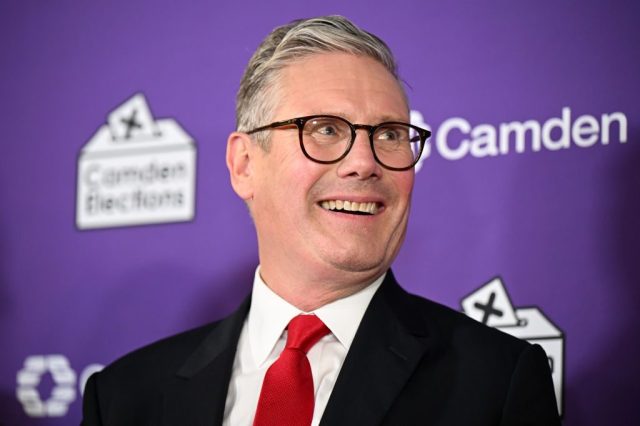
'Local government re-organization could come to define English politics this year — and ease Starmer’s exit from the top job.' (Leon Neal/Getty Images)




If you told me a year ago that 2025 would see more interest rate cuts, reduced net migration, falling costs of borrowing and the abolition of the two child benefit cap, I would have been incredulous. After my initial surprise, I might inquire about the political consequences of both Labour’s electoral base and the bond markets having been placated. Presumably such events played to Keir Starmer’s benefit? Having received a battering in his first six months, things must be looking up for the beleaguered PM.
And yet 2025 was an annus horribilis for Number 10. Entering 2026, Reform now boasts the largest membership of any party in Britain, taking that mantle from Labour last December. All available polling indicates a drubbing for the Government at the next election, with some forecasts even placing them in fifth. One poll by Ipsos declared Starmer the most unpopular PM on record since 1977 — and that includes Liz Truss. In October, another poll, this time by YouGov, suggested Prince Andrew was more popular than the Government.
Why are things so bad for the PM, particularly given the avoidance of a fiscal crisis, and successive interest rate cuts? The first is Zack Polanski, with the Green’s attention-grabbing leader disrupting Labour’s political calculus. The idea of an anti-Reform coalition, pledging to “stop Farage”, only works for the Government if they are the ones to lead it. The second is that first impressions count. Unfortunately for the Prime Minister, he quickly came to be associated with cuts to the winter fuel allowance, gratis Taylor Swift tickets and a party benefactor buying dresses for his wife.
Whatever the explanation for Starmer’s poor performance, it must be tempting for his retinue to surmise they’ve hit rock bottom. That’s the bet of Morgan McSweeney, the PM’s chief of staff, who claims that 2026 will be the “year of proof”. Yet if there’s an iron law of politics, it is that a sequence of bad events creates its own inexorable pull. Just ask Boris Johnson, Jeremy Corbyn and Theresa May. Some other fiasco will likely befall the PM in the months ahead: and it could well involve local government reorganization in England. It has, so far, remained beneath the national radar. That will soon change, as the implications of the shift becomes clear — and more elections are likely postponed.
It is hard to believe that a single report, compiled five years ago by a consultancy, provides the blueprint for the largest reorganization of local government in decades. And yet that is precisely what is happening with the English Devolution White Paper. Published little more than a year ago, it draws extensively from a PWC report of 2020, whose conclusions can be summed up by the phrase “bigger is better”. This is specifically true regarding savings. If all 21 of England’s “two-tier” authorities were successfully merged into larger “strategic authorities”, PWC claims, the taxpayer would save more than £700 million a year.
Insisting on economies of scale is hardly unusual — and the number of two-tier authorities, where some services are administered by a district or borough council, and others by the county council — needs fixing. It’s also clear that larger authorities are better placed to plan ahead and recruit the right people, and if England is to have more metro mayors — which have generally worked — the combined authorities they oversee would need more streamlined, uniform parts.
Even so, the logic’s seemingly brutal application to one of Europe’s oldest nations, and some of its most venerable towns and cities, is striking. Places like Southampton and Portsmouth are set to have a single mayor for instance, despite being two rival cities both dating back almost a millennium. At one point, even distant Bournemouth, whose needs are entirely different, was touted as being in the same mayoral authority. Among the political class, though, the past is often seen as trivial, with place and experience a distant second to the spreadsheet. For them, England’s great towns and cities are as fungible as an NFL franchise.
Alongside that heavy-handedness, a political crisis is also brewing. “Strategic authorities” and “accountability frameworks” may be abstruse terms, part of a purposefully inscrutable lexicon. Suspending elections, however, is an extraordinary step — underscoring that something strange, and perhaps even sinister, is afoot.
Last year, ministers delayed four mayoral elections set for this May. As a result, Greater Essex; Hampshire and the Solent; Sussex and Brighton; and Norfolk and Suffolk must all wait until 2028 to elect their inaugural metro mayors. Reform was competitive in each of those races, and its supporters allege a fix. But despite their protests, the postponement is the result of ineptitude rather than conspiracy. The relevant local authorities had not been given the time, resources or bandwidth to prepare.
Yet if suspending these four elections is bad, the Government has a defense of sorts: these metro mayors are entirely new. The same can’t be said for what is set to happen next. In all, 204 councils, across 21 so-called “areas”, are subject to re-organization. Sixty-three of those councils are set for elections in May: and which Labour now hopes to postpone.
Rather than simply postponing these contests, however, as the Government did for the four mayoralties, it has “invited” local authorities to request delays, which ministers will review from January. In other words, after widespread criticism the first time round, Number 10 is eager to spread the blame in the months ahead.
Unfortunately for Labour, council leaders have so far rejected the prospect of suspending democracy. One example is Hertfordshire, where a cluster of six district and borough councils have stressed they harbor no appetite for postponement. Or there’s Hampshire. Last week, Steve Pitt, Portsmouth City Council’s leader, told The News that there would be no request to delay, saying that “…democracy cannot be interrupted because of the Labour government’s chaotic handling of both devolution and local government reorganization”.
Pitt reflects a consensus among Hampshire’s senior local politicians. That includes Labour-controlled Southampton whose leader, Alex Winning, was eager to highlight how any decision to postpone rested “entirely with the Government”. Labour councils have been left high and dry by the national leadership, with Number 10 trying to deflect some of the blame on them. But on the doorstep, those same councillors will be telling voters the truth: this is Westminster’s mess.
And here, again, it’s hard not to return to history. To the north of Hampshire lies the ancient Saxon capital of Winchester. “Winchester City Council has only ever suspended elections in the event of war or pandemic,” declared its leader, the Liberal Democrat Martin Tod. The city’s modern electoral history began in the 1830s, but it has had a mayor since the 1190s, meaning a continuous process of political representation stretching back almost a millennium. That could be halted this year.
Precisely why Labour would do all this depends on your perspective. While it’s true the party is set to fare terribly this May, most authorities facing the prospect of no elections are not administered by them. At the same time, though, these are generally places where Reform was looking to build on last year’s successes. Then there’s the fact that many of the councillors returned would have to step down before their term ended — because their authorities would no longer have existed. Either way, it’s increasingly clear that merging authorities, and introducing a plethora of new metro mayors, was always going to be hard over a two-year turnaround.
Besides, it’s also uncertain whether the much-vaunted re-organization will even reduce costs in the end. Last year, then-Deputy Prime Minister Angela Rayner declared that “a significant amount of money” could be saved, citing that 2020 PWC report which projected £2.9 billion of savings over five years. And yet the same organization that commissioned the 2020 report, the County Councillor Network, wrote in March how newly enlarged authorities below 500,000 residents would see no financial benefit.
This is important because some authorities — like Brighton — will likely be permitted to remain at around 300,000 residents. By PWC’s own accounting, that will mean no benefits. In which case: what’s the point? And if Brighton were an exceptional case that would be one thing, but it turns out around half the new authorities will be below the 500,000 mark.
Just as remarkable is that the Government hasn’t conducted a cost review of its own, so even the forecast savings remain uncertain. This merits repeating. The financial forecasts behind local government re-organization, something so important that hundreds of millions will be spent up front with elections likely postponed — they simply weren’t made, or indeed scrutinized, by the very Government proposing them.
So who did commission that 2020 PWC report? The County Council Network, which is itself a part of the Local Government Association (LGA), the national body representing councils in England. The CCN’s partner organizations include, you guessed it, PWC.
Indeed, that the Government hasn’t conducted its own review is especially concerning given PWC arguably stands to benefit from the radical streamlining of local authorities. Merging areas like payroll, human resources and IT departments are any consultancy’s bread and butter. The same applies to the inevitable redesign of management structures, rationalization of assets and integrating council services.
At the same time, one might even argue that consultancies such as PWC stand to gain from making any new bodies as complex, and the process as disruptive, as possible. After all, maximal opacity means a greater dependence on outside help — and more billable hours. The consultancy-industrial complex, alongside outsourcing, has, to borrow a phrase, enshittified local government. But the political class has so far failed to catch up.
“Trust in politics is falling,” declares the 2024 White Paper. That is certainly true. But surely not even Keir Starmer thinks the design of English local government should be based on a paper commissioned by a consultancy which stands to benefit from as much disruption as possible?
Beyond the possibility of suspending democratic elections, and there being scant evidence for tangible savings, there is a final, terrifying point to consider. Authorities which run surpluses are expected to merge with authorities running deficits — with little to no financial assistance available from Westminster. Surpluses and reserves will be pooled, as will liabilities.
In other words, some authorities, which have been managed comparatively well, will have a form of austerity imposed on them to provide a soft bail out for those which have not. When ministers talk about “financial scale” and “resilience” what they essentially mean is merging stable, solvent councils with struggling neighbors. Things could go very badly wrong: imagine the political equivalent of RBS swallowing up ABN Amro before the last financial crisis, or Lloyds acquiring HBOS straight after. In some places, anyway, residents and local leaders are concerned that the net result will be higher council tax and poorer services.
Local government reorganization could come to define English politics this year — and ease Starmer’s exit from the top job. But beyond its short-term consequences, not least suspended elections, it also distills so much about our political class: identify a genuine, existing problem; adopt a technocratic blueprint devised by consultants; implement the whole thing with maximum incompetence. We’ve seen it before with the “NHS Programme for IT” and HS2, and will likely do so again with ID cards.
In his masterful Ruling the Void, political scientist Peter Mair claims political elites have retreated into institutional “safe havens”, focusing on governance procedures rather than representation, with this only disconnecting them further from the electorate. But even Mair would struggle to believe that a PWC report could lead to the suspension of elections — all in the name of saving money, even if nobody really knows how much.
Aaron Bastani is the co-founder of Novara Media, and the author of Fully Automated Luxury Communism.
 AaronBastani
Join the discussion
Join like minded readers that support our journalism by becoming a paid subscriber
To join the discussion in the comments, become a paid subscriber.
Join like minded readers that support our journalism, read unlimited articles and enjoy other subscriber-only benefits.
Subscribe