




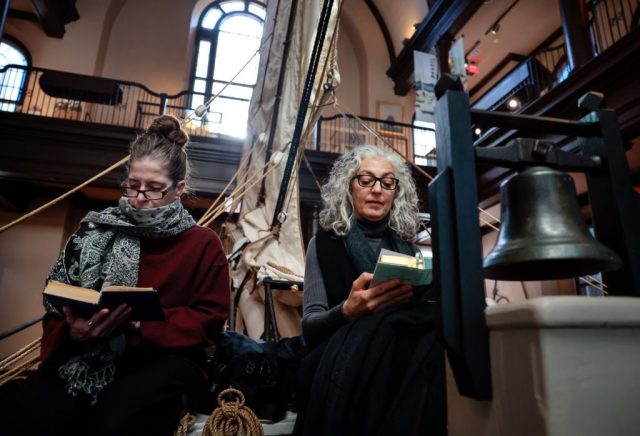
Having a whale of a time. (Craig F. Walker/The Boston Globe/ Getty Images)




Moby-Dick is notoriously impenetrable and impossibly rich. It might be the only novel about which the following two statements are both true: first, that an average reader might need to be forcibly strapped down to finish the whole thing, and second, that if Moby-Dick were all he read for the rest of his life, he wouldn’t miss out on all that much. That might be why the New Bedford Whaling Museum’s annual 25-hour reading marathon of Melville’s classic has persisted for almost three decades.
New Bedford, Massachusetts is the first waypoint of Melville’s protagonist Ishmael on his route to Nantucket and the whale ship Pequod. “Nowhere in America,” Ishmael tells us, “will you find more patrician-like houses; parks and gardens more opulent, than in New Bedford… All these brave houses and flowery gardens came from the Atlantic, Pacific, and Indian oceans. One and all, they were harpooned and dragged up hither from the bottom of the sea.” That is, they were built by whaling. New Bedford has changed a lot since Ishmael walked these streets. Few would describe it today as “patrician-like” or “opulent”, but the modern city’s takeover by Portuguese and Portuguese-speaking (particularly Azorean and Cape Verdean) seafarers resulted directly from the whaling boom of the early 19th century. And inasmuch as Ishmael’s spirit remains, they are the ones who guard it.
This year’s reading began in a museum gallery containing a half-scale model of the whale ship Lagoda, with room for little else. A brave subset of the 3,000 or so souls who would come in and out over the next 25 hours were crammed in — shank to flank, as Tom Wolfe might have put it — leaning against columns, spilling out the doors. Dog-eared copies of the book were clutched or splayed out on the floor, Post-it notes protruding like the spines of polychromatic hedgehogs.
Barely had I taken my own cross-legged seat when the first of 278 volunteer readers, a sonorous baritone, invited us to “Call me Ishmael”. The audience whooped. I scanned the room to size up my fellow travelers. About half looked like current or recent college English majors; about 70% were women. The rest were mostly older adults — both New England lifers and literary tourists. So much for the “end of reading”.
It is rare nowadays for such a varied group of people — they hailed from an array of backgrounds, speaking with a variety of accents — to come together around an artwork so completely foreign to our own time. In her memorable 2002 article “Against Presentism”, historian Lynn Hunt decries the “moral complacency and self-congratulation” that arise from our era’s collective sense of “temporal superiority”. In the two decades since, these tendencies have only grown worse. By the early 2020s, even America’s founding fathers found their achievements minimized or their memorials defaced because they lacked the moral clarity of the 21st-century world — even if their innovations helped build that world.

How extraordinary, then, at a moment when whales are a protected species and women run many of our largest industries, that these readers have dedicated 25 hours of their lives to understanding a man who inhabits an exclusively male world of danger, action and adventure, and who sees whale hunting as the noblest of human pursuits. In her essay, Hunt writes that “respect for the past, with its concomitant humility, curiosity, and even wonder. . . enables us to see beyond our present-day concerns backward and forward at the same time. We are all caught up in the ripples of time, and we have no idea of where they are headed.” It may be that great literature has a power to instill that understanding in us that even great historical writing lacks.
Admittedly, there were moments during the marathon when I sensed the presentist mask reasserting itself. For instance, when Ishmael postulates that perhaps he himself, and not a South Pacific cannibal like his “bosom friend” Queequeg, is the genuine “savage”, a cheer arose from the crowd. A young man behind me tittered: “That’s actually pretty progressive!” as though satisfying 21st-century progressives should have been among Melville’s objectives in conceiving the character of Ishmael.
We moved between venues as we cruised through the book at around 33 pages an hour. I was one of the lucky few to hear Father Mapple’s sermon on the Book of Jonah read out in the tiny Seaman’s Bethel where Melville set it. I squeezed into a pew, peering at the walls of the bethel which still bear the same memorial plaques Ishmael describes, commemorating crews lost in shipwrecks and whaling accidents around the world. Seeing these plaques, meditating on the boundless pain they represent, gave me a greater appreciation of Ishmael’s obsession with the Christian dichotomies of good and evil. Imagining the crew listening to the sermon, comparing themselves with the prophet Jonah, it became vividly clear that he was a way for them to salvage meaning from an unrelentingly dark and dangerous life where death came unannounced and gory.
At around dusk, we reached the most divisive of Moby-Dick chapters: the 32nd. “Cetology” is the first and longest of several chapters in which Melville disgorges his years of research on the biology of whales and commerce of whaling. In a charming display of Melville nerd-dom, the room cheered when the infamous chapter was announced, and gave a little chuckle when Ishmael introduces the chapter’s contents as “almost indispensable” to understanding the novel’s action (“almost” is doing rather a lot of work there).
How easily one forgets that an average American reader in 1851 would never have seen a photograph of a whale, nor had any sense of how to figure out which drawings or paintings of whales were realistic, and which fantastical. Novelists who write of things utterly foreign to their readers’ experience must be very specific. Even so, I overheard one young lady outside yelling into her phone: “Why does he put all this stuff in there if it has no direct relevance to the narrative?”
As night fell, we settled in for the true endurance test — 12 hours of the Pequod encircling the world and Captain Ahab sinking into madness. Through most of the night, the 220-seat theater where these passages were read was full. Couples and groups of friends took turns sleeping and keeping watch. It is funny how tempting it is to slip into nautical patterns of behavior with such engrossing source material to suggest them.
The sun rose. And then, finally, at noon, the words: “Chapter 133. The Chase — First Day.” The focus of one-and-all snapped back from the wandering expansiveness of the open ocean to Moby-Dick’s endgame. A few minutes later, Ishmael was clinging to a floating coffin on a vast disinterested ocean.
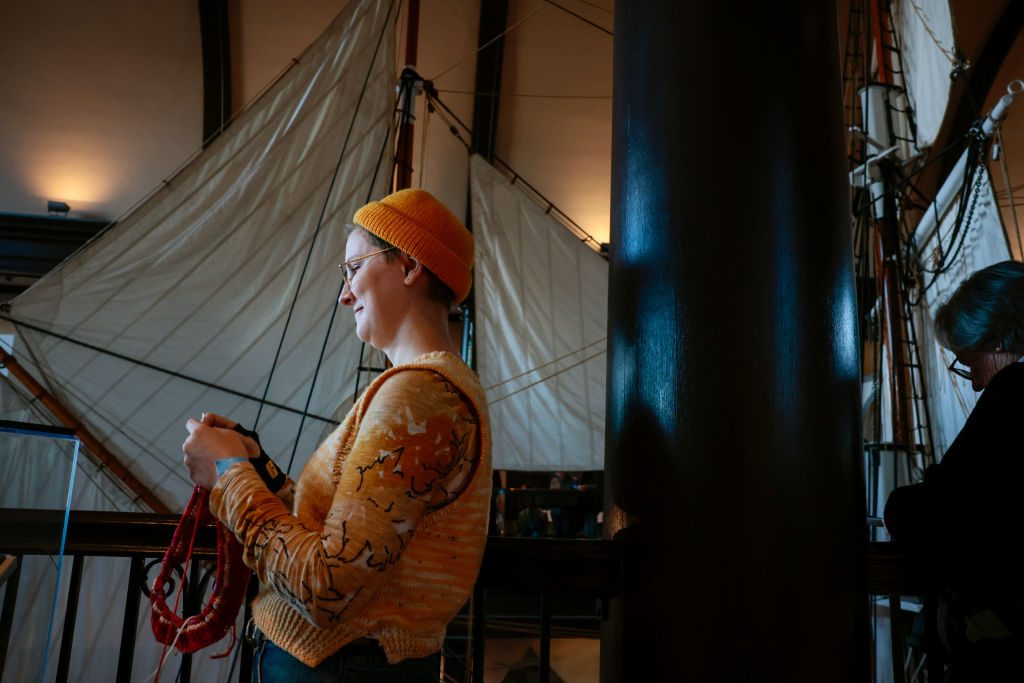
Aside from exhaustion, the prevailing feeling as we filed out of the whaling museum, clutching our marine-themed goodie bags, was bewilderment. Moby-Dick is a bewildering book, all the more when read in a single sitting. This might be because Melville, with his penchant for turning characters into archetypes and ephemeral moments into eternal principles, is writing to persuade all peoples and all eras at once. He seems to speak directly across the ages to a reader in our own time who has asked him a question. We can imagine the young woman at a meet-the-author event with Melville’s ghost at some swell Manhattan venue: Why, she demands, would any sane person voluntarily risk his life to prowl the world’s oceans in a wooden vessel to find, kill, and disembowel huge man-eating monsters and melt their flesh down into lamp oil? And why would they further pledge their allegiance to an even bigger maniac who had resolved to subdue the world’s single deadliest sea monster or else die in the attempt?
Melville knew that even in 1850, such shots across the bow of cool-headed reason demanded a passionate defense. Even among readers living near Melville’s farmstead in Pittsfield, Massachusetts, located multiple days from New Bedford by stagecoach, the whaling life would have seemed utterly foreign. And so, his narrator sets out to make the irrational inevitable: to convince us that for a man of his time, or indeed of any time, there is no work more honorable or more beautiful than whaling. The most unsettling thing about Moby Dick may be that even after we witness the White Whale’s slaughter of all Ishmael’s shipmates, we are still forced to admit that he has succeeded. That we (particularly we men) might never have the chance to live as fully or as deeply as Ishmael did.
When we read a little bit of a book at a time, we have a chance to dismiss or disqualify things that we read out-of-hand, due to their dissonance with our world. One of the chief benefits of reading a work like Moby-Dick in one sitting is the opportunity to swallow it whole — to bring into our minds an entirely different living world — dissonant with our own but rich with eternal knowledge that our world has forgotten.
There’s more in that dissonance than one can process in an evening, or perhaps even in a lifetime. But I take some comfort in the fact that Moby-Dick’s author felt exactly the same way about the ideas he advanced. Indeed, he reveled in the incompleteness of it all. “God keep me from ever completing anything,” Melville writes. “This whole book is but a draft—nay, but the draft of a draft. Oh, Time, Strength, Cash, and Patience!”
Join the discussion
Join like minded readers that support our journalism by becoming a paid subscriber
To join the discussion in the comments, become a paid subscriber.
Join like minded readers that support our journalism, read unlimited articles and enjoy other subscriber-only benefits.
Subscribe