




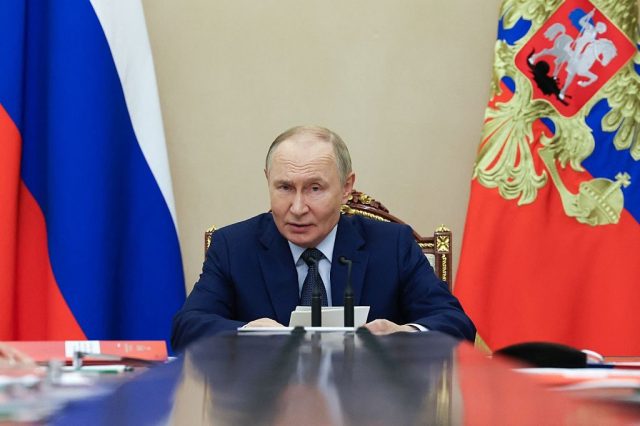
Putin intends to grow his sphere of influence. (Alexander Kazakov/ POOL/AFP/Getty)





As Nicolás Maduro sits in his Brooklyn jail cell, 2,000 miles from home, he may well be wondering if things might have turned out differently. What if he had been born outside the Western Hemisphere, say in Kyiv? If he had, he could be enjoying a quiet berth in Moscow, with a potential return to power on the cards.
Such was the fate of Viktor Yanukovych, the former Ukrainian leader who fled to Russia following his ousting in the 2014 Maidan Revolution, and who would likely have succeeded Zelensky if Putin’s forces had captured Kyiv in 2022. More recently, a comfy retirement was also the fate of Bashar al-Assad, who traded running one of the world’s most brutal regimes for playing online video games and brushing up on his ophthalmology.
Of course, Maduro, Yanukovych and Assad all led very different countries. But in comparing the fate of the Venezuelan strongman with his fellow ex-despots we can learn much about US power in the Americas — and the Kremlin’s willingness to cede it. Just last May, after all, Maduro visited Moscow for the annual Victory Day parade, with Vladimir Putin waxing lyrical about strengthening economic ties with socialist Venezuela. Yet in the end, Putin did nothing to save Maduro, and has remained tellingly quiet on his arrest by US commandos. The comparison with other erstwhile Russian allies couldn’t be starker.
This matters, for it shows how America’s foreign policy revolution dovetails with Russia’s own geopolitical recalibration. Just as Trump has signaled that he’s ready to wash his hands of Ukraine as quickly as possible — for mutual Russian and American enrichment — so too has Putin decided that Venezuela isn’t worth Moscow’s time. And while there may not have been any explicit deal between the White House and the Kremlin, when the dust settles, a Putin corollary to the Monroe Doctrine may likely emerge, with vast consequences across Eurasia.
Russian dominance over Ukraine is far from guaranteed, and Trump has lately been openly frustrated with his counterpart in Moscow. But with the Russians remaining steadfast as ever in their maximalist aims in their invasion, thumbing their noses at any Ukrainian proposal and driving a wedge between an increasingly Ukraine-skeptical Trump and Kyiv’s European allies, the mercurial Trump is unlikely to resist Russia’s ultimatums forever. And whatever form the Ukraine peace deal eventually takes, Putin is sure to come away with the understanding that Trump has taken from Venezuela — that military action in his corner of the world is not only an effective, but indeed a necessary, method of maintaining his sphere of influence in the so-called Russkiy mir, or Russian world.
Reacting to Trump’s attack, former Russian president Dmitry Medvedev was strikingly effusive. “He and his team are very staunchly defending their country’s national interests,” Medvedev said of Trump, adding that as a result of the operation, the US has “nothing to reproach our country for”. For Russian leaders, then, Trump’s actions mirror their invasion of Ukraine not just in form but also in strategic logic — that maintaining a regional sphere of obedient client states through force, and punishing those that step out of line, isn’t aggressive imperialism, but merely guarding a superpower’s legitimate national security priorities.
This logic has lain behind Russia’s geopolitical behavior ever since the fall of the Soviet Union, especially since Putin’s rise to power, and indeed has animated its opposition to Nato expansion and efforts by countries as varied as Ukraine, Georgia and Kazakhstan to break free from Russia’s orbit. As far as Putin is concerned, the biggest problem with the Soviet collapse was not necessarily the end of communism, but the disintegration of Russia’s imperial sphere, and the subsequent lack of clarity over where Russia’s sphere ended and America’s began.
For Russia, the existence of such spheres of influence is as natural as the existence of national boundaries themselves — before the Soviet Union, in the 19th and early 20th centuries, Tsarist Russia held sway over Eastern European countries such as Bulgaria and Serbia, while also enjoying authority in Iran and China. Putin has long seen Trump and his Ukraine peace process as a vehicle to formalize a new division of the world, and regards Trump’s move in Venezuela to be a decisive step in that direction.
He’s right to see it that way. For Trump, Venezuela is not a culmination of his policy in Latin America, but a new geopolitical beginning. While he has never shied away from coercive diplomacy in the region, his pressure campaigns had thus far been primarily economic — bolstering allies like Javier Milei in Argentina, while punishing critics like Colombian President Gustavo Petro with sanctions. Now, though, not only has he deployed the military to advance his interests, he’s unified his agenda under the banner of wholesale American domination of the New World, hinting at military action in Cuba, Colombia, and even Mexico, not to mention ramping up threats against Greenland.
Combined with the US troop drawdown that is quietly but meaningfully underway along Nato’s eastern flank, all this looks like a fundamental recalibration of American priorities, and one that is duly being emulated by Russia. Putin has failed to match his words of support for Maduro with concrete actions — Venezuela’s pleas for military aid in the lead-up to the American operation were apparently met with shrugs by the Kremlin. Not that Maduro should have expected anything else. He may have invited Assad to Moscow, but Putin was nonetheless happy to abandon the Syrian regime as rebels conquered Damascus in December 2024. Why, then, would Moscow stick its neck out for a more distant, even less important partner halfway around the world? As in Syria, Putin is likely counting on the fact that regime change in Caracas will be much less transformative than hinted at by Washington, and that Russia will manage to salvage the bulk of its investments in the country’s oil sector without stepping on America’s toes.
It’s hardly lost on Putin that Trump was able to achieve in Venezuela in a matter of hours what his forces have failed to achieve over four years of war in Ukraine, and at the cost of over a million casualties. More than that, America’s victory in Caracas is likely to have sent a clear signal to Russia: what matters is less US power, but where Trump is willing to deploy it. Zelensky reacted to news of Maduro’s capture by hinting that the US should do the same against Putin. But though it’s entirely possible that the US could carry out such a mission, the new rules Trump and Putin are laying out mean that it never will, and nor will it intervene against lower-level Russian proxies in Moscow’s near-abroad either.
Of course, 19th-century-style spheres of influence are not created overnight, and despite Trump’s desire to dictate terms to his neighbors in the Western Hemisphere, a leader cannot steer the course of other nations through shock-and-awe alone. While Trump has clearly set the groundwork for an American counterpart to the Russian world, it’s likely it will fall to a more disciplined and strategically minded successor to finalize this new American empire. Though self-proclaimed isolationists like Tulsi Gabbard may well object to this seeming bastardization of America First, there are plenty others in the MAGA camp who’d be happy to take this mantle up. Despite their origins outside the movement, JD Vance and Marco Rubio are now both loyal Trumpists, and would have no qualms about cementing American dominance in the Western Hemisphere.
But in opening the door for such a foundational reorientation of US priorities, Trump has given Putin the signal that a thoroughgoing division of the world is right around the corner. This remains true despite the cyclical back-and-forth over Ukraine — Trump’s on-and-off annoyance with Putin is based not on fundamental differences in outlook, but on the Russian leader’s unwillingness to meet Trump halfway, even though both of them understand, broadly speaking, how the conflict’s end will impact geopolitics. Regardless of who ultimately controls the northwestern part of Donetsk Oblast, Russia will carve out its own version of victory in one way or another, and will go on to force the Colombias and Greenlands of its own neighborhood to its will.
As in Iran a century ago, Russia may establish a partial sphere of influence in Ukraine while wielding less direct, coercive influence over Kyiv. That’s likely to be echoed by increasingly kinetic threats against the eastern Nato states, newly exposed to Russian pressure by the great American reorientation. While Russia has lately saved its most dramatic hybrid attacks for Poland, it’s unlikely to try to occupy the country as it seeks to rebuild its old sphere of influence. Estonia and the Baltic states are a different story — with the US retreating from Europe, and threatening to unravel the entire Nato alliance by considering military action against Greenland, a Russian assault on these countries, especially a hybrid one, is no longer the stuff of fantasy. Recent US intelligence findings have confirmed that Russia has never abandoned its dreams of reclaiming Estonia, Latvia and Lithuania after losing them in 1991, and with the resurgence of multipolar spheres of influence where might is right, reestablishing some sort of control over them will naturally be high on Putin’s to-do list after Ukraine.
Elsewhere in Europe, Bosnia and Serbia will be as ripe as ever for Russian retrenchment. Despite already being friendly toward Moscow, Serbian President Aleksandar Vučić has long sought to balance Putin against the EU, but with his political future looking shakier than ever, as the country’s youth turn against him, Russia may offer him a much-needed lifeline — albeit at the cost of Serbia’s European ambitions. Bosnia’s Serbs likewise have long relied on Moscow for support, and the twin earthquakes of declining American power in the Old World and Russia’s ascendancy in Eastern Europe may give them the opportunity to finally unite with Serbia proper.
Further afield, countries like Armenia, which have previously drifted away from Moscow toward Washington, could find themselves handed back to Putin on a silver platter. Yerevan has recently been warming up to Russia, after years of diplomatic backsliding, and in a tell-tale sign of things to come, Russia has been investing in disinformation campaigns in the country. With neighboring Georgia already firmly in Russia’s grasp, Armenian Prime Minister Nikol Pashinyan shouldn’t be terribly surprised if he found himself Maduro’ed in future. In Central Asia, too, another corner of Russia’s traditional backyard, Moscow may have incentives to rein in nominal allies that have started to split from the herd — though with Chinese influence on the rise, Putin may have to establish the limits of his sphere of influence there not with Trump, but with Xi Jinping.
Outside of this near-abroad, much less is clear. Russia, for instance, has been able to weather the loss of Assad in Syria. That’s largely because the political transition there, under Ahmad al-Sharaa, like the one seemingly on the horizon in Venezuela, proved to be much more pragmatic than initially advertised. For one thing, Russia has managed to hold onto its bases in the country in 2025. Yet the question is: to what end? Russia’s Syria bases at this point serve mainly as logistical resupply points for warships and aircraft headed to Africa, where Russia continues to exert influence through mercenary groups like the Africa Corps, a rebranded version of Wagner. Even so, it remains unclear if Moscow will be able to have its cake and eat it too, as it rebuilds its sphere of influence in Eastern Europe, the Caucasus and Central Asia while deepening its influence elsewhere. The answer is probably not, but with a caveat — like Trump, Putin will concentrate his attention much closer to his own borders, all while continuing to project economic and soft power into Africa and the Global South.
At the same time, something else will happen: the emergence of Russia as a wholesale diplomatic sponsor, offering its services as the anti-Western strongman of the world and providing political cover for dictators like it did for Assad until 2024. Already, amid growing protests in Iran, the Ayatollah has made plans to hightail it to Moscow if things get dire, and it’s likely Russia will provide the same service to other state and non-state leaders too. The reason Maduro didn’t get the same treatment wasn’t because Russia was too incompetent to provide it to him — rather, amid the geopolitical realignment underway, the Venezuelan leader was the sacrificial lamb Putin needed to bring his preferred international order into being.
In the days since the Venezuela raid, Eastern European opponents of Russia have sneered at the ousting of Maduro, viewing his downfall as a reflection of Moscow’s weakness. But while Russia may be happy to stay passive in some corners of the world, the country’s neighbors may soon see it toppling Maduros of its own much closer to home — and this time, it will have Trump’s precedent to back it up.
 Michal_Kranz