




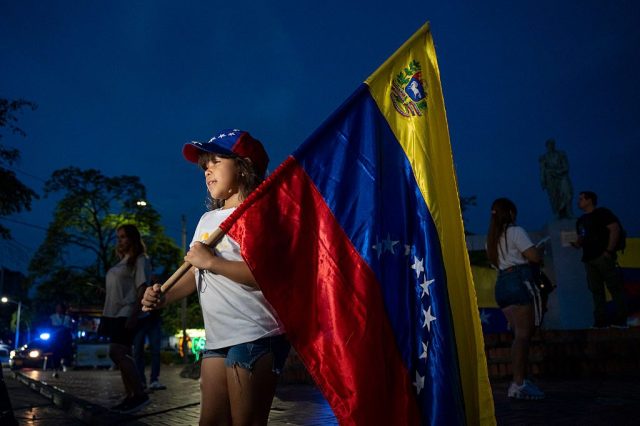
People gather on the Colombia-Venezuela border. Credit: Jair F. Coll/Getty)





Twenty-six years to the day after Manuel Noriega’s surrender in Panama, US authorities executed a spectacular capture of Venezuelan dictator Nicolas Maduro. At 2 a.m., a series of explosions were heard in the capital city of Caracas. Hours later, Maduro was in handcuffs en route to the Southern District of New York, where, similar to the Panamanian strongman, he faces charges of drug trafficking.
The symbolism of the Venezuelan exfiltration op, on the anniversary of Noriega’s surrender, speaks volumes about the Trump administration’s thinking on Venezuela. The conclusion of Operation Just Cause in 1990 delivered a rare success in US-imposed regime change: Panama has since emerged as a vibrant democracy. The same may not be true of Venezuela.
As of this writing, the exact circumstances of Maduro’s capture remain unclear. Members of the Venezuelan opposition claim that the arrest was negotiated with the regime, implying that some of the dictator’s underlings turned against him. Asked at a news conference whether opposition leader and Nobel Peace Prize winner Maria Corina Machado would take power, Trump replied: “They have a vice president, y’know?” and suggested that Machado lacks the popular “respect” needed to govern. But he later implied in an address that Washington would oversee a regime transition and run Venezuela’s oil industry.
A Panamanian scenario the White House might be considering is one in which Vice President Delcy Rodríguez will call for free and fair elections, as a result of which some other figure — perhaps Edmundo Gonzalez, who ran in Machado’s place in 2024’s stolen vote — assumes the presidency. Another alternative is that Maduro’s regime remains largely in place, with Rodríguez and Interior Minister Diosdado Cabello kowtowing to Trump’s oil and deportation demands.
Then there are the dangerous scenarios. Infighting between regime loyalists and the opposition could provoke a prolonged conflict akin to the guerrilla battles and terrorism that racked neighboring Colombia for decades. Even if Venezuela avoids outright state collapse as in Libya or Haiti, Marxist guerrillas and other pro-regime elements are likely to wage an insurgency against an opposition government.
Maduro’s regime is unlikely to survive if Trump follows through on his threats of further strikes should the remnant junta not meet his demands. Opposition from the Venezuelan military and guerrilla proxies could prove resilient to US air strikes, with Rodríguez stating she intends to retain power (though it is possible that she maintains a more pro-American posture than her ex-boss, Maduro). The White House has also shown a reluctance to put boots on the ground. Trump, however, has floated the prospect of funding American support — perhaps even an occupation — through the appropriation of Venezuelan oil.
To be fair to Venezuelans, and Miami neoconservatives like Secretary of State Marco Rubio, it’s plausible that Maduro’s ouster could prove a modest success. A good indicator of a country’s prospects of returning to democracy is a past history of electing and peacefully transferring power. Unlike Iraq, Libya, Afghanistan, or Syria, Venezuela had a relatively strong tradition of continuous (if flawed) democratic government before Maduro’s predecessor, Hugo Chavez, took power in 1999.
Despite years of repression and a grievous humanitarian crisis, Venezuelan civil society remains vibrant. Numerous polls have suggested that majorities in the diaspora are willing to repatriate to a post-Maduro government. Cheering crowds have erupted throughout the country in scenes reminiscent of Saddam Hussein’s downfall in Iraq.
There’s likewise cause to believe that many within the regime voted for the opposition in the 2024 election. For all of his faults, Chavez was an effective populist, in that he always valued his regime’s legitimacy via popular will, expressed at the ballot box. While deeply corrupt, the Leftist icon won all four of his elections fairly and by large margins. This fact brought him to the short-sighted conclusion that his regime could only fall thanks to fraud by his elitist opponents. His government thus instituted a seemingly foolproof electoral process, whereby all participants signed and received electoral tallies with unique QR codes from electronic voting machines.
In 2024, it was these tallies, courageously collected and uploaded by the Venezuelan opposition, that corroborated a likely 40-point victory by Maduro’s opponent, Gonzalez. In the wake of more than 10 years of mass killings, torture, mismanagement, opposition own goals, sanctions. and US-backed coup attempts, Chavez’s regime lost all claims to popular legitimacy under his successor, Maduro. If a future opposition government can retain the loyalty of the armed forces, it’s more likely that a guerrilla insurgency could be contained; elected leaders could then begin to rebuild the institutions that Chavismo destroyed.
Yet there’s enough reason to doubt a happy ending in Venezuela. It may not be possible to ensure a stable opposition government without lasting support from the US military. Unlike Noriega, Maduro’s regime never exercised a true monopoly of force. Rather, it achieved relative peace in recent years by cutting deals with various armed groups on a case-by-case basis. Thousands of guerrillas from the Colombian National Liberation Army, known as the ELN, and FARC dissidents control vast swaths of the country, particularly along the Colombian-Venezuelan border. Both groups have pledged to defend the regime’s “Bolivarian Revolution” and have decades of experience combating security forces, sabotaging vital infrastructure, and conducting acts of terror.
The best model for a guerrilla insurgency in Venezuela comes from the height of Colombia’s Armed Conflict at the end of the 20th century. During the 1980s, ’90s and early aughts, guerrillas and drug cartels conducted hundreds of car bombings, massacred civilians, and even captured the Palace of Justice in the heart of Bogotá. Colombia, however, avoided the kind of economic collapse and inflationary chaos seen recently in Venezuela and has a highly sophisticated military, hardened by more than 60 years of experience in counterinsurgency tactics. Venezuela, by contrast, has an undisciplined and profoundly corrupt military, armed with mostly outdated equipment.
It’s possible and even likely, moreover, that elements within the Venezuelan military will refuse to lay down their arms and carve out fiefdoms in conjunction with criminal and insurgent groups. Even in Panama, it took months to completely quash Noriega loyalists after his surrender, despite the presence of some 27,000 American troops.
Venezuela has more than 10 times the area and six times the population as Panama. In practice, the regime built by Chavez, a colonel, was a military dictatorship akin to Noriega’s and other US-backed regimes in the Americas. Thus, the military is the most decisive facet of the country’s future, with or without Maduro. The regime has more than 500 generals, the most of any country in the world and a means for dividing spoils and coup-proofing its leadership. Any successor to Maduro will confront 500 problems in attempting to extricate the military from its criminal rackets.
The regime’s relative security in recent years via mass repression and symbiosis with armed groups also saw the country’s homicide rate fall to 26 per 100,000 last year, down from 90 per 100,000 in 2016. A power vacuum could portend an explosion in violence amid a truly failed state carved up by various factions. Unlike Panama in 1990, Venezuela has been teetering on the verge of failed-state status since the price of its bulk commodity, oil, first collapsed in 2014. Its economy is roughly four times smaller than what it was during the aughts and is the third most corrupt on the planet after Somalia and South Sudan.
Against this backdrop, nation building will be a tall order.
Whatever is in the cards for Venezuela’s future, the Trump administration should remember its campaign promises and avoid dragging Washington into another forever war, this time in America’s own backyard. Even if chaos doesn’t trigger a mass exodus of refugees, a prolonged military presence will necessarily boost legal immigration, thanks to chain migration through military personnel marrying locals. For all its talk of restoring an American arcadia by way of 100 million deportations, the administration itself has halted deportation flights to Venezuela by repeatedly closing the country’s airspace.
Maduro’s ouster also has significant geopolitical implications. Hours before his capture, the dictator met with a special envoy from Chinese President Xi Jinping. Beyond symbolic statements of solidarity, the Chinese Communist Party almost certainly relayed a message that Caracas, an unreliable debtor to Beijing, was on its own. The harsh truth for Maduro is that he wasn’t worth saving by his preoccupied Chinese and Russian allies.
The “anti-imperialist” leader largely dug his own grave by alienating his most vital regional allies. Chavez spent decades promoting Venezuelan soft power in the region through discounted oil sales. But by threatening to invade and annex two-thirds of Guyana and later Trinidad, Maduro turned once-close allies in the Caribbean into states willing to act as the staging grounds for his own ouster; he also sponsored guerrilla violence against his Leftist neighbor, Colombia’s President Gustavo Petro, for failing to recognize his “re-election.”
At the same time, Trump’s embrace of naked plunder on charges of “counternarcotics” sends a clear signal to the CCP that an equally preposterous pretext is fair game for invading Taiwan. Considering that the president has pardoned dozens of convicted fraudsters and drug traffickers — including former Honduran President Juan Orlando Hernandez, who was indicted by Trump-appointed stalwart P. Kevin Hastel of trafficking 500 tons of cocaine into the homeland—the White House’s war-on-drugs justification stretches credulity.
The message sent to other Leftist governments in the Americas is that they can be deposed at any time and for any reason. Speaking on Fox News on Saturday, Trump suggested that it was the cartels that really run Mexico, rather than President Claudia Sheinbaum: “I’ve asked her a number of times, ‘Would you like us to take out the cartels?’… Something is gonna have to be done with Mexico.”
Then again, if Venezuela deseconds into a true failed state, or if American troops get mired in a South-American Afghanistan, it’s possible that the administration will learn from its mistakes and avoid turning the rest of Latin America into the Middle East. Alternatively, modest success in a post-Maduro state could embolden the White House to bomb neighboring Colombia, Brazil, Central America, and, of course, Mexico, as some MAGA luminaries have always wanted. Never mind the refugees who would then storm the southern border.
For now, Venezuelans can rejoice that their country’s long night of Bolivarian tyranny might be coming to a close. It is to be hoped that the American people’s reluctance to sink into a Latin-American quagmire will ensure that whatever comes next will be on Venezuelans’ own terms.
