




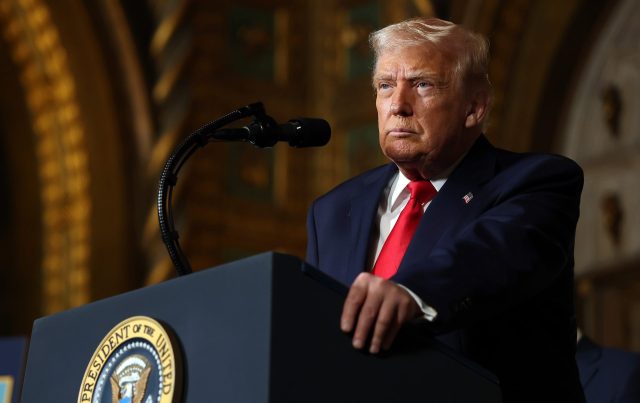
'What does Trump intend to do if not nation-build?' (Getty)




The Maduro snatch was not an easy operation. When the goal is to find and extract two uncooperating individuals surrounded by armed men, everything must work perfectly. It did. And the success of this audacious operation has handed Trump the second military victory of his term. But while the success of the first — the Iran air strike of last June, which obliterated key nuclear enrichment facilities — was achieved by a bombing strike that lasted 37 hours, the stabilization of Venezuela, the operation’s stated intention, could not be accomplished in 37 days, nor even 37 weeks.
For Trump, the Venezuela scenario presents significant intertwined problems. Firstly, his officials must come up with “stabilization” policies to rebuild, or at least patch up, the country’s horribly decayed public services — the result of years of thievery and neglect. Secondly, he must persuade his own followers, who are devoted to the credo of “America First”, that what is going on is not, repeat not, “nation-building” — the infamous military malpractice that ensured the very expensive US defeat in the Vietnam War and, decades later, in Afghanistan.
By stating that Venezuela’s notoriously hardline vice-president would remain in place to rule in place of Maduro, implicitly over an unchanged government, Trump was signaling to his alarmed followers that he was not seeking “regime change” and that the US would not start spending billions to build the government of a new and democratic Venezuela. The only spending that he has so far mentioned is the investment of US oil companies to rehabilitate Venezuela’s long-neglected oil fields and increase their output and profitability.
I was frankly surprised to hear Trump talk of Venezuela’s “immense” oil reserves, rhetoric which not only provides ammunition to anti-American propagandists, but which is also factually wrong. As everybody in the trade has long known, those reserves are only “immense” for practical purposes if the country’s very heavy oil can be extracted — and given that huge investments are necessary to do that, the reserves cannot be profitable unless oil prices rise far above current, or even remotely probable, levels.
As things currently stand, Venezuela can only produce one million barrels a day of oil. If its petroleum infrastructure is rehabilitated, it could quickly double its production. Then, with more investment, it could double it again to four million barrels a day, the level of Iran and Iraq, not of Saudi Arabia, the US or Russia.
Trump’s restraint in letting the regime continue essentially as is — but for an end to its logistic support of Colombian drug shipments to the US and Europe, and to its ties with Cuba, Iran and Russia — is unlikely to last.
Past US attempts at “nation-building” amounted to very costly failures because the task was entrusted to the US armed forces, whose deep and varied expertise did not, and does not, include the techniques of imperial governance. Such statecraft moreover requires the confident assertion of a decisive civilizational superiority — terribly unfashionable these days but the only possible justification for imperial rule.
It was a feat last accomplished by General Douglas MacArthur, from the moment he arrived to rule Japan on August 30, 1945, fully ready and willing to make decisions on anything that came his way. That included the feasibility of Emperor Hirohito’s continued rule, which he emphatically favored, ultimately having his way in spite of global opposition by endorsing the execution of hundreds of captured Japanese officers, which culminated with the 1948 hanging of seven top imperial lieges.
Compare that with David H. Petraeus’s record as US commander in Afghanistan. He thought it wise to piously mumble about the “Holy Koran” in a land ravaged by Islamist extremism — once even in response to the killing of a female Norwegian lieutenant colonel by a mob which had been stirred to action by a state-salaried Imam lying about a Koran burning in Florida.
Venezuela is neither Japan nor Afghanistan, however, but a structurally misgoverned Latino republic, which once nonetheless thrived thanks to its oil revenues that were collected directly by the state, and which once also enjoyed democratic elections, clean drinking water and affluence. Now its people starve as the wealthy elites are in exile and have been replaced by several million Chavistas who do little or no work to collect their wages and benefits as militia members. All the while, disorder appears to be increasing on the streets of Caracas.
What does Trump intend to do if not nation-build? How does he convince his followers of his actual intent? And who will produce the necessary stabilization policies?
What the country needs is rebuilding, and that starts with the economy. The country’s devastating decline began when Hugo Chavez came to power in 1998, quickly replacing capitalist failure with communist failure imported from Cuba. But unlike Cuba, whose only competitive industry is prostitution for hard-currency tourists, Venezuela was always rich in oil. The greatest economic crime that Chavez initiated, and that Maduro completed, was the destruction of the country’s once-admirable state-owned oil company Pedevesa. Before Chavez began replacing its executives and even engineers with his unqualified followers, the company was very efficiently run by a cadre of highly professional petroleum engineers.
It was not enough for Chavez to weaken Pedevesa’s profitability by giving large amounts of oil to Cuba for free: he replaced its executives with his political hangers-on, and then did the same even with its production engineers. Because Brazil’s oil industry was growing during those same years, and because Pedevesa had an excellent reputation, many of its expert employees migrated to Brazil, and inevitably Venezuela’s oil output started to decline, eventually down to one million barrels of oil per day or fewer, instead of three million and more.
When Maduro took over, he might have saved Pedevesa — and his country’s economy — by expelling the Chavez parasites and issuing a call for the company’s veterans to return. Instead, he chose to earn US dollars by using the Venezuelan armed forces to help the Colombian drug cartels send their goods to the US, Canada and Europe by land and sea.
Now the key to Venezuela’s recovery is the return of the diaspora. The wealthy Venezuelan exiles in the Dominican Republic’s La Romana enclave, as well as in Key Biscayne, Florida, and beyond, include highly skilled professionals who are badly needed back home. Yet while they may be celebrating Maduro’s ouster, they are unlikely to return until the country is fully stabilized by others.
The far larger number of very recent exiles — in the millions — who have fled as far as Chile to feed their families are much more likely to return because they have no wealth to live on, nor have they settled down. Facilitating their return with the provision of transport and food is the one thing that the US could do with its military means, along with the implicit threat of more air strikes if the militia prevents the return of the exiles to their abandoned homes. That is all the US can do without a politically and practically impossible return to “nation-building”.
Having seized control of Venezuela, the US must restore the country to working order and do so quickly. Otherwise it will soon exhaust the patience of Trump’s America First followers — who have every reason to be skeptical.
Professor Edward Luttwak is a strategist and historian known for his works on grand strategy, geoeconomics, military history, and international relations.
 ELuttwak
Join the discussion
Join like minded readers that support our journalism by becoming a paid subscriber
To join the discussion in the comments, become a paid subscriber.
Join like minded readers that support our journalism, read unlimited articles and enjoy other subscriber-only benefits.
Subscribe