




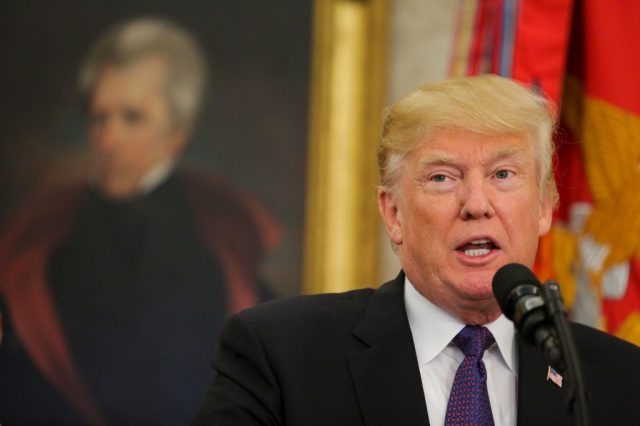
A portrait of Jackson hangs in the Oval Office. Credit: Getty




A waning European empire controls a large, sparsely populated, and naturally promising territory not far from the US homeland. An ambitious American statesman — some call him a despot — insists that Washington must own the territory, lest it serve as a platform for bad actors who’d threaten the security of the United States. Deploying minimal firepower, he takes control of the territory; an enfeebled Europe grumbles but finally relents.
No, I’m speaking not of President Trump’s plans for Greenland, but Andrew Jackson’s military campaigns in Florida that prompted the Spanish Empire to cede the territory to the United States in an 1819 treaty (Florida would become a state a quarter-century later). The historical parallels aren’t accidental. President Trump has long looked to Jackson — America’s seventh president, first national populist leader, and the co-founder of the Democratic Party — as an inspiration.
The Greenland gambit is Trump’s most Jacksonian move. It’s also the clearest sign yet that Washington in the opening decades of the 21st century no longer views itself as the preeminent global hegemon, charged with upholding international rules and disciplining a handful of wayward “rogue states.” Instead, America increasingly sees itself as one power among others, locked in rivalry over land, natural resources, and material security.
That about describes the world in which Jackson, known as “Old Hickory,” operated. Trump and the wider Trumpian cohort have drawn what they see as the necessary conclusions and are pitilessly remaking US strategy to meet this new, old moment.
The shift shouldn’t come as a surprise. A year ago, I attended President Trump’s inauguration and one of the inaugural balls — and was struck by the Jacksonian vibes that gripped Washington. As I wrote in these pages, the second Trump inaugural offered “remarkable similarities” with Jacksonian democracy: the hard-charging nationalism, the anti-elite rhetoric (coupled with solicitude for pliant elites), the pledges of a coming golden age.
One step toward American renewal discussed in those early days was the takeover of Greenland. Such talk struck me as “preposterous” — the word I used to describe it in my UnHerd dispatch from the inauguration. I admit: I really didn’t think he meant it; surely, this was the opening bid in a negotiation that would conclude with Washington securing even better military-basing and mining rights than the existing agreement permits (and the current arrangements are extremely generous).
But under the Jacksonian dispensation, no territory is truly secure without Old Glory planted on its soil. Which brings us to Jackson’s conquest of Florida in the years after the War of 1812. Jackson wasn’t president then. But he was famous as the Hero of New Orleans, the US Army general who’d repelled an invading force of some 8,000 redcoats before news of an Anglo-American peace treaty had reached the New World.
Afterward, Jackson emerged as an irrepressible advocate for the expansion and consolidation of US sovereignty across the North American continent. He found it downright offensive that the Old World powers should exercise any influence nearby. Doubly so when the Europeans conspired with the tribal “savages” — or when they failed, through weakness or neglect, to prevent the Indians from attacking the United States from European-controlled areas.
Spanish Florida presented the latter kind of problem. From it, the Seminole tribe mounted attacks on white settlements in the United States. And inside it, on the Apalachicola River in the northwest part of the territory, a group of escaped slaves had taken over an abandoned British fort heavily stockpiled with arms and artillery. The Negro Fort, as it became known, encouraged resistance to America’s “Peculiar Institution” and invited still more rebels and escapees.
The Monroe administration charged Jackson with suppressing threats along the southern border — but, crucially, without challenging Spanish territorial claims to Florida, unenforceable though they were. But Jackson couldn’t quite bring himself to accept the second half of his orders. And so he both suppressed the threats and took over Spanish forts in Pensacola and elsewhere, diplomatic niceties be damned.
He justified his actions as self-defense against Seminole raids and other threats emanating from Spanish Florida. “The Government of the United States,” he wrote at one point in the campaign, “is bound to protect her citizens, but weak would be her efforts and ineffectual the best advised measures if the Floridas are to be free to every enemy.” Earlier, US forces had already destroyed the Negro Fort, but Jackson’s subsequent campaign in 1818 extended this logic to the broader Florida frontier.
In other words: He believed that so long as the Spanish flag flew on the Florida territory, the American people couldn’t obtain the full measure of security to which they were entitled. And so the Spanish flag had to be removed. And so it was. Jackson’s overstepping of his military authority was initially embarrassing for the Monroe administration. Jackson’s critics there feared that unless Pensacola was restored to Spain, “war would result, the economy would crash, and the administration would be punished by the American electorate,” as the historian H. W. Brands sums up their view.
Outside critics pilloried Jackson’s apparent insubordination and his brutal ways in the campaign, not least his decision to execute two British officers (on the grounds that they had aided and encouraged the Seminoles against America). “We are fighting a great moral battle for the benefit not only of our country but of all mankind,” declared House Speaker (and Jackson arch-rival) Henry Clay. “Remember that Greece had her Alexander, Rome her Caesar, England her Cromwell, France her Bonaparte” — and America its would-be imperial despot, Jackson.
President Monroe returned the Spanish forts, but he refused to censure Jackson on the grounds that pathetic Spain had allowed Florida to become “the theatre of every lawless adventure,” and its rule over the territory was on its way to oblivion. He described it as a place “with little population of its own, the Spanish authority almost extinct [and] in a great measure derelict.” Jackson’s actions, then, merely ratified European weakness, and ultimately led to the full US takeover of Florida through the 1819 treaty negotiated by Secretary of State (and future President) John Quincy Adams. And the town of Jacksonville was so named in honor of Jackson’s military actions in the Sunshine State.
The resemblances to the current controversy are uncanny: the weak empire (Europe); the sparsely populated territory (the 30,000 or so Greenlanders); the Scotch-Irish disdain for European manners (Jackson’s and Trump’s); the threat of third parties endangering the United States through the contested land (China and Russia, in the current case). But above all: the rather expansive view of what it takes to secure the United States and a willingness to use light pretexts to extract lands from states incapable of defending them.
But there is one crucial difference: Most of Jackson’s actions, as a military chieftain and later as president, were either overwhelmingly popular or at least had a base of popular support. That can’t be said for Trump’s Greenland takeover, which is widely unpopular. Still, there is no denying that it is the Jacksonian foreign-policy legacy — both admirable and troubling — that Trump carries with him into the Arctic. “Every man combined with a gun in his hand,” Old Hickory himself wrote, “and all Europe combined cannot hurt us.”
Sohrab Ahmari is the US editor of UnHerd and the author, most recently, of Tyranny, Inc: How Private Power Crushed American Liberty — and What To Do About It
 SohrabAhmari
Join the discussion
Join like minded readers that support our journalism by becoming a paid subscriber
To join the discussion in the comments, become a paid subscriber.
Join like minded readers that support our journalism, read unlimited articles and enjoy other subscriber-only benefits.
Subscribe