




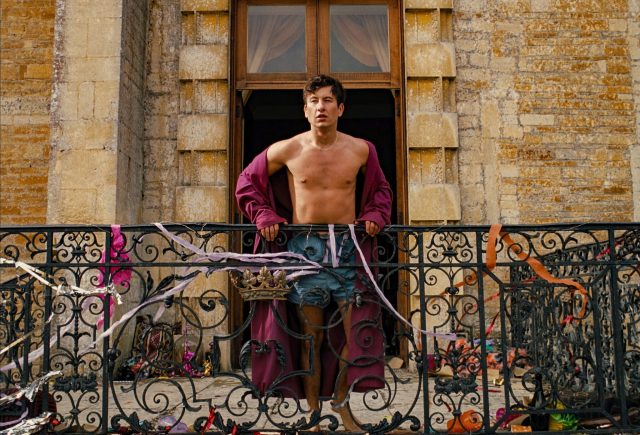
Films like Saltburn (2023) depict Oxford students partying wildly. Photo: Getty





Everyone who has attended Oxford University knows about the sex parties. Many who haven’t been anywhere near the place do too. Oxford is the subject of endless fascination — the setting for movies like Saltburn and books like Evelyn Waugh’s Brideshead Revisited. And even before the image of David Cameron doing unspeakable things to a pig’s head was branded into the nation’s imagination a decade ago, the idea of posh boys and girls doing debauched things in rarefied surroundings made compelling tabloid fodder.
The alleged porcine transgression is supposed to have taken place at the invite-only Piers Gaveston society ball, which since the Seventies has enjoyed a reputation as a highly exclusive party, complete with sex, a litany of class-A drugs, and a fortune teller. It has hosted the likes of Hugh Grant, as well as political elites-to-be — and takes place in a forest where groups can take shelter in yurts, away from the photographers known to stalk outside the event, hoping for a glimpse of someone famous’s son or daughter.
But less well-known and storied than Piers Gaveston, however, are the houseshares. One such example is a 12-room townhouse, initially christened the House of Delphi, which has hosted fortnightly sex parties for the past ten years. These parties were smaller, more frequent, and styled as queerer and more progressive than Piers Gav — an alternative to the elite debauchery of the Bullingdon Club types. Oxford’s ceremonial and self-important bent lends itself to the more formalized sex party.
Delphi has variously been described as a polyamorous community, an “art commune”, a “polyamorous commune”, a space for queer youth to explore their sexuality — and a cult. The house members have actively engaged in their own mythologization, envisioning themselves as the spiritual descendants of Oscar Wilde or Lord Byron, and their orgies as bacchanals; cataleptic trance, epicurean excess. Oxford could never resist the arcane, the sense of ritual, history, and tradition being handed down from one generation to another. In this case, the “house of” prefix is a nod to the trans/drag ballroom culture of the Seventies and Eighties, and the Delphi part derives from the Ancient Greek oracle. (As a Greek, I always found Oxford’s obsession with ancient history amusing). The invitations arrive with little pomp and intrigue; usually in the form of a message on Facebook or WhatsApp.
I never attended any Piers Gav or House of Delphi events, and the sources I spoke to were initially reluctant to share their experiences. Some feared reputational damage, some had signed NDAs, and others retained close networks with current members of the scene.
Many described the parties as being “kind of weird”. Another dismissed Piers Gav as “really lame Oxford shit”. But it was also clear that these events were hugely important to people in finding their identity. Delphi, for one, was an experiment; how can a house, existing largely for the purposes of hosting group sex parties, actually work?
Delphi operated as a houseshare; in signing the lease, you agreed to turn over both rent money and your room for events. The houseshare structure allowed members to share the cost of the parties, and provided a private and intimate space. The houses were run by a sort of Board of Directors, with some alumni staying on in an advisory capacity.
As for the parties themselves, the various floors and rooms in Delphi were designated for different purposes. Much as a nightclub might have an R’n’B room, a cheese floor, and so on, Delphi had rooms for shibari demonstrations, pole dancing workshops, drag shows, dancing, and, of course, sex. It was next door to a houseshare of older nudists, so there was no risk of offending the neighbors.
Everyone I spoke to had developed an esoteric philosophy around these parties and their purpose. It was not merely a soirée, but something more deeply-penetrating than that: a mode of living. “What Delphi is like at its wankiest… is not a house. It’s a community of about 80 people who happen to have lived there at some point or are connected to the house,” said Robin (not their real name; as is the case with all of my interviewees.)
They took care of their own: there were instances when those who were part of the scene found themselves out of a job and unable to pay the rent. Often they were allowed to stay at Delphi, with room and board largely covered.
Jay, a postgrad student, was invited to a liturgical-themed sex party in the early 2020s in an Oxford houseshare that hosted sex parties, but was not Delphi. Guests were greeted with wafers, themed rooms, and nuns — lots of nuns, for the party was primarily attended by women. The ground rules were laid out, and then the announcement came — it was time to commence the sex.
Jay described it as a “really DEI” spiritual descendent of old-school Piers Gav — with a commitment to sex positivity and diversity. Still, no one was under any illusion as to what they were there for: debauchery.
The mattresses were propped up on the wall to clear space for activity on the floor. What stayed with Jay was a scene of someone performing “the most vigorous kind of cunnilingus I’ve ever seen in my life … like a pig in the trough”. Pigs seem to haunt Oxford.
Delphi was unable to avoid some of these pitfalls, endemic to life at Oxford or at universities generally. Around 2021, members found themselves reckoning with a reputation for lax rules and serious incidents.
The more seasoned would select their “favorite” 18-20 year old and take them under their wing, inviting them to these parties and initiating them into the more experimental sexual elements. Alex, who was part of the scene in the late 2010s, told me that this was possible largely because the elders were “well-established people. People with good careers, people with sometimes relatively high public profiles.”
“Everyone had to be bisexual and open to having sex with everyone,” said Jamie, who attended Delphi parties in the early 2020s. You could, in theory, say no, she explained, but if you did, you were made to feel like a “party pooper” or that you were being judgmental. If you didn’t want to have sex, then why were you there in the first place?
Robin said he enjoyed his time at Delphi, but left feeling unsettled by some of the things he saw and heard. “You would just have this group of people that was, frankly, incredibly horny, very open for whatever. And they would bring freshmen in who were not really aware of what was going on, and they would be confronted with stuff that was just not what they were prepared for.”
It wasn’t unheard of for students to see their tutors, or their friends’ tutors, in compromising positions. During my time at Oxford, there was a movement called “It Happens Here” which campaigned — successfully, as of 2023 — to ban intimate relations between students and tutors. The ban continues to inspire impassioned debate. One Oxonian, who is currently part of the sex party scene, confronted me recently, arguing that some postgraduates in teaching positions are not much older than undergraduates. If an undergraduate feels they need protecting from witnessing someone slightly older than them having sex, she argued, they shouldn’t be attending these events in the first place. To me this individual seemed to be showing willful ignorance of the dynamics at play.
In 2021, with Delphi’s reputation now marred, its community enacted a rebrand. As restitution, they excommunicated three or four members of the house over allegations of sexual assault and misconduct. They also gave themselves a new name — which they urged me not to share.
A current resident of the house reached out on Instagram to tell me that “a lot of bad stuff went down with Delphi”, and that they do not want to be associated with their predecessors. Representatives of the group are keen to impress that they are Delphi’s Manichean opposite (though they share a residence, culture, and purpose).
They also insisted there had been no sex parties since — though all other sources attest otherwise. According to these accounts, in the early days of Delphi’s rebrand, members spent hours in meetings trying to find a way to keep the party going without people getting hurt. They opted for a strict guest list — no plus-ones — and sex before 2 a.m. was prohibited. By then, attendees would have dwindled, the inebriated would have been carted home, and the remnants would know what to expect.
None of these rules, however, made for a failproof recourse — and complaints over a lack of accountability have persisted. Jamie told me that when incidents were brought to the attention of house members, they were dismissed, as the perpetrators were established members of the scene, and close friends. When I asked the current resident whether they had made any substantial changes to anything other than their name, they did not respond.
Delphi, and the other house shares, were supposed to be a more enlightened alternative to the Piers Gaveston — which gained a reputation as a place for posh boys to get laid. Sam was involved with Piers Gav’s organizing team in the early 2020s. In a post-#MeToo and Everyone’s Invited era, safety and consent were at the forefront of organizers’ minds. Still, those organizing Piers Gav events were untrained — insofar as anyone can be well-versed in putting on a party. The promise of sex at Delphi parties meant people felt entitled to it, or “think it’s expected of them”, Sam added. Meanwhile, those presiding over the parties were reluctant to get police involved if things went awry.
Discussing her experience of Piers Gav, Sam suddenly looked harrowed. “It’s hateful that this thing was handed down,” she said. She compared the ball to a cargo cult — a “pretend” version of an imagined Piers Gav. She also mourned Piers Gav’s potential: “It’s actually quite a tragic tale, where there was a utopian ideal, and it got punctured by the fact that these guys were kids and were not able to look after anybody, let alone themselves.” Sam often ponders over the collateral that enabled people to have this “profoundly freeing space”, and whether it was all worth it.
Others were still more damning in their retellings. Angela, who attended parties between the late 2010s and early 2020s, came to be dismayed at the make-up of the organizing committee. “It was plain creepy how, once people became leaders of the society, they would stay on committee for years,” she said.
It took a few weeks of talking for Angela to provide me with a full testimony of her time in the Oxford sex scene. When sex, teenagers, NDAs, social clout and secrecy are thrown into the mix, she said, “it’s a recipe for disaster”. The principal problem with Piers Gaveston, as she saw it, was the way 20-somethings were elevated to positions of authority as purveyors of these experiences. “The word ‘cult’ is quite diluted nowadays but here I vehemently mean it,” she says. “It was astounding how the very same people who applied razor-sharp critical thinking in their tutorials turned utterly docile in that social setting.”
In 2024, a group of students appealed to the Piers Gaveston committee via letter to expel a committee member for predatory behavior. There was “an unspoken rule where for certain potential invitees, entry to the event was conditional — it rested on first having sex with [the committee member]”. The polemic cited threats of social isolation and being blacklisted from Piers Gav as a way to silence allegations against committee members.
The authors of the letter did not feel that Piers Gav was, as they hoped, “a space of flamboyant creativity, queerness, and bacchanalia”, but was instead a space where sexual misconduct was permissible on the condition that the perpetrator had social status.
Piers Gav, with its gag clauses and official committee, also resembled “a legacy corporation”, said Alex, who was part of the scene in the late 2010s. This was how you got a party which is passed down generation to generation, almost cryogenically maintained, but with more women, queer people, and working class people in attendance. Straight white men were de facto discounted from being on the committee. Still, said Jamie, the Piers Gav parties were attended mainly by “rich, privately-educated techno types who want to be really cool. They all did just go to the same private schools.”
These structures imbued the events with an institutional feel, which, in turn, set them up to disappoint. “Once you’ve given something a name, then people have expectations, and then you have to start running things like a business,” Jamie said. Unlike most businesses, however, there was no HR, and no oversight.
Similar dynamics, of course, play out across the university, outside the sex party scene. In 2021, a PhD student in my college, Harriet Lester, went to Al Jazeera with her story; she alleged she had been systematically sexually assaulted by a fellow postgraduate. When she went to the college for help, Bruce Kinsey, formally responsible for student pastoral support, told her “it depends where you want to land up… you don’t want to powerfully piss off people who you may meet again downstream.” The implication was clear: don’t piss off people who are, or who will become, powerful. Students straddle the boundary between teenager and adult. You’re old enough to make your own mistakes, but not old enough to be taken seriously.
Still, for many of the people I spoke to, the experience had its positives. Most people’s entry-point into these parties came via their partners; a sort of benign flirt-to-convert scheme. They often had fun, met cool people, and were able to explore their sexuality. It was a resonant part of their university experience — and they wanted to add to a more nuanced picture. This was a group of well-intentioned kids, enjoying one another’s company, interspersed with a number of wrong-doers who got too “heady”.
For Robin, the house parties were “a network for future networking … you are meeting people who are probably going to be doing something very cool at some point.” The same is true of just about any Oxford society — only here, participants were bonded by their participation in BDSM, exhibitionism, voyeurism, costume and kink.