




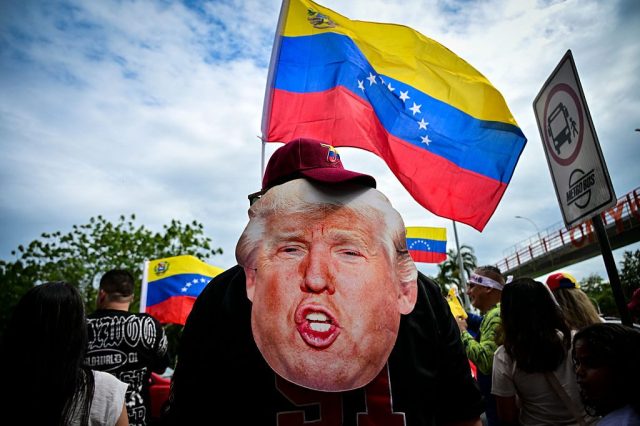
Flying the flag (Martin Bernetti/AFP/Getty)




Irrespective of Nicolás Maduro’s eventual fate and whether he will stand trial in New York, it appears — for now — that the regime in Caracas has survived in altered form. US military action concluded swiftly following Maduro’s abduction and exfiltration, and there are persistent rumors that his capture was at least partially “negotiated”, with segments of the Venezuelan military facilitating his overthrow.
Despite Donald Trump’s provocative assertion that the United States is going to “run” Venezuela and manage its transition for the foreseeable future, Washington has so far avoided the far costlier path of outright occupation. Trump has openly dismissed US-backed opposition figure María Corina Machado as lacking the domestic “support and respect” necessary to lead the country, while signaling that his administration is instead liaising with Venezuela’s vice president (and, tellingly, its oil and finance minister) Delcy Rodríguez, whom he described as “willing to do what we think is necessary.”
With Rodríguez named interim president by Venezuela’s Supreme Court (presumably with American approval), and no indication that Washington is prepared to deploy the hundreds of thousands of troops required to govern the country directly, Trump appears intent on “running” Venezuela indirectly — through the existing state apparatus and the military — while using sanctions, naval embargoes, and the credible threat of renewed force as an albatross around the neck of the Venezuelan leadership.
The objective, in short, is not regime change in the conventional War on Terror sense, but instead managed continuity: preventing immediate collapse, securing oil infrastructure, and coercing compliance without assuming responsibility for the country’s political and social wreckage. If true, this raises the likelihood that the entire episode has been a US-backed military coup that will ironically preserve Chavismo and Bolivarian politics in Venezuela in a new US-dealing, “business-first” garb: simply without Maduro himself.
Such an outcome would suggest that the Trump administration resisted the temptation of full-scale ideological regime change and remains pragmatic enough to avoid a prolonged ground invasion of Venezuela. The fallout — refugee crisis, internal unrest, and elite fragmentation — remains to be seen. Yet history offers little comfort that Maduro’s removal will lead to stability, let alone liberal democracy. If past US interventions are any guide, the long-term effect is more likely to be the further militarization of Venezuelan politics, with nationalism and social order emerging as the primary glue of regime solidarity.
Indeed, despite widespread discontent with Maduro’s rule, pro-government crowds have already gathered in Caracas to protest his overnight ouster by a foreign power. Chavismo, long sustained by anti-imperialist rhetoric, may now find renewed legitimacy precisely because Maduro was removed not by Venezuelans themselves, but by Washington and the CIA.
Beyond Venezuela itself, the broader message of the operation is unmistakable. The United States has forcefully communicated to the nations of the Western Hemisphere that it will justify its military interventions by claiming the right to enforce US law internationally — at least in the Americas — regardless of sovereignty, regional instability, or political blowback. Coming on the heels of the National Security Strategy’s call to reassert an updated, neo-mercantilist version of the Roosevelt Corollary to the Monroe Doctrine, the strike represents an ultimatum: Washington will act as the hemisphere’s police, enforcing its economic sphere of influence by force if necessary.
Washington’s actions in Venezuela reflect a Trump doctrine that views the world less as an ideological battlefield of liberals and autocrats than as an arena of zero-sum economic competition among great powers. In this framing, the Western Hemisphere is not merely a security perimeter, as in Roosevelt’s doctrine, but a commercial hinterland whose resources, markets, and supply chains must remain firmly under American control. Venezuela’s vast oil reserves, critical minerals, and strategic location for maritime trade therefore loom far larger in Washington’s calculus than any abstract concern with democracy, international law, or human rights.
Ideology, again, is secondary here. What matters is deal-making, playing ball, and cooperating with US commercial interests. This helps explain Washington’s readiness to work with figures drawn from the core of the Chavista state rather than the long-favored exile opposition. Loyalty is transactional, not doctrinal; legitimacy flows not from ballots or values, but from compliance with the imperial center.
This also explains why the attack on Venezuela appears unprovoked when assessed through traditional security frameworks. Caracas posed no credible military threat to the United States, nor was the country on the brink of imminent collapse, something that might have triggered intervention on classical Rooseveltian grounds. The intervention’s triggers were economic; its legalistic framing as countering narco-terrorism or drug-trafficking is nothing but window dressing. The goal was to secure US leverage over Venezuelan resources while decisively excluding non-hemispheric competitors — above all China and Russia — from consolidating their economic footholds in the Americas.
The unresolved question is whether this “Trump Corollary” is geographically bounded. Does it, to put it bluntly, actually put America First? Will the military interventions stop in the Americas, or does it foreshadow a broader claim that the entire world constitutes a legitimate US sphere of interest — continuing the decades-long tradition of transforming the American military into a global police force?
Only time will tell. But if the “American-Sphere” logic that undergirds the Trump doctrine loses its geographic grip and sense of limits to bleed into outright globalism, promoting US corporatism worldwide down the barrel of a gun, then the Trump administration has learned the wrong lesson from America’s postwar misadventures. While the more macho America Firsters might try to justify military interventions in the hemisphere on realpolitik and geoeconomic grounds, such militarism will be exceedingly difficult to explain, and indeed execute, across far-flung Eurasia: where other regional powers will inevitably exercise their own claims to sphere of influence.
Ultimately, unrestrained militarism is not only expensive and inflationary, but risky and escalatory. If Trump loses touch with basic tenets of Washingtonian realism, and refuses to adapt to the more regionalist and civilizational world that is emerging, then his checkmating of Maduro will be remembered as a pyrrhic victory that reenergized military interventionism, emboldened the globalists, and precipitated America’s decline as a great power.
Regardless, the approach lays bare the fiction that Trump’s foreign policy is isolationist. It is not. The Trump Doctrine may be skeptical of nation-building, regime change, and Middle-East-style forever wars, but it has no aversion to unilateral, willful, and even unprovoked use of force. On the contrary, it will resort to military action whenever and wherever it perceives American economic dominance to be challenged.
This exposes the central contradiction at the heart of Trumpian realism. While the National Security Strategy speaks the language of sovereignty, national interest, and restraint, it simultaneously treats the sovereignty of adversarial states as conditional and expendable. The logic is blunt and unapologetic: power decides. Unless adversaries are sufficiently strong to deter American action, they can be intimidated, coerced, or even removed.
By framing a cross-border military strike and the forcible abduction of a sitting head of state as an extension of domestic criminal process, Washington has effectively asserted a doctrine of extraterritorial police power backed by overwhelming force to use as cover for economic conquest. If national sovereignty can be nullified by indictment from a foreign, extra-judicial court, then no state outside the protective umbrella of US power can consider itself secure. Today it is Venezuela; tomorrow it could just as easily be Iran — or any other regime that can be rhetorically and legalistically reframed as “criminal” rather than simply a political, ideological, or strategic rival.
There is an uncomfortable irony at play here. In removing the head of a sovereign country through a swift “special military operation”, Donald Trump accomplished precisely what Vladimir Putin attempted — and failed — to achieve in Ukraine. He excised an intractable thorn on his side in hopes of reestablishing America’s sphere of influence over a country in its near-abroad. The difference lies not in principle, but in capability. The operation showcased the overwhelming superiority of US military power while signaling Washington’s renewed willingness to enforce its hemispheric dominance. After all, preventing Western encroachment in Ukraine is far more existential for Russia than Venezuela is for the US.
Trump will undoubtedly tout this as a decisive victory. He outmaneuvered Maduro, avoided US casualties — at least for now — and demonstrated American primacy and resolve to the region. Yet the more difficult task lies ahead. Whether Washington can compel Maduro’s successor — be it Vice President Rodríguez or Defense Minister Vladimir Padrino López — to subordinate Venezuelan sovereignty to American economic and strategic interests remains far from certain. The assumption that, through US military coercion or its “Big Stick”, Venezuela will simply offer up its oil and mineral wealth to US companies reflects a deep imperial hubris that harkens to the 19th century and is at odds with the post-unipolar reality of our time.
In the end, US machismo may have bested Chavismo tactically. Strategically, however, it risks entrenching the very dynamics it claims to oppose: hardened nationalism, militarized politics, and a regional order defined less by stability and mutual recognition than by fear and intimidation. It also does little to address the fentanyl crisis in the United States, which has nothing to do with Venezuela being a cocaine transit hub.
Still, the precedent has been set for new waves of US military interventions abroad — and in a multinodal world increasingly resistant to American primacy, the costs of enforcing an economic empire through global policing may yet exceed the benefits.
Arta Moeini is the Director of Research at the Institute for Peace and Diplomacy and founding editor of AGON.
 artamoeini
Join the discussion
Join like minded readers that support our journalism by becoming a paid subscriber
To join the discussion in the comments, become a paid subscriber.
Join like minded readers that support our journalism, read unlimited articles and enjoy other subscriber-only benefits.
Subscribe