




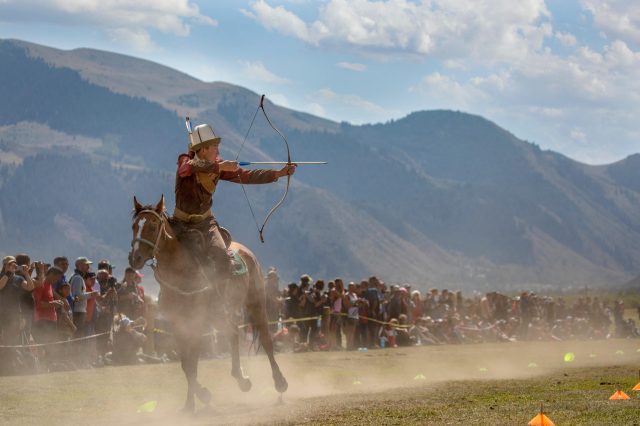
The country is mountainous and largely rural, with proud nomadic traditions. Photo: Kairi Aun




When I first spent time in Kyrgyzstan in the mid-2000s, the drunk American military contractor was a familiar sight, almost a local institution. In Bishkek, the capital, the US had a significant Air Force base — initially named in honor of a firefighter who died in the 9/11 attacks, later renamed after the hero of Kyrgyzstan’s national epic. Even though servicemen themselves were confined to the base at that time, a rich subculture had emerged around it, of alcoholic contractors, and the bars and sex workers who catered to them, and then, a step removed from that, a vibrant NGO community that helped make Kyrgyzstan “an island of democracy” in Central Asia, as a popular expression had it.
I was there as a student and when I returned in 2023, to teach, a great deal had changed. The air base was long gone — it had been shuttered under Russian pressure in 2014 — and the US presence in nearby Afghanistan had vanished as well. The swaggering military contractors were getting drunk in some other bar somewhere else in the world. And the NGO sector that, as one interlocutor put it to me in the 2000s, was “growing like mushrooms after the rain” had all but disappeared. I currently live next to the old Soros Foundation building — which closed its doors in 2024 following the passage of a Russia-inspired “foreign agent” law. It’s a large complex and it looks beautiful, but I’ve never seen anybody go in or out; it feels like a mausoleum for a whole generation of hopes about Westernization and liberal democracy.
My experience living here has largely been about pondering an absence, one which has become all the more striking since Trump’s re-election, the closure of USAID last year and the near-termination of US soft power in the region — even before the White House made explicit their focus on the Western Hemisphere with this week’s daring raid on Venezuela. I can count on one hand the number of Americans I’ve met who live here and, probably on two, the number of Americans I’ve met who’ve even passed through. It’s a part of the world that is about as far away from the contiguous United States as it’s possible to get but that had at one point seemed integral enough to the Pax Americana for a base to be set up and for a certain amount of soft power to flow through here, both to lend logistical support to operations in Afghanistan and to radiate power deep into the territory of the former Soviet Union. Now that the tide has gone out, the question is: what does a society look like if it’s basically untouched by direct American influence?
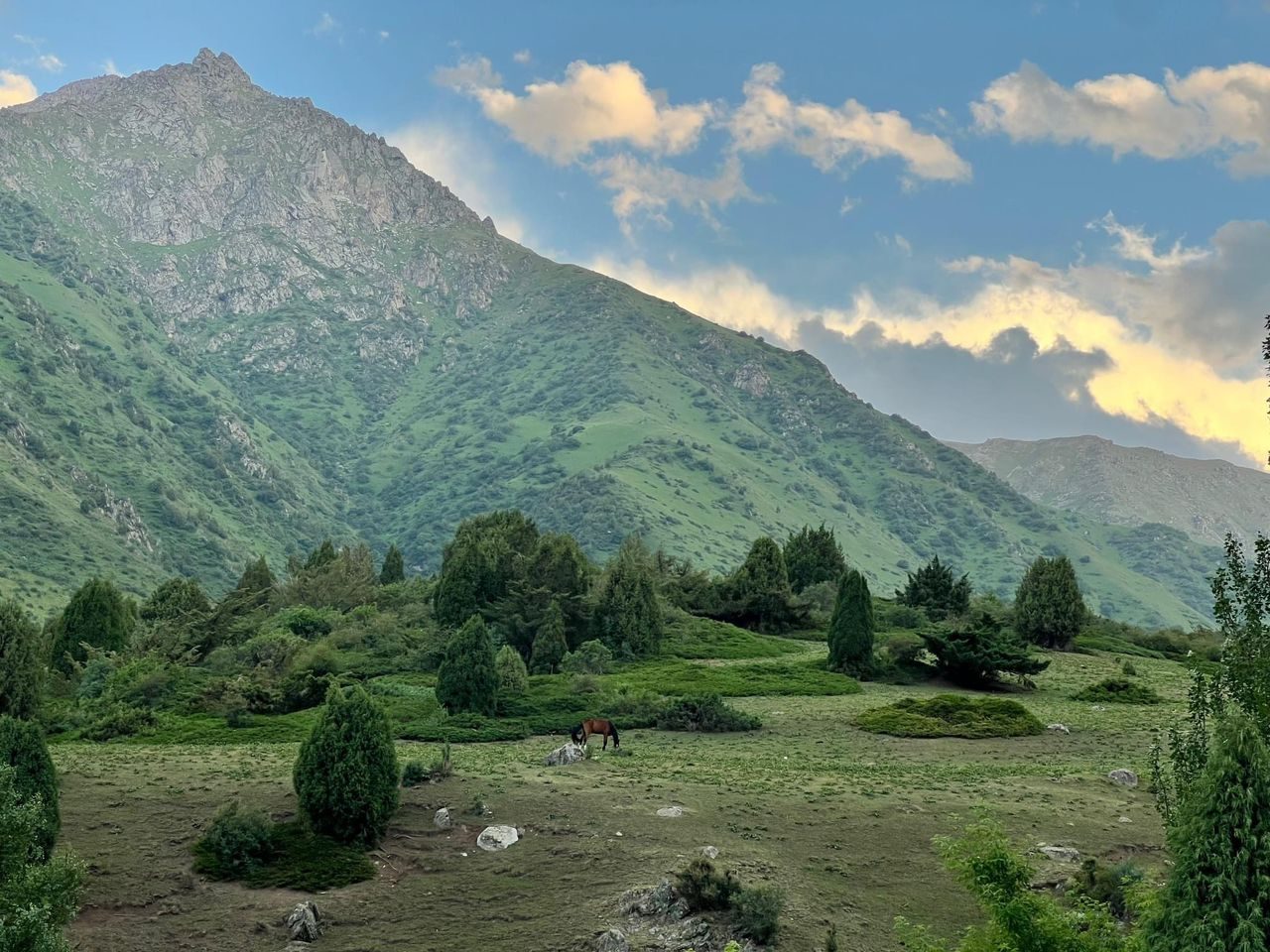
Why the US should be expected to have any contact with a country like Kyrgyzstan is a fair query to start with. Look at a map zoomed out and the country seems to be swallowed in an embrace by China to the east and by Kazakhstan and — more distantly — Russia to the north. The country is poor, with a nominal GDP per capita of under $3,000, and has limited natural resources. It’s mountainous and largely rural, with proud nomadic traditions, a culture taking in elements from the Russian, Chinese, Arabic, and Turkic worlds, and its history couldn’t be more remote from America’s. But spend time here and a certain US influence becomes obvious enough. I am able to teach my journalism course in English at an international university with good comprehension from my students. My students routinely make fun of me for how behind the curve I am in following P. Diddy’s trial or not quite being able to explain who Charli XCX is. Many of them fantasize about living in the US. If I’m in a cab, it’s routine for the driver to suddenly put on speakerphone a brother or cousin who’s living in the States so that we can trade pleasantries with one another. Bishkek is filled with malls that give me flashbacks to the time I spent living in Los Angeles. And, as an American, I am treated with a respect and an interest that I don’t think I’ve quite experienced anywhere else in the world — there’s just a curiosity about Americanness that I think much of the rest of the world has moved past. Actually, my number one complaint living here is about the tinny American music played in coffeeshops that I am forever asking waiters to change or at least adjust the volume on.
If that influence seems superficial — just the flotsam of 21st-century pop culture — it can also deeply influence people’s life choices. Agnieszka Pikulicka, a Polish journalist who has published widely on Central Asia and writes the Turan Tales Substack, certainly thinks so. “Thanks to US involvement, a whole generation of Central Asians — not only Kyrgyz — had a chance to build their own NGOs and media, study in English according to Western curricula, travel abroad and absorb democratic values,” she tells me.
It’s not always so easy to know where to assign attribution, but those democratic values seemed connected to a relatively open culture where crime and corruption have steadily decreased and the economy has for years had reliable growth. The quiet but effective tourist slogan “You’ll Like Kyrgyzstan” gives a general idea. Meanwhile, in the region as a whole, Kazakhstan and Uzbekistan finally, in the last decade, transitioned out of their Soviet-era authoritarian leaders — the latter in particular has undergone an eight-year period of striking liberalization.
If I were writing this piece a year or two years ago, that’s probably where I would have ended it — with America’s direct influence on the region ebbing away but with the region making progress on its own terms and in a way that was not incompatible with liberal democracy. Now, though, I am far less sure. Kyrgyzstan has, since I have been here, arrested opposition figures; closed the leading independent media outlet; fallen into a pattern of repossessing private property based on a reading of arcane laws; installed new “firewall” systems for controlling web access; and fallen deeper into “not free” status in Freedom House’s annual report. The notion of Kyrgyzstan as an “island of democracy” — flung around in international circles just a few years ago — is giving way, under President Sadyr Japarov who came to power in 2021, to a creeping authoritarianism. To give a very small but telling example: when I first came here, I really enjoyed jogging in the main sports stadium — the one also used by the national football team. The track would always be full of people, and it would be a really nice time — people jogging or working out in the exercise park. When I would talk about what I liked about Kyrgyzstan, that would be the kind of thing I would point to — I never in my life in America had the opportunity to go for a jog in Yankee Stadium. About a year ago, though, when I went to take my usual run, the gate was closed and an intimidating guard shouted at the high school team who had come for their workout that the stadium was now closed to the public and closed for good.
I don’t want to draw too many inferences from events that are tied to Kyrgyz domestic politics, and it’s not as if there’s a clear cause-and-effect between, say, Trump’s election or the end of the war in Afghanistan and Kyrgyzstan’s authoritarian turn in the 2020s. But what clearly is true is that a sort of ideological vacuum showed up with the waning of US influence in this part of the world, and I suspect, in many other parts of the world that are in a similar place of choosing their geopolitical identity. The sense in the 2000s was that the future lay in the direction of capitalism and liberal democracy — as an irresistible trajectory for a developing country like Kyrgyzstan. That was far from seen as unequivocally a good thing — I remember concerns about “runaway capitalism” and about the loss of traditional culture — but it just seemed like a fact. That’s now far from the case. When I first returned to Kyrgyzstan in 2023, I was struck by how many more hijabs I saw around than I had noticed in the 2000s. The most visible manifestation of soft power in Bishkek is a gleaming mosque built and funded by Turkey. Chinese influence can be felt above all in large-scale infrastructure projects, such as roads and railways, financed by the Belt and Road Initiative. Russian influence is, not surprisingly, ubiquitous in a country that was part of the Soviet Union, with Russian widely spoken and Russian state media popular particularly among older people, but becomes distinctly more noticeable in the recent adoption of foreign agent laws or the Putinesque consolidation of political power around the President.
The deeper point I would make is that, in the battle to conceptualize the future, it now looks far less like an episode of American TV. One of my students, when we were going around the room introducing ourselves at the start of the semester, said as his kind of statement of purpose that he was “opposed to the LGBT agenda”. The phrase “human rights”, which seemed to be making its bid towards universalism in the 2000s, now — under the barrage of Russian state media — is understood as being inextricable from Western soft power. The US and its gold-paved streets might still figure in my students’ airy post-graduation plans, but they’re as apt to say something about Dubai or China — and the difficulty of getting student visas under the Trump administration has shifted their attention away from the US. Whatever the US was supposed to stand for — even if J. Lo can comfortably sell out her Kazakhstan tour, and the Back Street Boys can “get nothing but love” on theirs — is now in recession.
Whether you think this is a deep loss or not reflects, of course, your underlying point of view. For Pikulicka, America’s inward turn directly undermines Central Asian civil society. “With Donald Trump taking a more authoritarian turn himself, those [NGO] groups have also lost arguments in their struggle against authoritarianism and local regimes, all of which have been tightening the grip over freedom of speech and — in the case of Kyrgyzstan — small but hard won democratic achievements,” she says. For Peter Leonard, a long-time editor at Eurasianet who now writes the Central Asian-themed Substack Havli, Trump’s reassessment of priorities may paradoxically lead to closer ties to Central Asia. “His vocal rejection of ‘woke’ politics is particularly appealing to conservative leaders in the region,” he tells me. “The president of Kazakhstan recently invoked Trump’s coolness toward LGBT values in an approving manner. This strongly suggests that US influence under Trump actually has room for growth, at least in political-cultural terms.” That new affinity with Central Asia seemed to produce surprising results at the end of last year in the C5+1 Summit in Washington where all five Central Asian countries signed far-reaching agreements with the US, including the eye-popping pledge for Uzbekistan to invest $100 billion in the US rather than the other way around.
Leonard’s is a very subtle point of view — that it’s not so much as if America’s influence in the region has waned as that the “brand” has shifted. Trump has a certain alignment with Central Asia that the more progressive NGO sector often didn’t. But living in Bishkek, where the volume of American influence is turned far down from where it was even a few years ago, I find myself reflecting on a vacuum— on the sense of something or other having been lost. What it is, I suppose, is some notion of the US as a force for good on a global scale. It’s not always so easy for me to tell if that’s something that Central Asians actually saw in the US or just what I hoped Central Asians saw, but there’s no question that propaganda from Russia has had its effect in depicting America as the origin point of various global conspiracies, while, especially with the closure of USAID, there is very little soft power initiative emanating from the US to counteract that impression. As Leonard thoughtfully says, there is a constructive role that the US could in theory play in the region. “It stands to bring investment with fewer political strings attached,” he says. “It brings knowledge transfer. And the US is legitimately, if self-interestedly, committed to advancing institutionalized integration among Central Asian states, which would make the region more sovereign and less dependent on China and Russia.”
There was a point in time when, no matter what else it might be, America was it — the future. Now that it’s become clear that capitalism no longer necessarily ushers in democracy and that the “American way of life” is not everybody’s cup of tea, there is a great lacuna in values on the international stage. Russia has been very aggressive in framing a vision of the future around conservative values; and China in doing so around a kind of state-managed technocracy. It’s far less clear now what the US stands for or why anybody should buy what it’s selling.
Join the discussion
Join like minded readers that support our journalism by becoming a paid subscriber
To join the discussion in the comments, become a paid subscriber.
Join like minded readers that support our journalism, read unlimited articles and enjoy other subscriber-only benefits.
Subscribe