








January 27 2026 - 7:00am
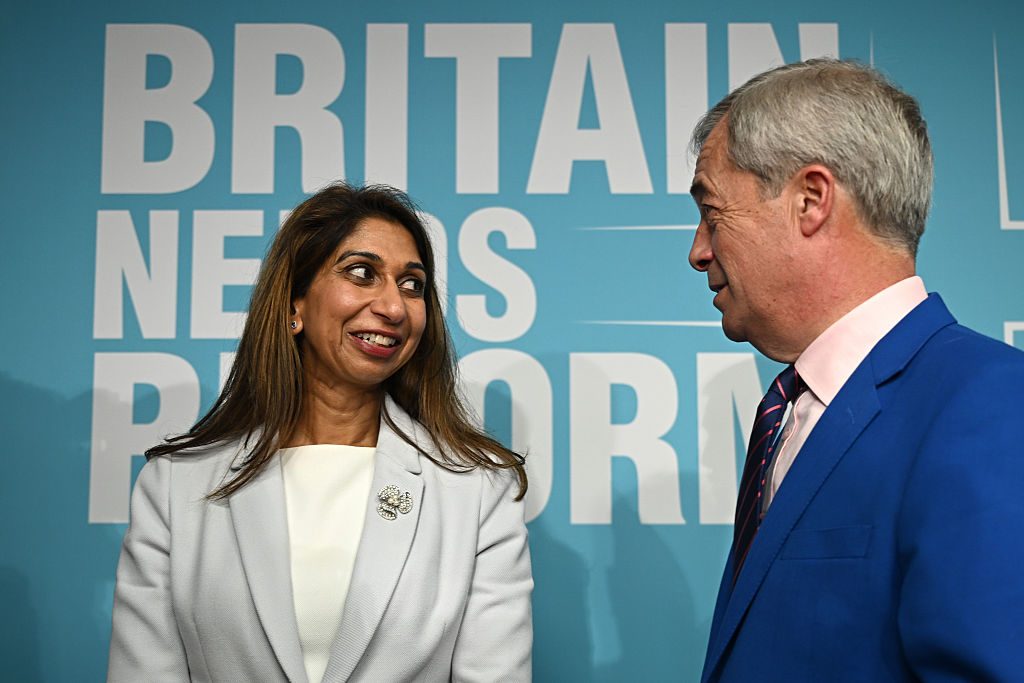
When Suella Braverman defected to Reform yesterday she said: “I feel like I’ve come home.”
Her former Tory colleagues clearly think she’s been semi-detached for some time, with the curtains drawn and the front door firmly bolted. Indeed, hers may be the least surprising defection in Conservative Party history. But if the Tory leadership thinks that means it doesn’t matter, they’ve made an even bigger mistake than issuing a nasty remark about Braverman’s mental health.
In fact, Braverman’s departure can be seen as the most significant of all the defections to date — if, that is, one realizes that it didn’t begin with yesterday’s announcement, but on 13 November 2023, when Rishi Sunak sacked her as Home Secretary.
That too was signaled well in advance. Despite her senior position in the Cabinet, Braverman had become increasingly vocal in her frustration with the Conservative government’s paralysis on immigration. She was, in effect, daring the Prime Minister to back her or sack her — and, eventually, he made a choice. What’s more, on the day that he fired her as Home Secretary, he hired David Cameron (as Foreign Secretary).
It’s debatable whether Rishi Sunak — a competent minister, but a hapless politician — meant to send such a provocative political message. But for the part of the electorate that had voted Leave, and then Tory, to take back control, that’s the way it was received. The Braverman/ Cameron juxtaposition left no doubt that, despite Brexit, the old establishment was still in charge.
But where’s the hard evidence that this made a lasting impact? Well, take a look at the long-term polling data and, in particular, the level of support for Reform UK. Before Braverman’s departure from the Cabinet, Reform was flatlining at about 6 or 7% of the vote — significant, but not transformational. But after 13 November 2023, we see an inflection point — the start of a long ascent that would turn British politics upside down. Milestones include the 14.3% of the vote won by Reform at the 2024 general election, followed by the party’s rise to a clear first place in every poll.
Of course, the return of Nigel Farage as leader had a lot to do with that upward momentum. So did the extraordinarily rapid collapse of the Starmer government’s popularity. But it starts with Braverman.
Note that one doesn’t have to agree with her politics or to respect her performance as a minister or enjoy her jibes at the “Guardian-reading, tofu-eating wokerati”. But give her this at least: when her patience broke with a fundamentally unresponsive system of government, she didn’t hide it and she didn’t pretend. Her walk home may have taken many years, but millions of voters have followed the same path.
To have any chance of winning them back, the Conservative Party needs to show that it understands what drove them away in the first place. It’s an irony that on the same day that Braverman formally announced her defection, Tory centrists launched a new movement — Prosper UK — whose response to the populist impulse is to repudiate it.
For true One Nation Conservatives, who distrust Reform, but believe that no part of our country should be left behind, this isn’t good enough. We’ve already tried to ignore those who haven’t prospered in an age of mass migration, and it’s been a disaster. The fact is that the left behind can leave us behind — as indeed they have.
Peter Franklin is Associate Editor of UnHerd. He was previously a policy advisor and speechwriter on environmental and social issues.
 peterfranklin_
Join the discussion
Join like minded readers that support our journalism by becoming a paid subscriber
To join the discussion in the comments, become a paid subscriber.
Join like minded readers that support our journalism, read unlimited articles and enjoy other subscriber-only benefits.
Subscribe