




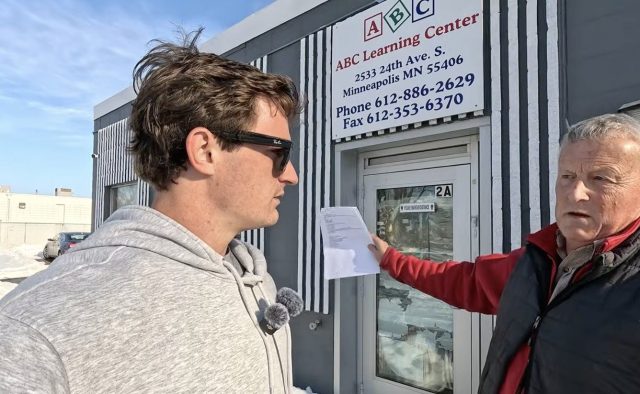
Nick Shirley investigates a daycare in Minneapolis. Credit: Getty





The American Right has found its answer to the mainstream media in the form of Nick Shirley, a 23-year-old YouTuber. On Dec. 26, Shirley posted a video on social media that has received, as of this writing, more than 140 million views across multiple platforms. It involved him going to a variety of Minneapolis-area daycares and health-care providers run by Somali Americans to see whether they would show him their children or produce certain kinds of information, such as their “health-care rates,” to prove that they are legitimate businesses.
Some establishments didn’t answer the door. Other attempts ended in confrontations with confused Somali women who appeared to have practically no English skills, bewildered by the young man and his old friend and partner in journalism, Dave, who’d just come by asking to see some kids.
In response, the Right-wing echo chamber went wild. “Prosecute @GovTimWalz,” tweeted Elon Musk. JD Vance exclaimed that Shirley had done more valuable journalism than the winners of the 2024 Pulitzer Prize. Before long, the Trump administration froze billions in funds for childcare and assistance to the poor going to Minnesota, and four other blue states for good measure. Rep. Eli Crane (R-Ariz.) has even introduced a resolution to award Shirley a Congressional Gold Medal.
Yet the real lesson of this story is how poorly suited the American Right is to engaging in journalism — and, indeed, the movement’s impoverished understanding of what journalism is all about.
Start by stipulating that there has been fraud involving Somalis in Minnesota. In 2022, the Biden administration charged 47 defendants in a $250 million scheme to exploit a child-nutrition program. This summer, the acting US Attorney for Minnesota said in an interview that his office had prosecuted cases amounting to $500 million in fraud over the past few years, and that in the case of the federal Housing Stabilization Services program, the “vast majority” of the money being distributed is fraudulent.
It appears that most of this is coming from within the Somali community, and The New York Times in November reported on how Democratic politicians in that state were shy about shining a light on criminal activity in a way that could demonize a minority group or alienate a sizable new voting bloc.
None of this, however, means that Nick Shirley was engaging in real journalism. What he did was the equivalent of a reporter covering the mafia randomly showing up at Italian-owned butcher shops and restaurants with a prefabricated narrative that criminal activity must be going on. Almost immediately, Shirley’s narrative began to fall apart. The Minnesota Department of Children, Youth, and Families last week visited the daycares targeted by Shirley and determined that they were “operating as expected.” Children were, in fact, present at all of the sites, except for one that had yet to open for the day. Apparently, just showing up at a daycare and asking “Can I see the children?” does not get you access to them.
Reporters from the Minnesota Star Tribune visited the 10 facilities in Shirley’s video, and found children in four of them. The other six were either closed or did not open their doors, which would be understandable, given what they had recently been through. At one facility, the paper reported, “the daycare’s phones now ring nonstop from early in the morning to late at night, with people pretending to want to place their children there or threatening harm.”
The Star Tribune reported that some of the facilities had been cited for large numbers of violations in recent years. And the state Department of Children, Youth, and Families is pursuing ongoing investigations of four of the 10 daycares in the video. One of them, Quality Learning Center, closed down after Shirley’s visit. But there is little in Shirley’s video that, without more, qualifies as evidence of wrongdoing.
From the video itself, Shirley appears to not have much understanding of how health-care and government licensing work. At one point, while wandering through a facility of various medical providers, Shirley wonders, “Why would you have the same company essentially inside of the same building?” The kid has apparently never heard of a medical plaza. While visiting an office that appears to have patients in a waiting room, he asks a bewildered receptionist what their “health-care rates” are — a question that no patient in the American health system ever asks a provider. At facilities like the ones in the video, payment is often provided through government health programs, and depends upon the exact services that are authorized. This isn’t like asking for a menu in a restaurant.
Shirley finds a facility that is licensed to care for 102 children, and expects to see exactly that number of kids, not understanding that this is the maximum number they are authorized to serve. When the Star Tribune went to the same place, the paper found around 50 children inside. They simply hadn’t been visible from the door. At another facility, Dave (Shirley’s partner) taunts people standing outside that they might need an Amber Alert for the exact number of kids that they are licensed to care for.
Shirley has inspired similarly ignorant imitators on social media. One December X post, from the sensationalist @WallStreetApes account, declares that regular homes in Minnesota being registered as assisted living facilities is indicative of fraud (it has garnered more than 900,000 views as of this writing). Yet as the journalist Christina Buttons points out, the trend in US policy has been towards encouraging home- and community-based care over large institutions, meaning that these homes could well be assisted-living facilities.
Some have followed Shirley in showing up to random Somali businesses and haranguing the people inside. One video with 16 million views as of this writing involves a YouTuber informing her audience that “90% of small businesses fail, yet the Samara Adult Day Care still has their lights on without having one customer seemingly.” The woman who answers the door doesn’t speak English very well, but communicates that she is waiting for a driver to bring the people they take care of. The lack of assimilation among Somalis clearly does hinder communication, but that is not the point the influencer is going for. Without any evidence that anything is untoward is happening, the woman is smeared as a fraudster based on her ethnicity and line of business.
The episode is another showcase of why the nation needs real institutions, and highlights the failure of conservatives to build or maintain ones Americans can trust. Elon Musk encourages “citizen journalism,” giving the impression that anyone can show up with a camera — without any background knowledge, editorial guardrails, writing ability, or fact-checking — and provide useful information on current events.
The amateurism is corrosive to Americans’ capacity to reform real problems. Shirley’s partner, Dave, claims at one point that Tim Walz took Minnesota from having an $18 billion surplus to a $6 billion deficit, a swing of $24 billion, of which he attributes 90% to fraud. In fact, Minnesota still has a surplus for the current fiscal year. There is projected to be a deficit of about $6 billion by 2028-2029, but no evidence is provided in Shirley’s video for the claim that fraud will be a substantial reason why.
The only attempt to ground his so-called journalism in empirical data is Shirley’s running tally of supposed fraud uncovered, based on which businesses he considers illegitimate. That determination, in turn, rests on little more than his unsuccessful attempts to locate children or wrangle “health-care rates” out of confused receptionists.
In a sense, Shirley starts with a narrative and then grabs on to whatever evidence he can find in order to tell the story, including short videos and official government numbers provided without the necessary context to understand what is going on. Do mainstream-media institutions sometimes do the same thing? Undoubtedly. But the Shirley version is so much more grotesquely low-quality — and subject to none of the editorial scrutiny and pushback that is routine for institutions like the Times even on their worst days.
To be clear, conservatives have uncovered a real problem in the form of government fraud. There are points to be made about topics such as immigration from clannish, hard-to-assimilate backgrounds, and Democrats letting fraud run rampant to avoid accusations of racism and to curry favor with an ethnic voting bloc. Yet a Times reader could have learned about Somali fraud in Minnesota in late November, minus the encouragement to harass random people who may not have had nothing to do with criminal activity.
Shirley is far from the worst influencer in the new Right-wing media ecosystem. That’s not saying much, however, in a community in which it is completely normal to sit in a podcast studio and fabricate “facts.” What the young YouTuber reveals, however, is in some ways even darker. It is that, even when the Right has a point about a news story, its partisans, and even its leaders, are either unwilling or unable to either demand or adhere to basic journalistic or intellectual norms. Moreover, there appears to be a growing appetite for opportunities to harass minority communities in real life over the sins committed by individuals who share the same background. That is a greater threat to the future of the country than welfare fraud.
Richard Hanania, an UnHerd columnist, is the president of the Center for the Study of Partisanship and Ideology and blogs at Substack.
 RichardHanania