




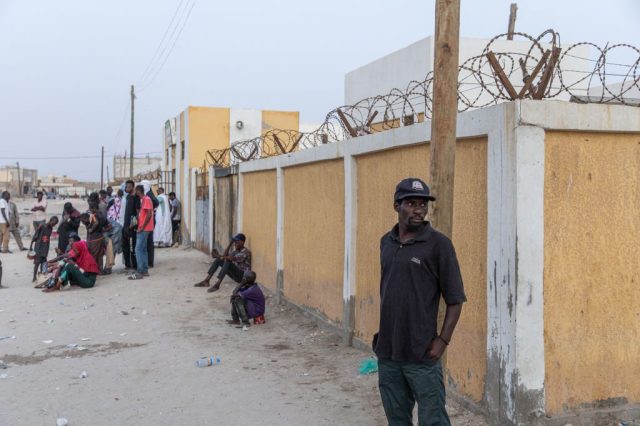
African migrants are being plucked off the streets. Photo: Getty




Breakfast at a roadside food stand in Nouadhibou, a dusty coastal city located along Morocco’s southern border, is marked by a sense of nervous excitement. “Since early morning, they’ve been picking up people,” says a local worker as he eats.
A moment later, a pick-up truck, carrying four masked, heavily armed members of the National Guard, lurches down the street before grinding to a halt by a nearby construction site. Here, workers from sub-Saharan Africa are gathered. The soldiers dismount, snatching one of the workers at random. He submits without resistance, and is hoisted onto the empty truck bed as the vehicle speeds away.
Half an hour later, the same vehicle looms into view. The truck now carries a full cargo of migrants. Simultaneously, police are raiding workplaces around the city. At night, they venture into people’s homes, breaking down doors. Those apprehended are detained and later dumped at the borders of Mali and Senegal.
Until recently, the Islamic Republic of Mauritania — a sparsely-populated desert nation sitting on the border between the Arab and African world — was an attractive destination for migrant workers from West Africa. Offering relatively high salaries, it also had a patchily-enforced immigration regime. But in March this year, that regime came to an end. Deportation raids suddenly started in Nouakchott, the country’s sun-baked capital, before gradually spreading across the country.
Home to both Arab and black African ethnic groups, Mauritania — the last country to abolish slavery — has long been afflicted by racial tensions. These tensions were compounded in the aftermath of the Arab Spring, when political upheaval across North Africa led to a surge of Sub-Saharan migrants through the country. Mauritania becoming a major transit point for migrants heading north, many of whom settled there among the politically dominant Beidane Arabs.
“We are a nation of 4.5 million, but in my opinion, we have at least eight million migrants here. They bring crime and drug trafficking and bad morals,” said Ahmed, a telecommunications executive, while driving his Toyota Hilux through the concrete sprawl of the capital Nouakchott. “Now, finally, the government is doing something about it.”
But the Mauritanian government has not publicly explained why it has started deporting migrants en masse. A €210 million migration partnership deal with the EU, signed in 2024 — the EU being concerned about arrivals to Spain’s Canary Islands from the country — may have been a factor. For its part, the EU has never explained how the funds were meant to be used. Ten months into the deportations program, it is to know precisely how many people have been expelled. But judging by the effect on industry, rather than non-existent official statistics, the deportations have been in the tens of thousands. The campaign has caused immense damage. The country’s African migrant communities have dwindled in number, with many deported under brutal and violent conditions. Meanwhile, factories, farms, and construction sites lie empty, deprived of the migrant labor upon which they depend.
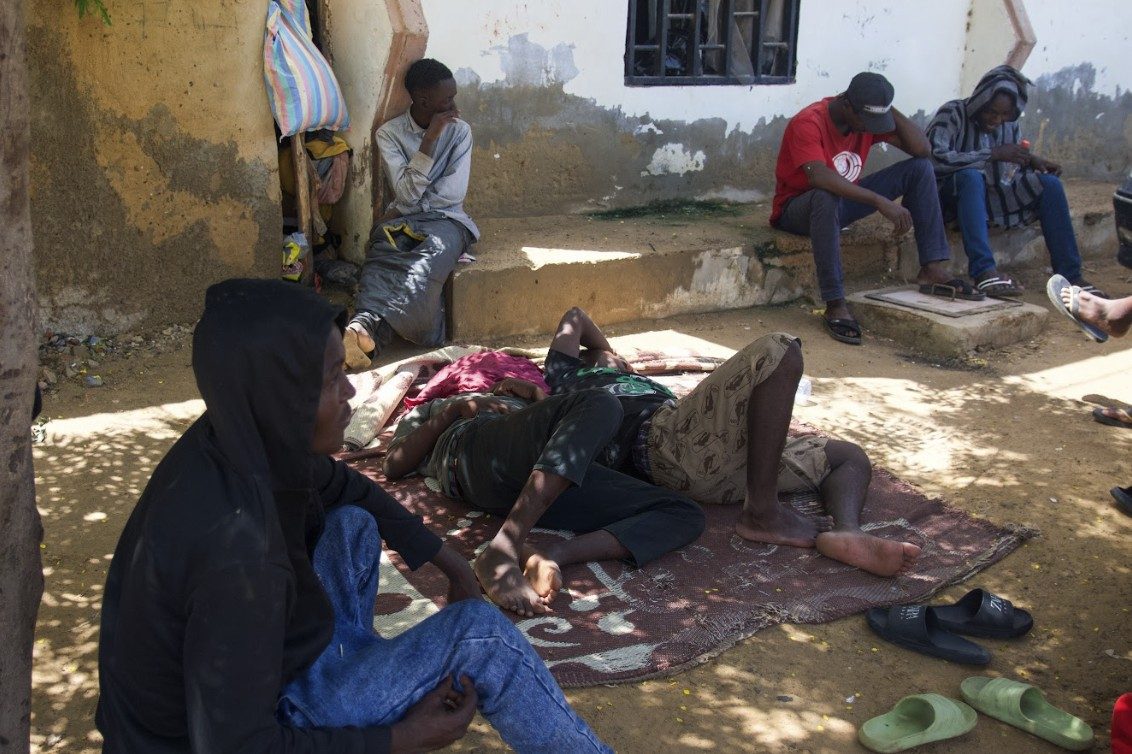
All this means that the desert nation has become an unlikely testing ground for the kinds of mass-removal policies that, in Western states, are threatening to elbow their way through the Overton window. Mauritania’s experience suggests that these policies are less about political will than about what a state must become to enforce them. It also demonstrates that such an operation demands enormous state capacity and resources, lest it descend into chaos and lawlessness.
One evening, police raided a compound in Nouaudhibou that was home to Ibrahim, a 25-year-old from Côte d’Ivoire. He was arrested alongside six others. Despite having the necessary documents to remain in Mauritania, Ibrahim was told dismissively to get into a pick-up truck. He was then brought to a detention center and held for five days together with 200 other men. During this period of detention he was given no food.
Suleyman, a 27-year-old Guinean, spent eight months in prison after being violently robbed. The police accused him of initiating the incident. The moment he stepped outside the prison walls, he was arrested over an expired visa. Several days later, he was dumped at Mauritania’s border with Senegal.
The process for determining whether migrants were legally in Mauritania was largely arbitrary. Youssouf, a Guinean factory worker who is in his early twenties and from the Fulani ethnic group, was arrested when police broke down the door to his room early one morning. Youssouf had been asleep beside a black Mauritanian — also Fulani — with whom he shared the accommodation. Both lacked identification, but Youssouf’s roommate was let go after demonstrating proficiency in Hassaniya, the local dialect of Arabic. Youssouf, speaking in Fulani, claimed to be from a village in the Mauritanian south. Unconvinced by his accent, police grilled him with questions about his ancestry. Because Youssouf was unable to verify his story, he was identified as an illegal alien and deported.
On the ground, the campaign has metastasized into a giant rent-seeking exercise — a function of a perverse incentive structure and systemic incompetence. Traore, an Ivorian construction worker in his mid-20s, was arrested three times in less than a week. Each time he regained his freedom after paying bribes of not more than £22. “It’s just about whether you have something to give them,” said Musa, a 24-year-old Gambian construction worker who was deported after police raided his room while he slept.
Seemingly indifferent to their assigned mission, police focused almost entirely on self-enrichment. Before being brought to a detention facility, Youssouf, the Guinean Fulani factory worker, had his pockets searched and the small amount of money he carried on him — the equivalent of £2 — confiscated. Elizabeth, an elderly Nigerian woman, recalled police breaking down her door while she slept naked, handcuffing her before she could dress. Upon finding that she held a valid residency permit, they stole her television, calmly carrying the loot towards a pick-up truck parked nearby.
Such behavior has caused a degree of confusion among Mauritania’s migrant population. “These Mauritanians, they have no IQ,” said Ruth, a street vendor from Sierra Leone when describing her interactions with Mauritanian police. Even though Ruth has valid documents, the police continue to pester her for money.
The inevitable economic disruption wrought by Mauritania’s deportation campaign seems to have had little influence over authorities’ decision-making. As raids intensified in Nouakchott and Nouadhibou, construction sites stood empty and factories came to a halt: many workers were deported, while others feared coming to work for fear of arrest. “There are no workers now, no people who can go to the sea to fish, because they are picking up people who have no documents,” said the owner of one of Nouadhibou’s largest fish-processing factories.
In the south, along the Senegalese border, the campaign took on a more self-defeating form. For no obvious reason, the government took it upon itself to roll out the deportation campaign in Rosso, a region whose farms — Mauritania’s agricultural backbone — rely almost entirely on foreign labor. Migrant workers were then forced to retreat deeper and deeper into the bush, far beyond the reach of military pick-ups. “They were harassing me a lot. Every day I had to run,” said Ibrahim, a laborer from Guinea-Bissau in his early twenties, while cooking over an open fire in a remote migrant camp where he lives with other workers from Mali and the Gambia. Forced to live off the land, bushmeat — including monitor lizards and other reptiles — is often seen roasting in camps along the River Senegal.
In these riverine bush areas, the farcical nature of the campaign becomes clear. It has achieved little in terms of its presumed goals beyond inflicting extensive human suffering and demonstrating the state’s capacity for cruelty. Those unlucky to be caught in Rosso and deported to Senegal can easily return within a day. “If they catch you, deport you, you go Senegal. Then tomorrow another way you return,” said Samba, a thirty-something Gambian rapper who works in agriculture on a seasonal basis. Migrants, familiar with the terrain and routes through the riverside marshes, would typically pay for fishing canoes to return them to Mauritania for as little as £4.
For others, returning to Mauritania is just a question of having the money to bribe their way through the countless checkpoints along roads between the borders and major economic centers. Those without cash are just waiting for the operation to cool down before they can return and rebuild their lost livelihoods.
Still, mass-removal policies have gained political traction in the West. In response to the shooting of two National Guard soldiers in Washington DC by an Afghan migrant, President Trump called for the denaturalization of migrants who undermine domestic tranquility and the deportation of those incompatible with Western values, alongside an outright ban on immigration from third-world countries. “If they can’t love our country, we don’t want them,” he later said.
Stephen Miller, Trump’s immigration tsar, went a step further. “Trump’s plan to stop the invasion of small towns in America: remigration!” he tweeted — remigration referring to the use of state-enforced expulsions to reverse existing migration-driven demographic trends. Miller’s comments came days after the State Department tweeted that “mass migration poses an existential threat to Western civilization and undermines the stability of key American allies.”
More recently, the fatal shooting of a civilian by an ICE agent in Minneapolis — and the uproar that has followed — shows how calls for mass removals can translate into chaotic and volatile forms of state violence when put into practice.
In the UK, too, calls for mass deportations and remigration are becoming more commonplace, with Reform UK and the Conservatives squabbling over who gets to claim credit for mainstreaming mass removals as a policy option. Surprisingly, these proposals fail to confront the realities of what their implementation would involve. When asked whether the first Reform UK government could realistically deport 500,000 people, Zia Yusuf limited his response to, “Totally, yeah.”
Discussions of possible obstacles rarely extend beyond potential legal hurdles. A 2025 paper by Restore Britain — an advocacy group led by former Reform UK MP Rupert Lowe — advertised, in its own words, as “the most comprehensive deportation policy ever produced in Britain”, fails to account for what mass deportations would look like on the ground. Its analysis of logistics is largely limited to how to exclude migrants from work and public services, alongside schemes to incentivize snitching. It provides no guidance on what is supposed to happen between the intention to deport an “illegal chancer” and the moment he enters a chartered flight. When Restore Britain’s Harrison Pitt, who co-authored the paper, was interviewed by GB News, the practicalities remained undiscussed.
Yet the Mauritanian case suggests that the questions of practical implementation — and state capacity — are, in fact, the most critical elements of any mass removal operation. Such operations rest on six basic requirements: identifying “targets”, apprehending them, detaining them, transporting them, expelling them, and preventing their return. In these respects, Mauritania has benefited from an extensive intelligence-gathering apparatus, despotic governance, the absence of rule of law, and little respect for human rights, thus exercising a certain competitive advantage over Western states. Mauritanian police were able to proceed with an efficiency-maximizing approach, prioritizing high numbers of arrests over any broader considerations.
While it might seem that Mauritania’s failure to prevent human suffering and excessive collateral damage is particular to its incompetent governance and inability to effectively enforce policy, it points to broader contradictions in mass deportations as a practical strategy. Contrary to what much of the current discourse would suggest, the viability of mass removals rests on far more prosaic questions about what the state can actually do, and at what cost.
Mauritania was able to turn the concept into action only because it is seemingly willing to exercise despotism and brutalize those it now deems unwelcome. It remains unclear whether there is another way to implement the policy. Any government wishing to implement a less arbitrary and brutal approach — providing at least a façade of legality — would need to develop a large, permanent apparatus of surveillance, detention and enforcement capable of tracking and controlling millions of people. This would inevitably come in combination with an expansion of state power and administrative coercion that chronically limited public budgets would struggle to sustain, even amid a scenario of sustained public support.
A completely different, yet equally important, consideration is how mass removals would change the moral fiber of our societies. While proponents of mass deportations might stress that migrants could be encouraged to leave voluntarily, through incentives rather than coercion, it remains questionable whether significant numbers could be persuaded to leave in exchange for a financial reward alone. Such a decision would mean sacrificing the prospect of a life-long existence in the West, and as of yet there are no convincing examples of successful cash-for-voluntary returns schemes adopted on a mass basis. If the ambition is not merely to marginally increase returns but to reverse demographic trends decades in the making, voluntary self-deportation schemes seem unlikely to deliver the numbers required.
Thus, any attempt to make such a campaign effective might necessitate radical changes in everyday life: neighbors denouncing one another, landlords and employers acting as auxiliary immigration officers, and routine identity checks becoming a normal feature of streets, shops, and workplaces. While public opinion on mass deportations continues to shift, it is one thing to endorse these ideas in the abstract, but quite another to live with the methods required to enforce them at scale. As the Mauritanian example suggests, the gap between these two positions is where the real political and moral costs lie.
Join the discussion
Join like minded readers that support our journalism by becoming a paid subscriber
To join the discussion in the comments, become a paid subscriber.
Join like minded readers that support our journalism, read unlimited articles and enjoy other subscriber-only benefits.
Subscribe