




'Demotic and blunt, always in attack mode' (ThomasKrych/Anadolu/Getty)




At the threshold of a handsome portico, Laila Cunningham is trying her best to hand a leaflet to a woman with messy hands. “I’ve got a pavlova in the oven,” the homeowner apologizes, seemingly a little surprised at her interlocutor’s conviction. Then, giving in, she accepts a turquoise piece of paper from which Nigel Farage is staring resolutely out at her.
It is an autumn Sunday morning in Hendon, and not many voters are opening their doors. It’s also Sukkot, a festival commemorating the end of the 40 years in which Moses’s followers wandered the desert, and in this heavily Jewish enclave of north-west London many seem to want to be left to celebrate in peace. For the dozen or so Reform UK canvassers who have gathered to leaflet here for an upcoming council by-election, the day is proving a disappointment.
Cunningham, who is becoming increasingly taken with the area as we walk, seems undeterred. “That’s a lovely porch,” she tells me as we pass big, detached Thirties villas set back far from the street. “It’s quite American. It’s like somewhere you would go trick or treating.” Wearing a blazer, running trainers and a bright pink strap that connects her bright pink phone to her body, Cunningham is bouncing up to people’s doors with a Tiggerish enthusiasm. “It comes down to getting votes out on the day,” she tells me, recalling her own campaign for a council seat in Westminster. “I was driving old ladies to the polls.”
When, in 2022, Cunningham stood in that election and won, she was a Conservative. In June last year, though, she quit the party and accused them of letting the country down. Now, she will run as the Reform candidate for London mayor. Announcing the news yesterday, Nigel Farage hailed her as passionate, articulate and entirely capable of defeating Sadiq Khan.
For Reform, Cunningham represents a shot at mainstream respectability in the capital. She is a former CPS prosecutor who now fronts Reform’s campaigns on crime — a major theme in their electoral strategy in London. She is a practicing Muslim and child of Egyptian immigrants outraged at the failure of other Muslims and immigrants to properly integrate. And, in somewhat of a pattern among Reform candidates, she is attractive and charismatic, with a telegenic smile and the zeal of the convert who knows their cause is on the rise.
With the collapse of the Conservative and Labour parties nationally, Reform hopes that with Cunningham as their figurehead they might make some headway in London. And while victory in the mayoral race remains unlikely, Tory supporters in the city’s affluent outer doughnut and disaffected members of the working class could be up for grabs.
Speaking to me at length over the course of a few weeks last October, Cunningham insisted that though open support for Reform remained “taboo” for some Londoners, they were waking up to her party’s appeal nonetheless. “There’s so much excitement with Reform because before there was never a choice, right? In London you were kinda Left-leaning, you went Labour. If you were kind of Right-leaning, you went Tory, and you didn’t really have a choice.”
Accompanying Cunningham through Hendon is a mixed crowd that attests to the genuine diversity of Reform’s support in the capital. Anirudh Shah, a gas and electric engineer who migrated to Finchley from India, tells me that he abandoned the Conservative Party for Reform because small business owners have been shortchanged for too long. “I believe Mr Farage will give back to those who pay,” he says. Among the British-Indians he speaks to, Shah claims, many feel the same way.
Trailing behind this posse, accompanying their son in a buggy, is Michael Cunningham, a handsome but slightly pallid American financier married to the mayoral candidate. We discuss Britain’s industrial decline and Laila’s unflagging energy. When she stood in Westminster, Michael believes, many people voted for her personally with no thought for the Conservative party. “She comes across as very authentic,” he says. “Authenticity is the biggest currency in the world.”
Several days before the canvassing session in Hendon, I’d met Laila Cunningham for the first time in the gleaming marble atrium of Millbank Tower. In 1997, the Labour Party had their headquarters in this very building. In 2010, the Conservative Party was based in another in the same complex. Now, Reform have moved in and are busy planning for what they believe could well be their own national triumph.
In a suite of offices many floors up from the ground, Cunningham and I sit in a room with a small photo of Farage and his dog affixed to the doorframe. A clock on the wall displays the wrong time. She leans forward and then back to emphasize her points, speaking with all the kind of fiery passion you’d expect on the stump.
When I ask about Reform’s voter base in Dagenham, where Cunningham believes the party is winning support, she pivots quickly into what sounds like a jumbled summation of her future mayoral campaign. “Who the hell voted for less policing in London?” she asks. “Who the hell voted for no police stations? Who the hell voted for so many immigrants that they’re working hard to pay for, the Boriswave. No one. Who the hell voted for the highest taxation since World War Two? No one.”
As a councilor, I say, she was hardly high profile. Now she is a regular on GB News, and feted by the national press. Has she enjoyed the transition? Joining Reform, Cunningham insists, has liberated her. “It feels great,” she says. “I have a lot to say.” Public speaking, she continues, has become a joy. “With the Conservatives, I used to dread it. You know, I’d be like, ‘Uh, yeah, I’m really sorry, we messed up.’ That’s why I wasn’t active on Twitter. I didn’t really say anything because I couldn’t.” Now, Cunningham exudes confidence during her regular appearances on GB News, including one in which she left Labour stalwart Barry Gardiner looking a little flummoxed. When I tell her that it seemed if she were enjoying herself tremendously, she says that is thanks to her family.
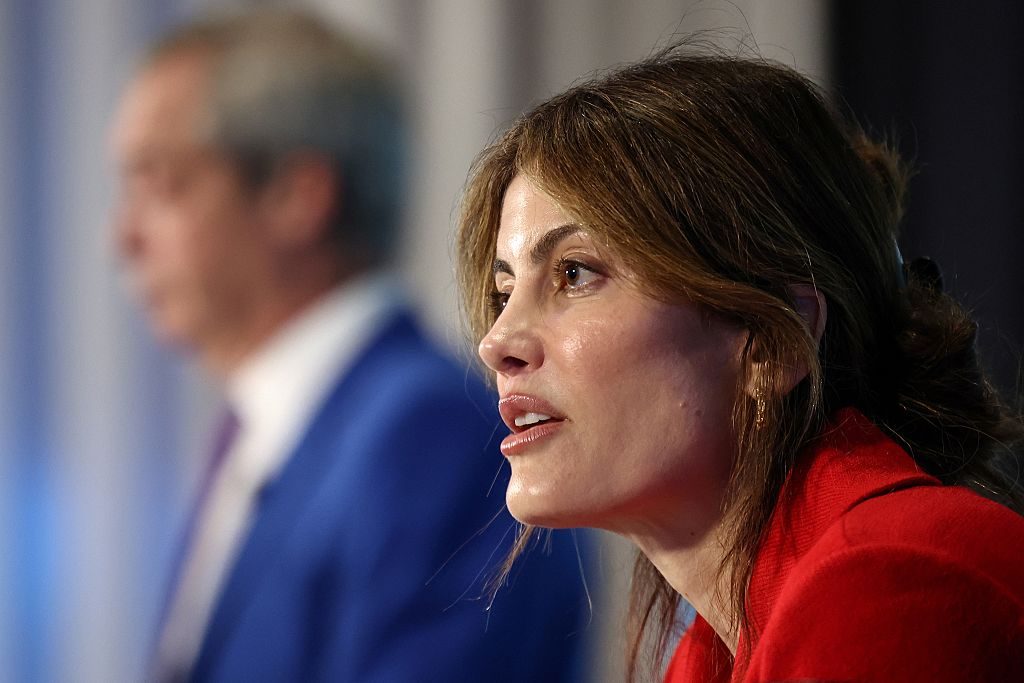
Cunningham’s parents migrated to Britain from Egypt in the Sixties, fleeing Nasser, pan-Arabism and socialism. Arriving with little cash, by her account, they took a succession of menial jobs before borrowing money and becoming small-scale property developers doing up houses. “They worked very, very hard,” their daughter recalls.
Born in 1977, Cunningham grew up in Kensal Rise with four siblings. The cut-and-thrust of political debate in the family home (she would later become the only child to support Brexit) is what she believes sharpened her rhetorical abilities. Her parents’ background has also shaped her political convictions. She believes that Egypt thrived under the British, whom she credits with building beautiful buildings and introducing the rule of law.
More broadly, Cunningham resents the Islamic religious fundamentalism that emerged across the Middle East and beyond through the latter half of the 20th century. And now, looking at Britain’s issues with homegrown Muslim terror, she believes our government should copy the methods of repression used by Egypt’s secular military regime, under which, she says, “you just say the word ‘Muslim Brotherhood’, you’re thrown into a horrific jail”. (According to Amnesty International, the Sisi dictatorship arrested some 1,500 Egyptians for political reasons in 2024, with torture endemic in the country’s prisons.)
Cunningham is similarly strident about her own childhood, giving the London of the Eighties a sepia-toned glow. A sports-mad child who played around the city and slept with a basketball in her bed, she admits that Kensal Rise was less gentrified back then, but stresses that she never felt as unsafe there as she does now. There was no knife crime and no gangs in balaclavas. But now, Cunningham believes, crime is out of control in London. It is this argument, more than anything else, that forms the core of Reform’s campaign to win support in the city. “I dare you to walk through the West End of London after 9 o’clock of an evening wearing jewelry,” Farage told a journalist last year. “You wouldn’t do it. You know that I’m right. You wouldn’t do it.” Attacking Khan, for his part, Donald Trump has argued that “crime in London is through the roof”.
Statistically, the evidence is far less clear. According to the Crime Survey for England and Wales, crime has been on a steady decline both nationally and in the capital. Farage and Cunningham, however, do not accept that measure as reliable. “It is not actual data,” she says. “It’s people’s opinions and what they’ve been through. And surveys are not accurate.” London is “definitely” more violent than it was 20 years ago, she insists to me. In the year to September 2025, however, there were 95 victims of homicide recorded by the Met, less than half the number compared to two decades ago.
What seems clearer to most living in London is that, like in much of Britain, the public realm is deteriorating. Phone theft is up and the number of people living on the streets is at record levels. Friends regularly recount stories of men smoking crack openly on buses and subways.
As a mother of seven herself, Cunningham worries about her own children growing up in the city. When one of her sons wanted a “semi-nice” jacket for his birthday she told him no: he would just get mugged for it. She puts this change in part down to the lack of visible policing, and an absence of police stations. Young people, she claims, have meanwhile been abandoned to social media and allowed to run wild.
Cunningham would like to see stop-and-search rates increased and rejects the idea that this would drive a wedge between the Metropolitan Police and black Londoners. “That’s the political narrative,” she says. “The real narrative on the ground is mums do not want boys carrying knives on the street.”
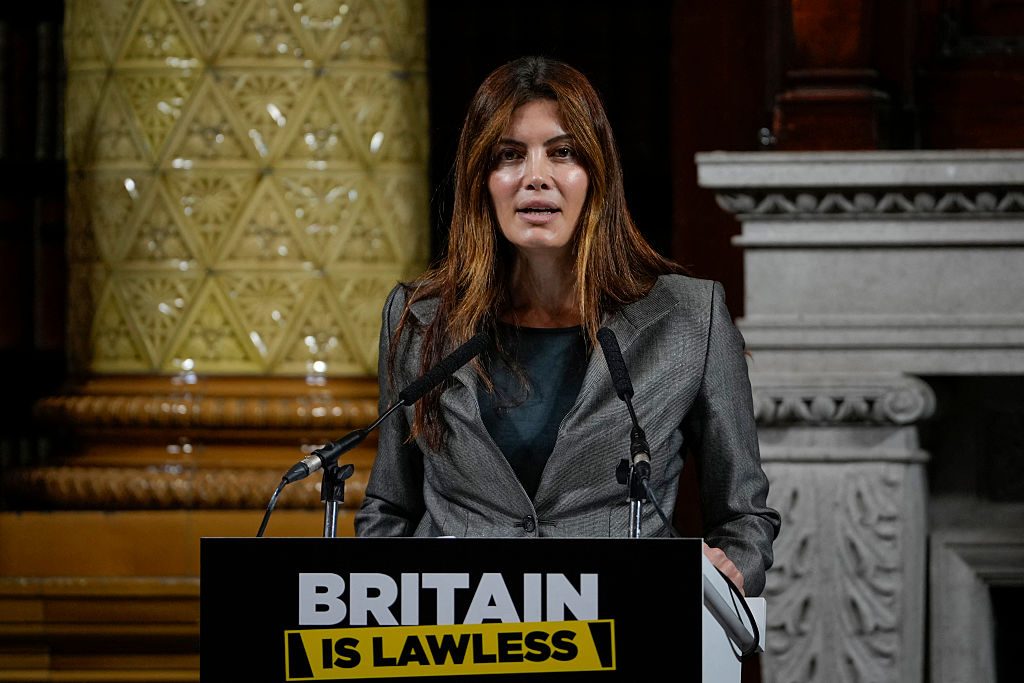
For Cunningham, the softness of our criminal justice system is a central factor in the capital’s decline. She recounts a scene she witnessed in a youth court in which, she says, a teenage girl accused of stamping on her schoolmate’s head was summoned to face justice. Putting on an effete, pathetic accent, Cunningham parodies an anxious criminal justice worker: “Hello, Susie. Welcome to court. We’re all here to help you. You know, we’re here to make sure that you are understood. Whatever you need.” Then back to her normal voice: “The judge was like, ‘Can you take your sunglasses off?’ She’s like, ‘Fuck no’.”
When I suggest that her beliefs are well summed up by the phrase “spare the rod and spoil the child”, she agrees. “They’re treated with white gloves when it should be, ‘what you did is wrong and we’re going to teach you a lesson that will take you into adulthood that it’s wrong’.” According to Cunningham, the failure to adequately discipline children is tied to a deeper moral slump in Britain.
She believes that feeling pride in Britain and your family has been treated as shameful; it has become acceptable to be promiscuous; one of her sons is asked “all the time” by teachers what his gender is. “I would like to normalize tradition,” she adds firmly. “I would like to normalize love of country, love of family, love of community.”
One of the most significant shifts that London has undergone over the past few decades involves demographics. With migrants coming from across the globe, the metropolis has sucked in a dizzying variety of communities at an historically unprecedented rate. As a consequence, white Britons have made up a minority of the city’s population since 2011. For some, such as Khan, who has described diversity as London’s “greatest strength”, this development is evidence of an economic and cultural success story. On the Right, however, ethnic diversity is increasingly presented as a threat to Britain’s stability.
Shortly before I first met Cunningham, Robert Jenrick was recorded discussing a recent visit he had made to Handsworth, a heavily Asian and black neighborhood of Birmingham. “It was absolutely appalling,” he told a local Conservative association, with his comments later published in The Guardian. “It’s as close as I’ve come to a slum in this country. But the other thing I noticed there was that it was one of the worst integrated places I’ve ever been to. In fact, in the hour and a half I was filming news there I didn’t see another white face.”
The same, I suggest to Cunningham, could be said about some parts of London. Does she share the shadow justice secretary’s concerns? “I do have an issue with what he said because I don’t think being British comes down to the color of your skin.” Her issue is with people not speaking English and not being “culturally assimilated with Britain”. It was quite sad, she adds, that for Jenrick the problem seemed to come down to people’s ethnicity, rather than their values.
Unlike him, she continues, Reform is concerned with culture rather than race. In her eyes, parts of London are “full burqa with burqas sold on the market”: and therefore pose a problem. While London’s identity has always been shaped by the migration, not least in the case of Cunningham’s own family, the politician herself is concerned that some areas of the city now feel as if they are not in England at all. “You know,” she tells me, “all the shops are in a different language. Women are walking around in burqas, and I’m like, ‘what, what’s happened?’ I don’t think that’s a good thing at all and I think that is a failure of our government.”
While she remains an observant Muslim and credits the religion with promoting kindness and charity, Cunningham also thinks there should not be Eid celebrations in Trafalgar Square, which have been running since 2006. “We’re not a Muslim city,” she tells me. When I ask if she would also like to cancel public Diwali celebrations, she responds that she would not say that right now. “People are upset that Britishness and British holidays are not represented enough.”
According to Cunningham, though, if London’s communities have become more segregated, it is down not to mass migration and multiculturalism in of themselves, but rather something else: the Labour Party. “They put people in boxes,” she says. “I grew up in London, had friends from all walks of life. Honestly, we never even saw color, we never saw religion.”
The week after we speak at Reform HQ, Cunningham makes an appearance at the Policy Exchange think tank to debate criminal justice policy with Chris Philp, the shadow home secretary, and Jonathan Hinder, a Labour MP who previously served as an officer in the Met. For Cunningham, the discussion, again on rising crime in the capital, is firmly in her professional wheelhouse.
A former prosecutor herself, she was anonymously dubbed a “vigilante mum” by MyLondon after stalking a gang of muggers that she believed had targeted her son. Addressing the small crowd of journalists and other attendees at Policy Exchange’s Westminster office, she begins by recounting this story, which has become something of a calling card. The comparison with Philp and Hinder’s own speeches, both fairly technocratic and dry, couldn’t be more striking, especially when Cunningham really gets into her stride.
The mayor has deprioritized public safety, she claims. You could probably find a knife hidden in “most places” around London because gangs are throwing them away to avoid arrest. The need for Arabic-language translators is hurting London courts. When Hinder refers to falling crime rates, Cunningham interrupts his address to tell him his facts are wrong — and doesn’t stop until the moderator tells her she must allow him to speak. The look on Hinder’s face reminds me of Barry Gardiner.
It’s hard to watch Cunningham in action here and not see a new politics taking shape in real time: demotic and blunt, always in attack mode, and totally uninterested in forming any consensus with Britain’s governing class. Philp and Hinder prepared for a Westminster panel discussion; Cunningham was ready for a brawl.
After the event ends, Cunningham disappears behind a curtain with her fellow panelists. Two young women from an Eastern European embassy tell me they have seen her on GB News, and think she speaks common sense. In their country, they say, they do not have to worry about their phone being snatched. The government just arrests criminals. Now, living in London, they have to think carefully about where they can play Pokemon Go.
At this year’s local elections and in the 2028 mayoral race, we will find out how many people in this city share their perspective. If Cunningham has anything to do with it, that number might be higher than many expect.

Join the discussion
Join like minded readers that support our journalism by becoming a paid subscriber
To join the discussion in the comments, become a paid subscriber.
Join like minded readers that support our journalism, read unlimited articles and enjoy other subscriber-only benefits.
Subscribe