




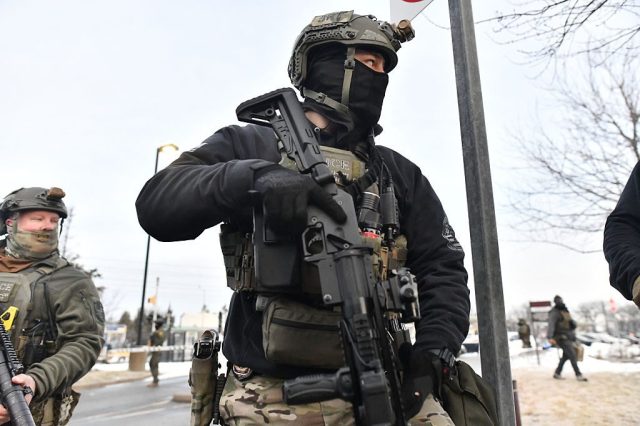
Armed federal agents have policed angry protesters in Minnesota. Photo by Octavio JONES / AFP via Getty Images




In professional wrestling, a “work” refers to that which is pre-arranged and part of the spectacle. Rivalries are decided beforehand, moves are scripted and rehearsed, and the archetypical roles of the actors — whether they are “heels” who people are meant to boo, or “babyfaces” who people are meant to cheer — have already been set long before the matches themselves. The concept of “work” is in turn closely related to the idea of “kayfabe”: the general concept of the actors staying in character, and retaining their apparent enmity, both inside and outside the ring itself. Kayfabe ensures that fans of wrestling can achieve a sense of suspended disbelief. Wrestling may be fake, but it should always feel at least a little bit real, even to the cynics.
The fans of wrestling want to get “worked”; they want to believe the spectacle is real, even though they all know that it is not. The way to get the fans to open up their wallets is to get them sucked into the fictional world of performances and rivalries, and so the companies and actors try very hard to make it all stick.
In contrast, a “shoot” is when the wrestling performance goes far enough that something actually crosses over into reality. As a wrestler, it is possible to “work” yourself into a “shoot”; to have the act you’re playing go so far as to take on a life of its own, outside of your control. A fan could begin stalking you, or could even attack you for things you did to the babyface in the ring; a fake rivalry could turn into a real one.
Today, a very similar dynamic has sunk its fangs into American society itself, and the consequences are becoming increasingly deadly. When Trump began his second term in office, he came in promising a far-reaching revolution in the basic assumptions that underlined American politics. In area after area, the status quo was to be overturned: industries would be onshored rather than offshored, US allies and enemies alike would be brought to heel by tariffs, and the results of decades of mass immigration would be upended through a titanic deportation effort. Having promised his voters the moon, Trump and his administration have struggled to actually deliver. Reindustrialization has turned out to be a bust, for US manufacturing employment is actually contracting. The trade war against China is de facto already over, resulting in only limited changes to the status quo but still causing huge damage to American farmers.
Centrally, the new project of mass deportations has also struggled to get off the ground. While the number of deportations are high in historical terms, they fall massively short of the goal of one million deportations per year that Trump set for his administration. The White House has found it tougher than expected to change the reality of slow enforcement, limited resources and the often glacial pace of legal proceedings. To make matters worse, there are a number of contradictions baked into the idea of massively expanded deportation efforts, and these contradictions don’t have a neat solution.
From the very start of his second term, the various parts of Trump’s coalition have been at loggerheads with each other about the direction and goal of the administration’s immigration policy. 2025 began with a bitter conflict between the “tech bro” wing and the broader Republican base over the need for, and scope of, the H1B visa program, a conflict in which Trump actually sided with the tech bros. On top of that, Trump has consistently wavered on the question of going after employers, even going so far as talking about extending some form of amnesty for illegals working on farms: an idea that the now-late Charlie Kirk warned could break the MAGA coalition. Like Saint Augustine, who supposedly cried “Lord, give me chastity and continence, but not yet!”, the Trump administration is caught between wanting to make good on its promises to ordinary voters, and the basic economic and political reality of having very wealthy donors who don’t actually care about any of that. This contradiction is nothing new in American politics — in fact, it’s been the status quo for the GOP stretching back decades. The GOP has long been the party of voters who are sick of illegal immigration and the employers who want more of it and in fact rely on it to maintain their profit margins. Historically, this awkward marriage has generally produced a politics that is heavy on the rhetoric and very light on the actual follow-through. Trump has not actually managed to transcend this fundamental contradiction; what he has done is come up with a very novel way in which to handle it.
If you can’t meet the goals you set out for yourself when it comes to actual mass deportation numbers, and your political coalition includes business interests who risk losing serious money if they can no longer access cheap, illegal labor, then what can you do? Well, you can turn it all into wrestling. ICE agents — who tended to keep a low profile and work mostly in plainclothes — now ride around in the open, heavily armed and wearing masks, with massive WWE-style media blitzes announcing their arrival. Until recently, ICE generally took some pains to avoid announcing their presence, particularly in blue states where they were known to be unpopular. But all that has been replaced with heavily promoted and hyped-up ICE “campaigns” in blue areas; campaigns that invariably lead to protests, clashes with governors and mayors, and recalcitrance from local law enforcement. All of this of course makes the process of actually finding and deporting illegal immigrants much slower and more dangerous than it would otherwise be. But that isn’t really the point: just like in wrestling, the administration is in the middle of a “work”; building a story and a hyperreality that their “fans” can make themselves part of.
On one level, the administration is truly pushing the envelope: Trump talks regularly about sending in the uniformed military to police Democrat cities, either to solve crime or to simply arrest all the dumb liberals who have supposedly ruined places like Chicago or Los Angeles. But when you actually dig into the details, these plans and suggestions for military deployments are almost entirely hot air, often involving dozens of soldiers for cities of hundreds of thousands. When deployments do happen, like in Washington, D.C., they go on only for a short while before they are quietly rolled up. Just like in wrestling, what matters is the storyline: actions like these are calculated based on what will move the media cycle and on what sounds impressive to the base. As with wrestling, the point isn’t actually to be real; the point is to feel real.
To millions of Americans, what is happening right now is starting to feel very real indeed. Republicans cheer as masked officers finally take off the kid gloves and roughhouse their political enemies. Democrats increasingly feel that the country is becoming lawless, and that the talk about having marines and Army soldiers use their cities as “training grounds” for future military conflict might just be real after all. And even if the actual mass deportations are fake, even if Trump ends up deporting fewer people than Barack Obama or Joe Biden, even if the plans to send in the military to “clean up Chicago” fall apart under even the faintest scrutiny, it doesn’t actually matter. The rocks and snowballs being thrown by protesters right now are real; the tear gas and the batons and the bullets are real. Slowly, surely, the work is morphing into a shoot.
On 7 January, the city of Minneapolis saw a “shoot” happen in the most tragic and literal sense of that word. Renee Nicole Good, a 37-year-old mother with no previous criminal record, was fatally shot in her car after being stopped by ICE agents. There is a great deal of footage available of the scene and the shooting itself, taken from multiple angles; the reader is thus free to make up his or her own mind about the incident. Yet whatever conclusion you draw about the details, the reality is that the details actually do not matter. They do not matter in the slightest, because before the body of Renee Good had even cooled, Donald Trump had already taken to social media to denounce her as someone who had “viciously” attempted to kill ICE agents. The US Secretary of Homeland Security, Kristi Noem, minced no words either, going so far as to essentially declare Good a domestic terrorist.
This kind of rhetoric is fantastically irresponsible, but it’s also not surprising. Rather than compelling people to tone down their rhetoric and back away from the brink, Good’s death immediately became another part of the hyperreality; in death she was transformed into another stereotypical, villainous heel for the crowd to boo and jeer. Pundits on Fox News immediately began talking about how this now-dead woman had written her pronouns — she/her — on her social media profiles, and that she apparently was in a lesbian relationship of some kind. At the same time, angry crowds in Minneapolis began pelting retreating ICE agents with jeers and snowballs, as videos of Good’s crumpled body spread like wildfire. One half of America had a new babyface, the other part got a new heel. Republicans could cheer that another dangerous and potentially terroristic liberal got what she deserved; Democrats received further evidence that the fascists in jackboots really were coming to kill them all.
America is busy weaving a great and terrible fantasy; one where the country is slowly inching toward civil war. Trump is talking about defeating the “enemy from within”, Steve Bannon is warning that Republicans will go to jail if Democrats win the midterms. Social media is increasingly filled with shrill talk about how the other side is dangerous and cannot be reasoned with, and polling indicates that a very large number of Americans are now worried about the risk of democratic decline and even civil war itself. People have already died as a result of this fantasy; even worse, their deaths rapidly become the fuel the fantasy needs to keep growing stronger and more believable. As the story grows in urgency, it is drawing in more and more people, making future confrontations and further deaths all the more likely. Neither side in this conflict has anything even remotely resembling clean hands. Before Renee Nicole Good, there was Ashli Babbitt. Before Donald Trump dismissed his own countrymen as seditious radicals and terrorists, Joe Biden and his party did much the same thing.
Increasingly, this kind of wrestling-like dynamic seems to be applied everywhere. The now almost entirely abandoned trade war between America and the rest of the world, going even further than the trade war with China, was one great big spectacle from start to finish. Massive, business-destroying hikes to tariff rates got announced through late-night social media posts. Trade delegations of important allies like Japan, upon visiting the White House to try to work out new trade policies, found themselves part of what turned out to be mere photoshoots: the Americans were neither prepared for nor particularly interested in actually settling on the details of some new agreement. In his various feuds with countries like Canada and Denmark, Trump has strayed far beyond geopolitical norms; but the feuds are reminiscent of Trump’s own history inside the wrestling world. Indeed, Trump has the rare honor of being the only president in American history to have been inducted into World Wrestling Entertainment’s coveted hall of fame, engaging in fan-favorite feuds such as the “Battle of the Billionaires” match between him and WWE co-founder Vince McMahon, the outcome of which led to Trump shaving McMahon’s head inside the ring.
But acting out the fake wrestling version of an incipient civil war is fantastically dangerous. The level of dehumanization, cruelty and bloodthirstiness one now sees on social media is already reaching a boiling point. Without some kind of reconciliation — which there appears to be zero interest in — more people will die, and the fantasy will slowly begin to turn into reality. America already has all the prerequisites for dangerous levels of social unrest and internal violence. The national debt is exploding, internal dissatisfaction with the state of the economy keeps rising, and the growing AI bubble is looking increasingly unstable. On top of that, it is engaged in multiple simmering conflicts over the world: trying to strong-arm Venezuela, guard against China, counter Russia and Iran, while also antagonizing all of Europe and threatening to annex Greenland from Denmark, a Nato ally. It has few friends and a growing list of enemies, forcing an increasingly overstretched and under-resourced military to try to be everywhere all at once. Historically speaking, the combination of social and economic crisis at home, and overstretch and wars abroad, is a dangerous one.
Moreover, America’s recent spate of high-profile assassinations should put to bed any lingering delusions — popular in the Joe Biden era — that a domestic conflict would be neat, easy, and containable. The US military, for all that’s impressive about it, cannot actually do much against the kind of internal violence that would be relevant here. Even Donald Trump himself, a man one of the most expensive security details in the world, was an inch away from losing his life to an assassin’s bullet only recently. If a concerted outbreak of political violence happens, very few people will be safe.
But that outbreak of concerted mass violence has not yet arrived in America. All talk of dealing with “the enemy within”, of sending in the troops to clean out Chicago, of calling in the National Guard to defend against Trump’s fascism, of “communists” or “fascists” about to take over the country and kill your friends and family: it’s all just fake. It is made up, it is a story. Yet people have already begun killing each other over that story, and as things stand nobody seems inclined to stop. As the late wrestling legend, Hulk Hogan, would have put it: sometimes, when you work a work, you work yourself into a shoot.
To that piece of wrestling wisdom, we could perhaps somberly add: if the work you’re working is about how dangerous enemies of the republic lurk around the corner, and how every political enemy is a domestic terrorist, a bloodthirsty communist, or goose-stepping fascist, it’s usually only a matter of time before the shooting starts.

Join the discussion
Join like minded readers that support our journalism by becoming a paid subscriber
To join the discussion in the comments, become a paid subscriber.
Join like minded readers that support our journalism, read unlimited articles and enjoy other subscriber-only benefits.
Subscribe