




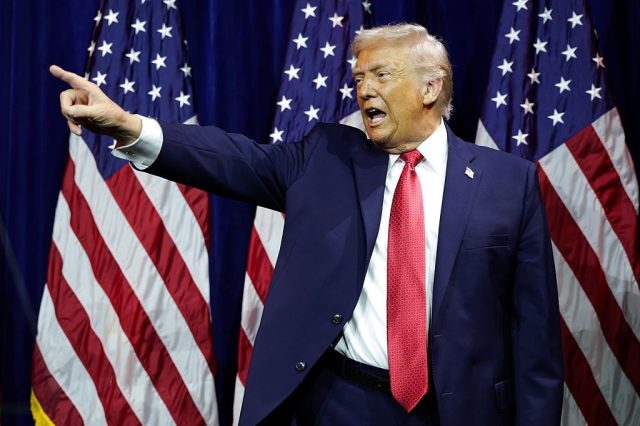
Once again it is up to Trump (Alex Wong/Getty)




Visitors to Tehran’s enormous and enormously luxurious Iran Mall in January 2024 must have wondered who would invest so much money for such extravagance in such an embattled country. The mall is the world’s largest shopping and entertainment center, with over three million square feet just for its shops, plus giant decorative fountains in a city running out of drinking water. At the time, Iran was exchanging missile strikes with Pakistan over each country’s war with its own Baluch population. It would soon also escalate its intermittent Israel war and suffer disastrous defeat.
The brave investor was Ali Ansari, a fervent supporter of Ayatollah Khamenei’s dictatorship and proud owner of a £33-million London mansion. He did not have to strive hard to obtain bank loans from the Ayandeh bank, which he fully owned and which offered high interest rates to attract deposits. Because everyone knew that Ansari was close to the regime, depositors were sure that they would be repaid and they were quite right. When the bank, whose largest client was Ansari himself, collapsed in October 2025, it was taken over by the long-established state-owned Melli bank, which immediately paid back the depositors with banknotes printed by Iran’s central bank.
But it was all too much for Tehran’s Bazaar merchants who could not unsee the obvious corruption at the heart of the regime that the Ayandeh bank scandal had exposed. To compound matters, the bank’s depositors were repaid with freshly printed banknotes that could only produce more inflation, on top of all the ocean of money printed for the Revolutionary Guards and their now-defeated Hamas, Hezbollah and Houthi appendages.
Traditionally religious, the Bazaaris continued to support the regime until its costly non-stop extremism finally resulted in direct warfare with Israel itself. The 12 days and nights of unresisted Israel air strikes from 13 to 25 June 2025 destroyed nuclear sites and army bases, as well as the regime’s military reputation. Even before Donald Trump’s B-2 bombers delivered their 14 heavy bombs on multi-billion-dollar nuclear installations as the final blow, the ever-boastful Revolutionary Guards had been exposed as incompetent buffoons who could not even protect their top generals and nuclear engineers from assassination in their own homes.
When the value of Iran’s rial collapsed, falling below one million to the dollar by October, the Bazaaris could no longer restock anything at all, imported or not, thanks to the ever-rising prices. They closed down on 28 December, announcing a strike and triggering protests that have since spread nationwide. Unable to find food, would-be shoppers were the first to demonstrate, quickly attracting others to generate increasingly large protests.
On 8 January this year, Reza Pahlavi, son of the last Shah, called on Iranian city-dwellers to go out to “conquer and control the centers of the cities”, specifying an 8pm start time. When many thousands heeded his call, Reza acquired instant credibility with the Washington officials and Arab rulers who had long ignored his claim that he could summon Iranians at large to challenge the Ayatollah regime. That Trump scoffed at the claim even after the mass demonstration is a curious error prompted by the isolationists lurking in the White House, who are contradicted by the photos and films of tens of thousands marching under the Iranian royal flag. Reza also appealed to the Artesh, the regular army, to assert itself. Long overshadowed by the much better-funded but now discredited Revolutionary Guard, its 300,000 men could step in and take over — if, and only if, the Revolutionary Guards are first targeted by the US.
That is how a Trump air strike could change the course of events. Its targets are obvious: the two headquarters of the Revolutionary Guards in Tehran, the Nasser-e and Quds-e, each housed in buildings well separated from civilian housing; and their equally distinctive buildings in Iran’s other cities starting with Mashad, Isfahan, and Shiraz.
The argument for the air strike is that it could bring down the now hated regime, but also that it would make Trump a man of his word. He distinctly threatened attacks if the regime started killing people, as it has done on the scale of thousands, with more deaths every day. As of now, however, Trump says that the regime assured him that there would be no more executions, to the great joy of J.D. Vance and his fellow isolationists.
The latter’s argument is that things could go wrong even if the US action is confined to several air strikes in the course of a single day. That is, of course, perfectly true of any military action — but it did not happen on 22 June last year when the nuclear targets were destroyed without incident. Nor did it happen when Mr and Mrs Maduro were lifted out of Caracas without any American being bruised in the process.
In addition to Vance and his cohort, our beloved Saudi friends are also very much opposed to any US intervention that might release 90 million Iranians from the cage of the clerical dictatorship. However hostile they are to today’s regime — which has attacked them more than once with missiles that burned oil installations — the Saudi monarchy and the lesser princedoms would be far more threatened by their close proximity to an exuberantly democratic Iran, which would be further liberalized socially and culturally by a flood of returning exiles from Hollywood, Stockholm and all points in between.
For others around Trump with darker thoughts, there is another reason to oppose any US action against the murderous Ayatollah regime. In addition to the Iranians and uncounted Yemenis, Iraqis, Syrians and key US interests right across the Middle East, Israel might also benefit from the demise of its most persistent enemy. That is reason enough for Tucker Carlson, and other vocal critics of Israel, to oppose any military action against the failed and murderous regime.
So once again it is up to Trump and his super-loyal and highly effective Secretary of State, Marco Rubio — the same one who argued that Maduro could be removed swiftly and cleanly. Luckily, Rubio paid no attention to Tucker Carlson’s predictions about Iran last year. So much for a war that “would kill thousands of Americans” and “which we would lose”.
Professor Edward Luttwak is a strategist and historian known for his works on grand strategy, geoeconomics, military history, and international relations.
 ELuttwak
Join the discussion
Join like minded readers that support our journalism by becoming a paid subscriber
To join the discussion in the comments, become a paid subscriber.
Join like minded readers that support our journalism, read unlimited articles and enjoy other subscriber-only benefits.
Subscribe