




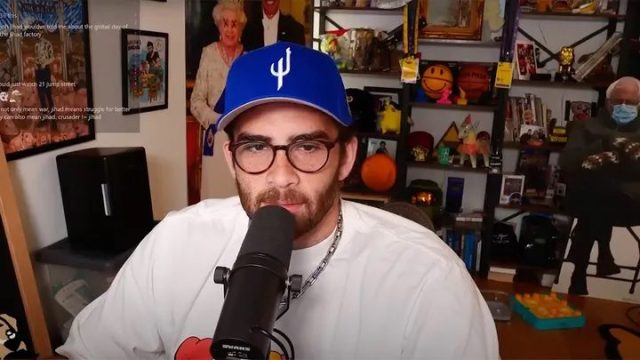
'Hasan Piker is a leftist darling of Twitch.' (YouTube)




“The audience is moving in my direction, and away from legacy publishers,” proclaimed Hasan Piker in a recent interview, as he explained why he hasn’t made a permanent move from his online platform into traditional media.
Piker, a native of New Jersey, is a leftist darling of Twitch, the livestreaming platform that has been a subsidiary of Amazon since 2014. Pretty much every day of the week, he logs on and discusses the news online to an audience of hundreds of thousands, often for seven or eight hours at a time.
And despite his resolution to remain an online personality, Piker has effected something of a breakthrough to the mainstream since Donald Trump’s re-election. Interviewed by Variety, GQ and Wired in the past months, he has also appeared on television and on podcasts produced by NPR and Crooked Media. The normies, for want of a better term, are suddenly paying attention. On the night of the American election, viewer numbers on his live coverage were larger than those of ABC News and the Associated Press.
Piker is the culmination of a particular attitude of political commentary: the hyper-online pundit who attracts both admiration and suspicion for being in touch with the youth. Heralded as a voice of the Left, despite his insistence that the Left cannot podcast its way out of its current malaise, he is the most famous among a cohort of influencers who have made their names talking about politics and current affairs on Twitch.
The rise of the Twitch commentator tells us much about how online audiences now prefer to engage in politics. It’s interactive, real-time and personality-led. Viewers don’t want to simply receive wisdom via the old-fashioned one-way street of a newspaper column or a late-night monologue. They want to interrupt a chain of thought live on air, send digital gifts, root for a team, leave an angry comment.
This revolution is happening everywhere, especially in places young men congregate on the internet. Why watch a distant-seeming porn star when you can message an OnlyFans model? Why be content with a passive index fund when you can participate in a short squeeze by buying shares from your phone?
Be it gaming, gambling or gooning, there’s a desire for an extra layer of participation. Where it leads is to a form of political engagement that is gamified, just like everything else.
Twitch itself was designed for games. Originating as a spin-off of the more generalist site Justin.tv, it quickly eclipsed its parent and became synonymous with that very 21st-century phenomenon: watching other people play video games online.
Many who made their names in livestreaming started out by simply playing video games on camera, chatting as they did so with the live audience. But politics was always there in the background. The gamut runs from transgender activist Keffals, to the debater Destiny, to Right-leaning provocateur Asmongold. They shifted as it became clear their audience liked it when they went on political rants or got into arguments. Maybe some of their audience hated it, but that, too, was interaction.
The inflection point came in the pandemic, when a house-bound global viewership swelled the numbers of people looking for online entertainment and community. This was also when Twitch emerged as a political force, emblemized in 2020 when Alexandria Ocasio-Cortez used the platform for a livestream of Among Us and gathered streamers, including Piker, to play the imposter-hunting game. It showed off her nous for online communication with voters, yes, but it also conferred legitimacy on Twitch. Here was an audience ready to engage with politics, if only political communicators would learn how to talk to them.
In many ways, political livestreamers make sense as a natural continuation of how politics is discussed online and how audiences interact with it. Thanks to the array of content and algorithmic tailoring, you can assemble a set of commentators you love — or love to loathe. The internet has long been a place to find your own personal Fox News.
Piker himself is part of an online political programming dynasty. His uncle Cenk Uygur is a co-founder of The Young Turks (TYT), a Left-leaning web series that trailblazed this kind of highly watchable, highly shareable discourse in the 2000s and spawned a massive network of related shows and pundits.
But while TYT adopted the sets and suits of the cable shows that came before it, Twitch streams have a DIY affectation. Gaming chairs, soft backlighting, carefully assembled memorabilia. It’s the same aesthetic that has defined YouTube for the past decade or more: that of an adult who finally has the funds to create the bedroom they wish they’d had as a teenager.
The tone is often casual, unrehearsed. It’s not uncommon for streamers to be live for five, six, seven hours at a time. Like the early webcam celebrities, they might just leave the camera on while they go about their lives, getting work done and gaming. The more organized shows might have an agenda of news stories to discuss and guests to debate or interview, but they can still be marathon sessions that are frequently interrupted by what users say in the “Chat”.
And that’s the real difference of the livestream era. Twitch — and its main rivals, Kick and YouTube Live — allow a level of interaction that shapes the discussion. Streamers respond to comments left in the live chat, sometimes even opening links their viewers send them and reacting to videos or articles live.
Creators are incentivized to interact because in doing so, they build a sense of community that keeps viewers coming back; fans in turn are motivated to keep commenting, keep sending digital gifts, in the hopes of getting a response. There’s a back-and-forth that makes it more engaging than the one-way communication of a Politics Live episode, or even than the discrete, curated moments of audience interaction on shows like Question Time.
Not only do audiences get to engage directly with content, they can shape it. The writer Samuel Rafanell-Williams calls this “online epistemic collaboration”, in which viewers are “involved in the meaning-making process during broadcasts”.
But this impulse to interact should be understood in the wider context of where internet content is going, in politics and beyond.
We know by now that attention is the currency of the online world, and that ways to hoard it are prized. What political livestreamers have cracked is that interaction makes everything that bit more exciting, the equivalent of playing a character in a video game rather than watching them in a film.
Perhaps not uncoincidentally, it’s a similar dynamic that powers OnlyFans. While users can look at the infinite reams of pornography available for free, they prefer to pay for access to a specific creator’s work. For a fee, they can make requests for custom content and even message their preferred performers — though they might in fact be talking to a bot or a professional “chatter”.
Some of the internet’s political pundits even combine the two worlds. Denims, who spends several multi-hour sessions a week keeping her audience up to date with the news on Twitch, also happens to post photos of herself in e-girl garb on Instagram. It’s all done with a knowing wink, very Margot-Robbie-in-the-bathtub. But it’s also built around things that are known to hoover up attention, especially the attention of young men.
Then there’s gambling. Like gaming, betting has long been intertwined with livestreaming. Ed Craven, the founder of Kick, also set up the online casino Stake. There is a whole subgenre of livestreaming dedicated to gambling live on air: if you want to keep viewers hooked, a wager is an easy way to create dramatic tension.
Going even deeper into the crypto caverns, there are also sites like Pump.fun. The token creation platform, which was set up early last year, allows anyone to make a so-called “memecoin” and attract investment to it. Users quickly began using it to make crypto tributes to their favorite public figures and watch the price go up or down with public favor. What could be more interactive than speculation?
That gold rush for attention can lead to some dark places. Nothing demonstrated this better than when Pump.fun introduced a livestreaming feature. Because the streams were tied even more directly to the creator’s financial rewards than other platforms, they quickly devolved into shocking, grotesque or illegal behavior.
While those streams weren’t political (unless you count the guy who pledged to shout “heil Hitler” a million times on camera if his memecoin hit a certain value) they demonstrate the nastiest endpoint of the attention-seeking domain.
In the case of Twitch, there is something intriguing about the possibilities of a malleable, participatory discourse. But there is also a danger that online debate becomes more about participation than the real outcomes.
The internet writer Ryan Broderick spotted this trend back in 2020, when he described it as the “Twitch theory of politics” on a podcast. Voters had stopped trusting politicians to deliver any policies they actually wanted, he argued, such that the only thing left to get out of politics was entertainment. “Suddenly the government — and politics in general and policy — become like an abstract thing,” he said. “It’s like a game, and you want to invest in personalities to play that game. And so what you’re doing is you are supporting your streamer, your influencer, to play the game of politics.”
In the intervening years, that dynamic has become more acute, and audiences have gone from wanting to watch this kayfabe display to wanting to participate. Indeed, platforms such as Twitch are allowing participants — both creators and viewers alike — to try on new political personae, watching what leads to the strongest reaction from those around them. This is not to say there’s any lack of conviction in today’s political discourse, it’s just that it has become secondary to attention. But attention is not the same as reflective engagement. The formats and platforms that originally seemed to reward authenticity — to the benefit of Piker and others — were really at the vanguard of our society’s profound loss of authenticity. Gamification and attention-seeking are anathema to deep engagement. But perhaps deep engagement was never what we really wanted.
Join the discussion
Join like minded readers that support our journalism by becoming a paid subscriber
To join the discussion in the comments, become a paid subscriber.
Join like minded readers that support our journalism, read unlimited articles and enjoy other subscriber-only benefits.
Subscribe