




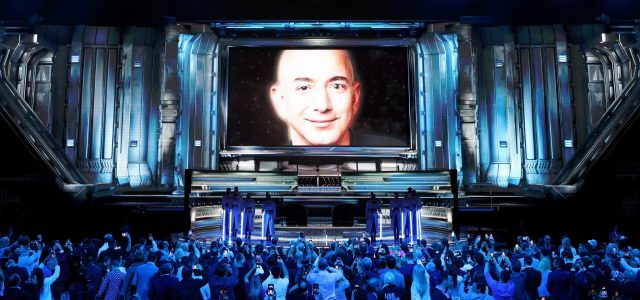
STEM lords dominate the culture. (Alexander Tamargo/Getty Images for America Business Forum)




“I would never read a book,” declared crypto kingpin Sam Bankman-Fried in a fawning profile published by the venture capital firm Sequoia in September 2022. “I don’t want to say no book is ever worth reading, but I actually do believe something pretty close to that. I think, if you wrote a book, you fucked up.”
When SBF, as he likes to be called, was arrested for fraud and money laundering a couple of months later, journalists and other literary sorts seized on his words as evidence of moral corruption. Expressing a disdain for books is not only “ignorant and arrogant”, wrote The Atlantic’s Thomas Chatterton Williams; it signals “a much larger deficiency of character”. “Sam Bankman-Fried doesn’t read,” ran the headline of a Washington Post editorial. “That tells us everything.”
But if SBF’s comeuppance provided comfort to the bookish set, it was of an icy variety. In dismissing books as outdated information-delivery devices, the young entrepreneur wasn’t saying anything out of the ordinary. He was giving voice to the zeitgeist. The philistines have taken over the culture.
What we’re seeing as we enter 2026 is a reversal of the situation C. P. Snow described in his celebrated 1959 lecture “The Two Cultures”. Snow, a Cambridge physicist turned popular novelist, argued that the culture of the West had split into two camps. On one side were “literary intellectuals” — novelists, poets, artists, critics. On the other were what we would today call STEM types — scientists, technologists, engineers, mathematicians. Between the two lay “a gulf of mutual incomprehension”. The intellectuals took pride in their lack of interest in scientific and technical developments, while the boffins remained largely ignorant of everything encompassed by the then-common phrase “high culture”. The two camps, Snow observed, might as well have lived on different planets.
Along with the knowledge divide came a power divide. To the public, the literary intellectuals — Snow pointed to the poet and critic T. S. Eliot as the “archetypal figure” — constituted the cultural elite. They were the ones who appeared in glossy magazines and high-brow television shows. They were the ones whose words determined what was worth talking about, whose tastes established the boundary between the great and the trifling. The scientists and engineers, with a few notable exceptions, remained out of the public eye, toiling in lab-coated anonymity. Their discoveries and inventions were shaping the future, but as individuals they held little cultural currency.
Today, the divides remain, but the power dynamic has been turned on its head. The STEM camp, in particular its technological wing, dominates the culture. Techies take prominent seats at presidential inaugurations and White House banquets. Their words and actions set much of the public’s daily agenda. And not only are they ubiquitous presences in the media; they’ve come to control the media, as news and entertainment have shifted onto the digital platforms they control. Mark Zuckerberg, Sam Altman, Jeff Bezos, Elon Musk: these are our new T. S. Eliots.
As for old-style public intellectuals, they’ve disappeared from the scene. There are still serious writers and artists and critics, but they work in insular obscurity, speaking less and less to the general public and more and more to one another. In universities, humanities departments shrink as students flock to STEM fields in pursuit of higher pay and greater status. In primary and secondary schools, art, music, and library programs are cut to free up money for EdTech investments. Those who once created and celebrated high culture now seem ashamed even to speak the phrase. They’ve come to doubt their own worth.
The cultural shift runs deep. People’s skills and habits are changing along with their perceptions. In the last 20 years, the number of Americans who read for pleasure plummeted by 40%, according to a University of Florida study published last summer. A third of US kids now graduate high school without basic reading skills, and a quarter of adults read at a third-grade level or worse. In the UK, the percentage of children who enjoy reading in their spare time fell from 55% to 33% over the last 10 years, according to a long-running National Literacy Trust survey. If the expansion of reading and writing was a defining characteristic of the 19th and 20th centuries, their withering is a marker of the 21st. As Times columnist James Marriott writes, “Welcome to the post-literate society.”
Those who built fortunes atop the rubble of literary culture smell victory. “Technology is the glory of human ambition and achievement, the spearhead of progress, and the realization of our potential,” proclaimed the venture capitalist Marc Andreessen in “The Techno-Optimist Manifesto”, a much-discussed 2023 blog post. He continued: “Technology is liberatory. Liberatory of human potential. Liberatory of the human soul, the human spirit. Expanding what it can mean to be free, to be fulfilled, to be alive. We believe technology opens the space of what it can mean to be human.”
One need not be blind to the joys and bounties of technological innovation to find such triumphalist blather repugnant. (In what might generously be interpreted as an adolescent attempt at provocation, Andreessen echoes the words of “The Futurist Manifesto” written more than a century ago by the proto-fascist F. T. Marinetti.) But, like SBF’s remark a year earlier, Andreessen’s screed catches the tenor of our time. It elevates technology to the position that art, literature, and even religion used to hold. Technology is the highest expression of human creativity, the dwelling-house of soul and spirit. Our instruments and our systems, not our inner lives, provide us with meaning and purpose. In Silicon Valley’s rigidly utilitarian conception of the human condition, there’s no room for imagination or aesthetics, metaphysics or faith. As for beauty, we’ll have to content ourselves with discovering it in an app interface.
The rise of generative artificial intelligence, as both a practical technology and a popular obsession, crystallizes Big Tech’s cultural takeover. AI turns reading and writing into automated industrial routines, optimized for speed and efficiency. It instrumentalizes intellect, allows the critical and creative work of the mind to be outsourced to machinery. The public, whatever fears it may have about the ultimate consequences of the technology, seems happy to employ it in myriad ways to save time and money.
In his most influential essay, “Tradition and the Individual Talent”, T. S. Eliot argued that poets and other artists, through years of deep reading and careful observation, forge within themselves an understanding of the works in their field so deep it turns instinctual. Beyond knowledge, they gain “the consciousness of the past”. Having internalized tradition, they can then apply the singular power of their own sensibility to transform it into something new, something that transcends the personal to become universal. Individual talent becomes the crucible that sustains tradition by carrying it, in new forms, into the future. In the aggregate, all these intricately connected acts of creation form the culture.
Generative AI gives us a parody of Eliot’s creative process. Tradition is replaced by a vast statistical model constructed of digital representations of the works of the past. Individual talent is replaced by a prediction function that mindlessly extracts patterns of data from the model and serves them up in the form of text, image, or sound. “Poetry,” Eliot wrote, “is not a turning loose of emotion, but an escape from emotion; it is not the expression of personality, but an escape from personality.” He immediately added a crucial clarification: “Of course, only those who have personality and emotions know what it means to want to escape from these things.” Bots like ChatGPT, Gemini, and Claude have no personality or emotions to escape from. In speaking to us with the voice of nobody, they mock us. Their hollowness is our hollowness.
There’s a deep irony here. Under the reign of the STEM lords, the public’s trust in science and scientists is decaying. Far from promoting empiricism and objectivity, the cult of virtuality is encouraging a return to superstition, subjectivity, and myth. The overthrow of the old intellectual elite and its replacement by the new technological elite, we can now see, opened a cultural hole that has been filled by ideological fervor, financial speculation, and prideful ignorance, all amplified by a digital communication system that, in its inhuman scale and speed, leaves little room for reflection or discretion.
Whatever their shortcomings, the old avatars of high culture shared a set of values — a respect for talent, taste, and tradition; a disdain for the flimsy and the fake; a commitment to rigor in thought and expression — that encouraged the pursuit of excellence not only in art and literature but in science, engineering, and other practical pursuits. If Snow were alive today, he might feel nostalgic about the state of affairs he bemoaned at the dawn of the Sixties. He might now see that the divide between the two cultures was not as sharp as he supposed. Their differences masked a deeper bond.
When, in a recent jailhouse interview, Bankman-Fried revealed he had started reading novels, I couldn’t help but think of the concluding couplet of W. H. Auden’s “In Memory of W. B. Yeats”:
In the prison of his days
Teach the free man how to praise.
Maybe there’s hope.
Join the discussion
Join like minded readers that support our journalism by becoming a paid subscriber
To join the discussion in the comments, become a paid subscriber.
Join like minded readers that support our journalism, read unlimited articles and enjoy other subscriber-only benefits.
Subscribe