




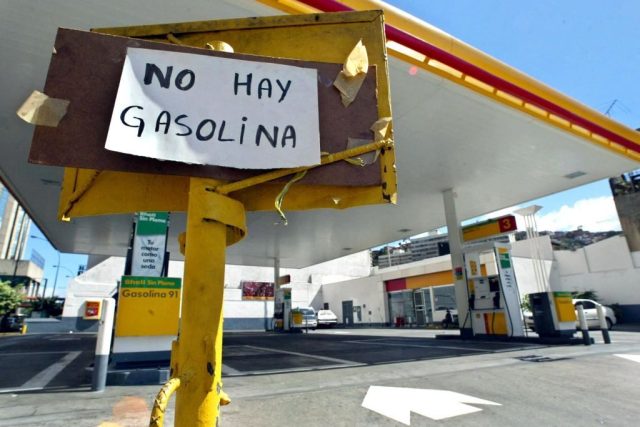
(Juan Barreto / AFP via Getty)




When world oil markets re-opened for trading late on Sunday, the commodity’s price hardly moved. That little piece of data suggests that if Donald Trump’s audacious move on Venezuela really was all about oil, it’s off to a bad start.
Since the operation to extract Nicolás Maduro from Caracas and fly him to the US to face trial, much has been said about how the American operation will shake up geopolitics and the world economy. China, which imports about half a million barrels of oil daily from Venezuela, has just lost a key strategic partner, delivering the advantage in the US-China rivalry to Washington. Meanwhile Venezuela’s vast oil reserves, which we keep being reminded are the biggest in the world, have now fallen into the grip of the US. With this control secured, America will control a vast supply of cheap energy, which it can use to enrich its oil companies, power its industrial renaissance and dictate policy to world energy markets.
But if all that were true, we’d have expected to see big movements in world markets. As traders digested the dramatic news, Chinese stocks would have plunged as the country’s growth prospects dimmed; oil prices would have either plummeted as the world anticipated the massive supply of new crude, or alternatively soared as the risk of conflict and attendant supply disruptions heightened; government bonds and the dollar would have rallied as investors flocked to the safety of US treasury paper in anticipation of wider conflict. That was, after all, what happened in past conflicts over oil: the 1973 Yom Kippur War tipped the world economy into recession, and the 1979 Iranian Revolution, by sending inflation skywards, helped bring down governments in the British and American elections in the next year.
But none of that came to pass this time round. Chinese stocks were up on Monday. Bonds barely budged. Currency markets revealed few signs of major movements to safe havens. The oil price moved sideways for most of the day. Essentially, traders were telling us there was nothing much to see here, folks.
Put simply, little has changed. The suggestion that a sudden flood of Venezuelan oil will swell global supply rests on the apparent assumption that all you need to do is sink a well a few feet down and black gold, ready to put into automobiles and diesel generators, will come gushing out. In fact, Venezuela’s oil infrastructure is so degraded by years of neglect, and its business environment so difficult to navigate due to decades of corruption and poor governance, that the scale of investment required to revive production, refinement and exports is vast — typical estimates being north of $100 billion over 15 years.
Where will all that money come from? Venezuela is broke and, in the absence of US security or financial guarantees, is unlikely to suddenly obtain access to abundant cheap credit. Even though Venezuelan bond prices shot up some 24% on Monday, that means investors will still pay a mere 41 cents on the dollar — which, when converted into a yield, leaves Venezuelan interest rates well into double digits. As for the private sector, although in the wake of the operation US President Donald Trump said US oil majors would “go in, spend billions of dollars, fix the badly broken infrastructure, the oil infrastructure, and start making money for the country”, those same companies have so far been noticeably silent on their own plans. A former executive for Chevron, the only American major that still has operations in the country, has floated the possibility of raising $2 billion for further Venezuelan investment. But the majors are, at least so far, waiting for more clarity.
With projects already underway elsewhere, it’s not clear what advantage they’d gain from suddenly re-allocating capital to Venezuela — not least because the long time-horizons involved would require a stable, predictable environment before the majors feel comfortable sinking money again. Which is to say, a regime change. And what happened on Saturday fell far short of that.
Instead, all that the weekend’s military operation accomplished was to change the leader, not the regime. And while the administration maintains that the new acting president Delcy Rodríguez, who is seen as a relative pragmatist among the Chavistas, will effectively do what the White House instructs it to do, the idea that the US can simply install a satrap and then retreat to the comfort of Pennsylvania Avenue stretches credulity.
With hardline Chavistas still in control of the military and a network of militias throughout the country, Trump will find it difficult to shape events without putting boots on the ground. Assuming he doesn’t do that, he will likely get lip service and not much more from a leader that is likely to have a weak base of domestic support. It’s hard to imagine any Venezuelan leader who acts as a US puppet being able to retain significant backing from either rival elites or the population at large. If Trump does try to bolster her by sending in American soldiers to establish order, it will do to his presidency what happens to most presidencies that start with a major foreign invasion: mark the beginning of the end.
Americans seldom like foreign military incursions, except for those that are brief and successful, like last summer’s bombing of Iran. And as the President who was elected on a pledge to end the country’s “forever wars”, Donald Trump has little political leeway to commit resources to a major Venezuelan operation. With his Venezuelan action already polling badly, he can talk the talk but will find it very difficult to walk the walk.
Investors therefore know that little has changed, which is why their response to the operation has so far been to stand by and wait for more. Which makes one wonder, what was this all for? As a piece of theater for the home audience, the daring and stunningly effective intervention may have been a ratings hit. But if it now bogs the US down in a country which has previously given it a lot of grief, all while hurting America’s international standing, it risks turning into a Pyrrhic victory.
In fact, there’s something about this whole operation that feels strangely anachronistic. Although some see this fight as an extension of the US sphere of influence or even a battle over drugs, most of the commentary, at least in the Western media, has treated this as a resource war, a variant of the Great Game to secure control of a key resource and thereby gain a stranglehold over one’s rivals. The sort of great-power conflicts which defined much of the past two centuries.
But the world has changed. The global economy is far less resource-intensive than it once was, and its oil intensity has been in long-term decline. In the 20th century, the world economy was powered by oil and coal. Today, even though that remains the case, the world is rapidly transitioning to diversified supplies of renewable energy which depend entirely on local resources. Over time, the carbon intensity of the world energy supply will thus decline further, making oil less strategically important. That no doubt explains why China’s markets were unmoved by the weekend’s events — it had already reduced its dependence on Venezuela to the point it accounted for only about 4% of its total oil imports. The country is leading the world into the energy transition at a rapid pace, installing renewable energy and reducing its oil imports precisely to end such vulnerability to disruptions to global supply.
And while Western countries are following Trump’s lead and starting to temper some of their moves towards renewable energy, the rest of the world is instead following China’s lead. The main markets for Chinese exports of EVs and solar panels are now shifting from Europe to the developing world. What is driving their transition is not concern with climate change but the more immediate gain of reducing import dependence and foreign exchange bills.
If anything, Trump’s move on Venezuela will further incentivize developing countries to speed up their efforts to decarbonize their economies. American administrations of all stripes have demonstrated their willingness to use their control of energy and financial markets as weapons. What better way for developing countries to remove that weapon than by eliminating one’s dependence on what America — or any other country for that matter — controls? They’ll localize energy supply and look for other ways to manage their money than parking it in the US. (Perhaps not coincidentally, gold was one of the few assets whose price did move sharply higher on Monday). Ethiopia, with its abundant hydroelectric resources, recently banned the importation of internal combustion engine cars in order to reduce its fuel bill, while Ukraine is making its electrical grid more resistant to Russian bombs by shifting away from big power plants to rooftop solar. Europe, one recalls, fell into recession when the 2022 Russian invasion of Ukraine cut off its gas supply, so it knows a thing or two about strategic vulnerability.
All that helps to explain why oil has been in a long bear market and has largely shrugged off the events that would have once caused major shocks to world energy markets, from Middle East wars to Latin American invasions. Trump has devoted American resources to seizing a prize which will over time be increasingly less sought. Which is why when he brandished it before the world, investors scarcely budged.
For all the talk of a return to 19th-century style gunboat diplomacy, a lot has changed since the high age of European imperialism. As Robert Pape, a specialist in insurgency at the University of Chicago puts it, the capacity to resist imperial aggression today far surpasses then. Where Gatling guns once faced men with spears, today, potential guerrillas have access to modern lethal weaponry on an industrial scale. It takes a lot of gunboats to assert supremacy today. Trump thus faces an unpleasant choice: either cut bait now, or go all in and watch his presidency be defined by the successes, or more likely failures, of what will be seen as his war.
John Rapley is an author and academic who divides his time between London, Johannesburg and Ottawa. His books include Why Empires Fall: Rome, America and the Future of the West (with Peter Heather, Penguin, 2023) and Twilight of the Money Gods: Economics as a Religion (Simon & Schuster, 2017).
 jarapley
Join the discussion
Join like minded readers that support our journalism by becoming a paid subscriber
To join the discussion in the comments, become a paid subscriber.
Join like minded readers that support our journalism, read unlimited articles and enjoy other subscriber-only benefits.
Subscribe