




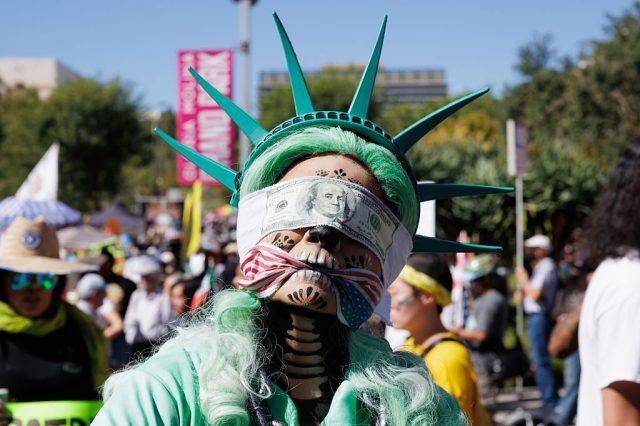
Welcome to moneyworld. (Caylo Seals/Getty)




The Asmat people live on the southwestern coast of the island of New Guinea, north of Australia, in what is now part of Indonesia. In the Oceania galleries of the Metropolitan Museum, you can today stand beneath a set of nine Asmat “bis” poles, each a towering spindle-carved stack of human figures wrought from a single mangrove tree. The tallest is nearly 20 feet high, and many display fabulous prow-like extensions, which stretch out from the genital-zones of this or that ancestor like an ornate yardarm. Some of those intricate booms are themselves composed of additional human figures, as if persons branched out from persons in time and space. Which they do.
There are reasons to wonder if these poles, and much else in the Rockefeller Wing, should be on Fifth Avenue. But here they are. And wandering through the halls recently, the late afternoon sun slanting through the window-walls, I realized how badly I had missed them for the last four years — while all of this was closed for renovations. When I first entered the southmost part of the room, where the bis poles used to stand, and they weren’t there, I panicked for a moment. Had they been… repatriated? I accepted that if so, it was probably quite correct. But I felt depressed. I sidled up to a guard in big shoes, and asked if there wasn’t some stuff missing in this room. He said no, that stuff was now next door.
Sure enough. Standing there beneath these human trees, strangely relieved, I was suddenly struck by the sense that the room in which I was standing — each elegantly balanced case and each careful label — delivered a precisely aimed punch in the nose for our moment, a wake-up slap for this bad dream.
After all, we in the US — as well as folks in the UK and Europe — are in the throes of intense conflict concerning “diversity”. In recent years, a longstanding and broadly operational national consensus around affirmative action policies (aimed at addressing legacies of racial and gender discrimination) has cracked rapidly into hostile camps: on the one hand, defenders of DEI policies and progressive identity politics; on the other, defenders of the “Enlightenment ideal” of free and equal persons judged on their substantive merits, without reference to sex or skin color. Each side accuses the other of bad faith, in addition to bad ideas. If it’s diversity you want, say MAGA pundits, how about we get some Republicans into your philosophy department? If you hate non-white people, counter the Brooklyn socialists, why not just say so, instead of pretending that you care about free speech?
Meanwhile, the Asmat bis poles look on, and they must be laughing hard in their woody cores: “Diversity?” one can hear them thinking, “How dare these cretinous buffoons babble on about diversity!”
After all, those looming funeral pylons, together with all the other majestic Melanesian artifacts around them, which hail from hundreds of totally diverse cultures, can see clearly the truth to which we are mostly blind: our world, the world of modern America and much of what lies beyond these shores, is, at this point, almost perfectly monolithic. Big picture, we all share one simple cosmology. Call it the “moneyworld”.
I know what you’re thinking: “That can’t be right! Look around! We are Christians and Jews, atheists and futurists, men and women and everything in between, black people from the South and recent immigrants from Asia. We are all so distinctive. And we believe a million different things. How dare you call us all the denizens of a single cosmology — and a counting-house ‘moneyworld’ at that!”
Almost. But not really. What we are, mostly, of course, is moderns, and what that means is that we navigate a world mapped in money values. A world shaped by ever-more-powerful programs for aggregating and augmenting “wealth” — wealth measured in dollars and cents. The masters of our universe are the financiers who look ceaselessly for ways to make their capital return new and bigger profits. We follow them, and pay tribute, when we can, with our little mutual funds. And we, too, as consumers and life-long market players, try to figure out how to win in the ledger book of existence: to buy the stuff we want for prices we can pay; to get ours at the auction block where we sell our wares, our time, our eyes, our minds. Indeed, we play the market with our whole beings, since we do everything we can to be rational self-maximizers in the continuous competition of the workforce, which demands that we conceive of ourselves as human capital, and “invest” in ourselves, through education and training, to optimize the ROI of our lives.
So what matters to the moneyworld? Money matters. What is “meaning” in the moneyworld? A billion dollars is meaning — everyone gets that. Are there other kinds of meaning? Sure, maybe. Like “happiness”, perhaps? True, we know it is a thing. But the good news is that economists can make you a model for it — denominated in dollars, naturally (they have no other units). What their models cannot capture is squishy at best. It might be real stuff, but it is so hard to quantify. Better pick a major in college that pays real dividends. In cash. You can puzzle about happiness after you make your first million.
Let me be clear about my view here: money is fine. Yes, yes, it is indeed a powerful technology for coordinating human behaviors, and markets can do good things at scale — allocate resources, drive innovation — in ways that are unmatched by any other social system or set of beliefs. I get it.
But the moneyworld is a world organized by price, a world of pure and continuous calculation. It is a world that only a machine could love — and the machines do love it. They run the numbers and keep the accounts. They have the data, and they use it — to monetize us, actually. Indeed, it is increasingly their world, and we only live in it — with many of us feeling more and more alienated and angry and unsure of what comes next.
A turn in the Oceania gallery of the Met is a chance to be reminded of how strange our machinic moneyworld really is. It has engulfed the planet as a ubiquitous system of meaning and order — but it has no soul whatsoever. No imagination. It knows, in the end, nothing about the stuff that makes us what we are as human animals: the dreams, the nightmares, our unique ability to find each other and tell stories powerful enough to make the earth a home and turn perfect strangers into kin — all the mad and magnificent ways we have worked to make sense of the experience of being alive on this planet. What makes us human, ultimately, is our ability to make meaning, not money. And we have done that in millions of ways, across millennia.
In New Guinea alone, a single island, there are some 800 different language communities. In some regions a mere 50 miles separates groups who are farther apart in linguistic and cultural traditions than China and France. How different are these worlds? Very. Look over here, at this “yam mask” from the Abelam people of the Middle Sepik River, over the ridge from the Asmat. It was placed on giant, man-sized tubers in rituals of fertility and initiation. It sits in a case, here, as a small and mysterious fragment from a very different cosmology of meaning and practice. Little of that world survives, of course: the grandsons of the makers of that mask probably work for the moneyworld now, logging in Malaysia.
Will a stack of greenbacks someday sit in a museum case on Mars, as artifacts of our globe-spanning but heedless and apparently self-destructive worldview? Who can say. But I like to imagine what the curators would write on the label.
For now, we have our work cut out for us. It is time to dig in and think hard about the different ways our ancestors have made meaning. Because what it is to be a human being is an urgent question to which every one of us had better have an answer. The rise of super-powerful human-emulator AI systems — which are both the flower of the moneyworld and its killer app — has made the question of our actual humanity the blazing question of our time.
We have been and believed so many things. That diversity, now, is a powerful inspiration as we face the monolithic moneyworld we have made. How can we arm ourselves against dehumanization in all its brutal forms? I don’t know. But I do know that there is no whitepaper that is going to save us. And that our museums, most of them, remain open. Some of the thinking we need is going to happen in their halls. It must.
Join the discussion
Join like minded readers that support our journalism by becoming a paid subscriber
To join the discussion in the comments, become a paid subscriber.
Join like minded readers that support our journalism, read unlimited articles and enjoy other subscriber-only benefits.
Subscribe