




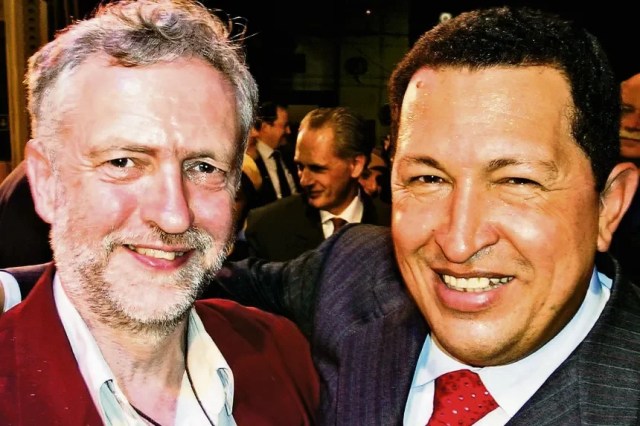
Jeremy Corbyn made little secret of his admiration for Hugo Chávez. Photo: Jeremy Corbyn via Facebook





The arrest of Nicolás Maduro represents a kind of a Rorschach Test for Britain’s hostile political tribes. Take Keir Starmer’s characteristically mealy-mouthed reaction: the former human rights lawyer and tireless advocate for international law was happy to prostrate himself before the King of the Court of MAGA, flagrant breaches of the “rules-based” international system notwithstanding. Perhaps that’s unsurprising for an ailing leader of a country that’s totally reliant on Washington both economically and militarily, submitting to the whims of the American monarch and clinging to the so-called “special relationship” like a limpet. The Right’s reaction to Maduro’s ouster was telling in its own way too — the conservative attachment to national sovereignty isn’t absolute, apparently, and the Westphalian principle of non-intervention can simply be waived if it suits a Republican White House. But it’s the reaction of Britain’s hard Left that’s most revealing of all.
For them, after all, the end of Chavismo isn’t just an act of imperialist aggression, ending once and for all the liberal-humanitarian pretenses of The West Wing generations, holding that American power represents something more than the brutal assertion of geostrategic interests at the point of an M4 Carbine. Yet if Trump has little concern for dressing interventions up in any idealistic garb, Maduro’s arrest also represents the symbolic end of a utopian project for Britain’s Left. Venezuela, for them, was once a paragon of political virtue, a model pupil for a world transformed. Of course, its failure was evident long ago, as the promise of Bolivarianism, or Venezuelan socialism, soured into a nightmare of economic collapse and mass emigration. Not that any of this really stopped some of Britain’s progressive dreamers, desperate for answers as far from home as possible.
For Britain’s Left-wing radicals, the domestic working class has always been a source of profound disappointment. Rather than fulfilling their proper historical role as agents of revolution, “The People” have been successfully bought off via moderate trade unionism, incremental reforms, and gradual embourgeoisement. As a result, many of our socialist intellectuals have internalized Marx’s 19th-century lament that English workers are “thick-headed John Bulls”, or else bemoaned our apparent culture of parochial conservatism. (Certainly, this is a convenient excuse for why much of the Left’s recent history has been marked by serial failure, even as evidence suggests consistent majority support for populist-tinged, social-democratic governance.)
And so the Left, wallowing in perennial domestic miseries, has tended to look abroad for their political beacons. During the Cold War, there was no shortage of high-minded “useful idiots” to excuse the follies of the Soviet Union, or else display their “radical chic” affiliations with an assortment of violent paramilitary and guerilla armies. Even Maoism briefly became the fashionable option for a niche sub-set of Western Europe’s youthful post-1968 generation, with the murderous iconoclasm of the Cultural Revolution presenting a more dynamic and rebellious — and therefore more palatable — alternative to the Kremlin’s gerontocracy.
More recently, Palestine has become the cause célèbre for younger generations politicized via short-form vertical video, convinced that events in the Occupied Territories represent a world-historic crux. Yet in the 2000s and 2010s, it was Venezuela that provided an example of a shining city upon a hill, of “Resistance”, of something called “socialism for the 21st century”, embodied in the charismatic persona of Hugo Chavez. Just as New Labour was basking in the warm embrace of the City of London and cosying up to the neo-cons, Caracas provided an outlet for the British Left’s affections.
Chavismo was at the forefront of Latin America’s “Pink Tide”, a wave of Leftist administrations that came to power promising a break with liberal economics and American regional hegemony. Of all the governments that emerged, it was Chavez’s brand of populism that represented its most radical wedge. Governing in the Latin American tradition of the charismatic caudillo, “El Commandante” had a simple model: amid the commodities boom of the millennium’s first decade — built on ballooning Chinese demand, Middle Eastern chaos and widespread concerns around “peak oil” — Chavismo would distribute surging crude export revenues to the urban and rural poor in the form of direct cash transfers, social welfare programs and subsidized everyday goods. Poverty was dramatically reduced while the ordinary citizen shared in several prosperous years of rapidly expanding gross national product.
It was these laudable efforts that earned Chavez, a former military man and a fervent nationalist, the praises of the extra-parliamentary and Labour Left. Thirty-two MPs signed a 2005 early-day motion brought by the Corbynite shadow chancellor John McDonnell praising Venezuela’s advances in “education, healthcare and land reform”. By 2007, Ken Livingstone signed a deal that saw Transport for London accept discounted petroleum in exchange for London officials advising Caracas on town planning and public-transport systems. In 2013, when El Comandante died of cancer, Jeremy Corbyn even penned an obituary titled “Thank You Hugo Chavez”.
Chavez described his project as “Christ’s work”. An apt phrase: for many a young Western ideologue, an organized political visit to Venezuela was practically a pilgrimage, even as Chavez himself was a deeply committed Catholic. Even so, Bolivarianism was also consciously draped in all the red regalia and classic jargon of the global Left: “anti-imperialism” was the default geopolitical stance; Yankee-led capitalism would be superseded by a new mode of social organization; an aging Fidel Castro was set up as a saintly figure; and commercial and military ties with the Cuban, Russian and Iranian governments were deepened.
All well and good. But Maduro’s ascension, following Chavez’s death, was nothing short of a national calamity. The seeds of decline had been sown even at the height of Chavismo, which saw average per-capita incomes surge. That hydrocarbon bonanza may have slashed poverty, but the whole model was reliant on high export prices. This was a new distributional arrangement rather than one based on a new model of production; the country remained dependent on resource extraction and exports just as it had under the old Caracas elites.
As oil prices fell to less than a third of their 2008 $147 peak, then, “Bolivarian socialism” became a short-lived chimera, its foundations too shaky to withstand US sanctions. Certainly, Venezuela’s heady extension of oil-fueled welfarism pales compared to the breakneck industrialization of the USSR, or indeed the growth-oriented, high-investment path set out by China. With oil revenues diverted to cash transfers and day-to-day spending, little was reinvested in Venezuela’s decaying infrastructure, nor indeed in the plant and machinery of the capital-intensive extraction sector. Industry atrophied, and the opportunity to diversify and increase the productive capacity of the wider economy was missed. Private-sector activity and investment was dampened by a combination of price controls and scattergun expropriations. And when commodity prices finally fell through the floor, Maduro responded disastrously, meeting his budget shortfalls by printing cash and pushing inflation up to a staggering 1,000,000%.
Nobody comes off well in Venezuela’s long unraveling, now reaching a strange denouement. The early promises of Chavismo were dampened by fatal missteps, and while Chavez himself was repeatedly elected by large margins, Maduro entrenched a level of cronyism that rode roughshod over separations of powers and subjected every part of the state apparatus to loyalist capture. His subsequent victories at the ballot box are broadly seen to have been fraudulent, and the idea that anyone could command majority support in a country in which the economy has contracted by over two thirds stretches credulity.
Yet there’s a wider tragedy here, too, one that lies far beyond Caracas. That begins with our own government: our impotence in the face of such boisterous breaches of international law exposes yet again our unhappy reliance on American imperial favor. For Britain’s Left, though, the lesson from the failure of Chavismo is in some ways even more profound. This, after all, was never just some abstract experiment — it was a real substitute for domestic failure, where socialism could be built at arms-length in exotic settings, without having to persuade the skeptical swing voters of Nuneaton.
What’s more, the underlying failure of Chavismo mirrors a failure of imagination from the Left here in Britain: without a new model that breaks fundamentally with our broken economic paradigm, Left politics becomes a struggle over the post-facto distribution of national income from the same spluttering growth engine. Hence we see some of the loudest Left outcries and mobilizations against freezes in welfare payments, or against reducing palliative cash transfers, none of which do anything to alter underlying, structural failures of neoliberal capital. The Left is still grasping in vain for an alternative that goes beyond the distributional and towards a new growth model. In just the same way, Chavismo, despite the nationalizations and lofty rhetoric, did little to build a new productive template, or new foundations for inclusive growth for generations into the future, instead relying on the foolish permanence of volatile oil revenues.
Not that any of this has provoked a reckoning — so much as a move to the next abstract cause, untethered from any new strategy for power, or any new models of growth or governance. The fact is that the modern British Left is still stuck in what Mark Fisher eloquently called “capitalist realism”, in which it’s easier to conceive of the end of the world than it is to imagine a world beyond capitalism. And yet look around Britain today, and there’s clearly so much that could be profitably foregrounded by a real, energized, pragmatic Left politics. National renewal; investment-led growth; a restitution of state capacity; the rescue of the public realm; a renaissance of national production based on well-paid work in domestic supply chains. All this is urgently needed — yet nothing will be achieved by fetishizing failure in foreign climes. Those hoping for a change in Left cultures shouldn’t hold their breath.
Jonny Ball is a Contributing Editor at UnHerd. He formerly wrote under the name Despotic Inroad.
 DespoticInroad