




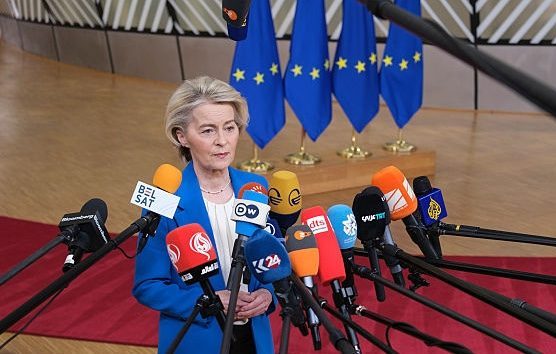
'The Union is beginning to resemble a crumbling empire.' (Thierry Monasse / Getty)




Belgium’s prime minister learned the hard way that one does not need to be a rabble-rousing populist to incur the EU’s wrath. Until recently, the moderate conservative Bart De Wever had largely stayed out of the European spotlight. This was relatively easy, given that his party belongs to the center-right European Conservatives and Reformists group in the European Parliament, which has strongly aligned with Ursula von der Leyen’s Commission on Ukraine. Yet in a matter of months he became the Brussels establishment’s public enemy number one.
His offense? Opposing Brussels’s plan to seize Russia’s frozen assets held in Europe. The overwhelming majority of them are parked at Euroclear, a Brussels-based clearing house that sits at the heart of global securities settlement. For Europe’s pro-war lobby, led by France and Germany, confiscation was presented as the only way to continue financing Ukraine’s war effort — or, failing that, to force member states to assume the burden collectively through other, increasingly extraordinary means.
Belgium, however, had compelling reasons to resist. Confiscating — or functionally expropriating — Russian central bank assets would violate one of the most sacrosanct principles of international finance: the neutrality and inviolability of sovereign reserves. Breaching that principle would not only set a dangerous precedent, but would also expose Belgium to potentially severe legal, financial and geopolitical consequences — as Euroclear is domiciled there.
As Robert Volterra, one of London’s most respected international lawyers, warned, confiscating Russian assets would be “absolutely illegal” and would haunt the EU for generations. The legal fallout could be enormous. Russia had multiple avenues for challenge and had begun to explore them, already filing a lawsuit in Moscow against Euroclear.
From there, Russia could pursue litigation in Belgian courts, potentially all the way to the supreme court. Belgian judges would be forced to determine whether Russian property rights under domestic law had been violated and whether the principle of sovereign immunity had been breached. On both counts, Russia’s case would be strong. Were Russia to prevail, Euroclear itself would be liable. Given the sums involved, the clearing house would almost certainly be rendered insolvent, triggering national and EU-level deposit guarantee mechanisms.
In such a scenario, Euroclear would in turn be compelled to sue the Belgian state, which would have ordered the effective expropriation of client assets. The prospects of such a claim would be far from negligible. Beyond Belgium, Russia could also bring cases before the European Court of Justice, the International Court of Justice and multiple international arbitration forums. Even setting litigation aside — one might argue that in the current context it would be hard to find a Western judge willing to rule in Russia’s favor — it is difficult to see how Belgium could justify refusing to unfreeze Russia’s reserves if and when a peace settlement is eventually reached.
It is therefore hardly surprising that Belgium emerged as one of the most vocal opponents of the plan. De Wever has bluntly warned that confiscation would amount to “an act of war”, likening it to entering a foreign embassy, stripping it of its contents and selling them off. One might reasonably conclude that he is simply defending his country’s interests by upholding international law. And yet, for this, he has found himself subjected to a smear campaign by the EU’s political and media establishment. He has been accused of acting under Russian intimidation — or worse, of being a Russian asset himself. At the same time, Brussels threatened to “treat Belgium like Hungary” if it continued to oppose the plan. That’s what happens when even loyal pro-EU governments dare to step out of line.
Despite the massive pressure, De Wever stood his ground. And he was joined by a growing front of dissenters. Hungary and Slovakia openly rejected the scheme, with Hungarian prime minister Viktor Orbán accusing the Commission of “systematically raping European law”. Italy, Bulgaria and Malta also expressed reservations.
The economic and financial implications of confiscation, after all, would extend far beyond Belgium. Once the assumption that sovereign reserves held abroad are immune from political seizure is broken, there is no telling what the consequences may be. Countries would begin to view euro-denominated assets not as a safe store of value, but as a political liability — one that can be confiscated at Brussels’s discretion. The message would be unmistakable: your assets are safe only as long as you remain politically compliant. The result would almost certainly be that capital would start to flee Europe — even faster than it already is.
Nonetheless, faced with growing resistance, Brussels last week resorted to invoking emergency powers under Article 122 of the Treaty on the Functioning of the European Union to indefinitely freeze the Russian assets, claiming this would allow it to act by qualified majority rather than unanimity. Yet this represents a blatant distortion of the Treaty. Article 122 applies strictly to emergency economic measures in response to natural disasters or severe economic disturbances. It does not apply to foreign policy, which unequivocally requires unanimity. The fate of Russia’s frozen sovereign assets, however, is self-evidently a foreign policy matter. Claiming otherwise is an extra-legal sleight of hand.
This is another example of a Brussels power grab. If Article 122 — or any other provision — can be stretched to justify the seizure of foreign sovereign assets and the imposition of massive liabilities on unwilling member states, it can be used to circumvent unanimity across a wide range of foreign policy decisions.
The threat, however, worked. On Friday, at the European Council meeting, the Commission failed to secure an agreement on the use of the frozen Russian assets. Instead, it secured agreement on a separate €90-billion loan, backed by the EU budget and underwritten by all member states except three (Hungary, Slovakia and the Czech Republic), which were granted opt-outs. In effect, the political obstacle was bypassed not by changing strategy, but by shifting the financial risk directly onto European taxpayers. As von der Leyen made clear in advance of the summit, there was little room for dissent: “No one will leave the EU summit until the issue of Ukraine’s financing is resolved.”
Incredibly, the deal foresees that the loan will have to be repaid by Ukraine only if and when Russia agrees to pay war reparations — effectively transforming hypothetical future reparations into immediate financing. This idea is, at best, wishful thinking. It is highly unlikely that Russia would accept binding reparations even in the event of a peace deal, meaning that there is little chance Ukraine will ever repay the loan. This is all the more striking given how much Europe has already spent: EU parliaments have approved at least €187 billion in support for Ukraine, on top of massive indirect costs.
This episode illustrates how the EU operates: by manufacturing false binaries that foreclose genuine political choice. Member states were presented with a stark alternative — either agree to confiscate Russia’s frozen assets or be prepared to collectively underwrite a massive new loan. What was never seriously considered was a third option: to stop pouring money into a demonstrably failed strategy and instead work to bring the war to an end through negotiations.
Yet it’s easy to see why the EU can’t afford to confront the failure of its Ukraine strategy — one that has inflicted immense economic damage on Europe while delivering nothing on the battlefield, and that has left Ukraine in a worse position than at the start of the war. Acknowledging this reality would carry enormous political costs for EU elites, particularly those most invested in the victory-at-all-costs narrative — hence their determination to keep the war going at all costs. This is why, even after failing to agree on confiscation, Brussels pushed through a massive, budget-backed loan as a substitute. The consequences will be dear: Ukrainians will continue to suffer and die in an unwinnable war, while Europe will remain entrenched in a permanent state of economic warfare and military-by-proxy confrontation with Russia, with a constant risk of escalation into direct conflict.
If there is a silver lining to this grim trajectory, it is that the recklessness of these choices will only exacerbate the contradictions of a project that is pushing the continent to the brink, ultimately forcing a reckoning — within member states and among Europe’s citizens alike. Indeed, the Commission may have succeeded in avoiding a catastrophic humiliation, but in doing so it exposed the increasingly authoritarian nature of the Union, willing to override national interests and discard legal constraints, democratic norms and basic economic rationality in pursuit of ideological crusades. Meanwhile, the enormous financial burden imposed by the latest deal will only deepen internal fractures and push national budgets to the breaking point — especially when it becomes clear that it will entail yet more resources diverted from Europe’s own crumbling infrastructure, underfunded hospitals and overstretched schools.
And Ukraine is far from the only flashpoint. Brussels is also struggling to secure backing for the Mercosur free-trade agreement with Argentina, Brazil, Paraguay and Uruguay. Here, too, resistance is growing. France has long led the opposition, with Emmanuel Macron reiterating recently that the deal lacks reciprocity on production standards, pesticide rules and food safety. The front broadened significantly this week, when Italian Prime Minister Giorgia Meloni described the deal as “premature”, citing inadequate safeguards for European agriculture. Italy’s stance is pivotal, as it raises the prospect of a blocking minority in the Council that includes Poland, Hungary and Austria too.
Protests have added to the pressure. On Thursday hundreds of tractors converged on Brussels as farmers from across Europe denounced what they see as unfair competition. Proposed safeguards have done little to calm opposition — leading to the ratification of the deal to be postponed once again at the European Council.
And so, as the contradictions within the EU continue to accumulate, it is increasingly difficult to see how Brussels can manage the backlash for much longer. The Union is beginning to resemble a crumbling empire, reliant not only on repression, censorship and electoral manipulation to maintain control, but also on ever more aggressive tactics directed even against pro-EU governments themselves. By forcing through ever more reckless commitments in the name of unity, it is simply setting the stage for an even more catastrophic implosion down the road.
Thomas Fazi is an UnHerd columnist and translator. His latest book is The Covid Consensus, co-authored with Toby Green.
 battleforeurope
Join the discussion
Join like minded readers that support our journalism by becoming a paid subscriber
To join the discussion in the comments, become a paid subscriber.
Join like minded readers that support our journalism, read unlimited articles and enjoy other subscriber-only benefits.
Subscribe