








December 27 2025 - 1:00pm
Conspiracy theories have a habit of turbocharging political movements in France. In the years leading up to the Revolution at the end of the 18th century, a period of riots and robbery called the Flour War was provoked by bad harvests and poor regulation leading to high grain prices. It was then inflamed by theories of a “Famine Pact”, which claimed that the elites were deliberately hiding grain from the population. The Gilets Jaunes, France’s biggest protest movement in recent years, had its own conspiracist wing which bled quickly into the wilder end of the anti-lockdown movement when Covid put a stop to the weekly protests. At present, the movement challenging power while hyped up on theories of plots of population control is that of the farmers who are blocking roads in Brussels and Paris.
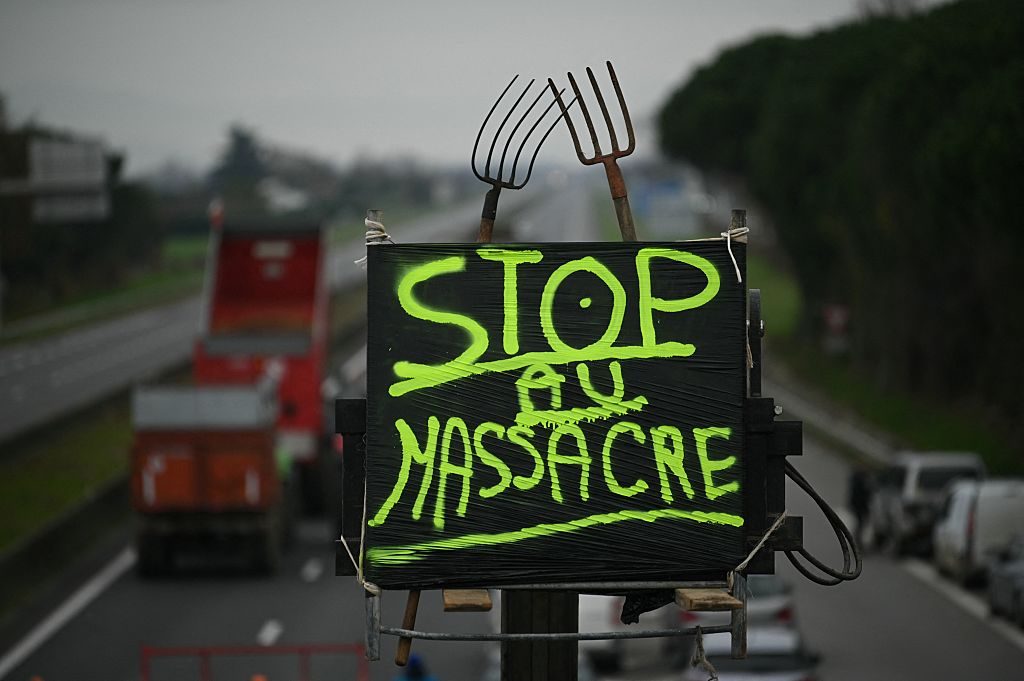
Farmers are up in arms for two reasons. The first is a government policy of culling herds of cattle in response to an outbreak of contagious nodular dermatitis (CND). While this is supported by the largest farmers’ union, the FNSEA, two smaller unions — the Peasants Confederation on the Left, and the Rural Coordination on the Right — oppose the culls. They argue that the government should instead prioritize a vaccination campaign and the culling of individual cows found to have the disease.
The second reason for these farmers’ fury is a free trade deal which the EU is close to finalizing with the South American trade bloc Mercosur. Although sections of the French agriculture industry, such as winemakers and the purveyors of dairy products, might stand to gain from opening up access to Latin American markets, other farmers fear that the deal will flood Europe with cheap Brazilian beef which isn’t subject to the same standards as meat produced within the European Union.
Because these two problems concern beef, and because it is EU regulations which demand the systematic culling of herds that have come into contact with CND, a narrative is emerging among certain farmers. According to this theory, the EU is in cahoots with a comprador French elite and Lula’s Leftist government to kill French cows and replace their produce with lower-quality Brazilian beef.
Posts denouncing the disease as a “fake pandemic from who knows where” which has been engineered to produce a situation in which there is “no more French meat, no more French milk, no more French butter” go viral on the Facebook pages supporting the farmers. They speculate that foie gras will be next as duck farmers are forced to vaccinate their birds.
The farmers’ anger is palpable, and in some quarters the tone of the protests is becoming darker. Pierre Guillaume Mercadal, a farmer with the Rural Coordination union well known for its proximity to the National Rally, has become a media sensation. In a video from November, he told the farmers that their “actions must become violent” and that they will have to “prepare to go to war” if they don’t want to “be put down like dogs”. Other internet-famous farmers also talk in terms of a war waged against them by Emmanuel Macron and Ursula von der Leyen. The scenes of tractors spraying manure directly on police vans in Brussels are a neat visual representation of just how these agricultural agitators feel about the authorities.
Beyond the banal operation of globalization, there is not a coherent plot to destroy French produce. Yet the conspiracy narrative is a powerful motivator to action for people like Mercadal. In tying the bovine health crisis to the EU’s Mercosur deal, the conspiracy theorists have pushed Macron to respond. While he has not given up on the CND culls, he has been forced to intervene to delay the signing of the Mercosur deal by the sheer ferocity of the farmers’ anger. The crisis also reflects the French political situation more widely, in which established institutions — in this case the Ministry of Agriculture and the FNSEA union — are increasingly delegitimized and radicals on the Right and Left are thrown to the fore. The farmers are simply another embodiment of the logic of the fractured Fifth Republic.
Join the discussion
Join like minded readers that support our journalism by becoming a paid subscriber
To join the discussion in the comments, become a paid subscriber.
Join like minded readers that support our journalism, read unlimited articles and enjoy other subscriber-only benefits.
Subscribe