





Paris Hilton performs at West Hollywood Pride in June. Credit: Getty




The last quarter century in Western cultural life has been wasted. Everything is a little bit mid, as the kids say. There have been impressive individual works of art and entertainment. But taken as a whole, the picture is bleak: our artistic output is derivative and cheaply didactic, either moralizing or starved for moral judgment and ideas. Now, as cultural criticism confronts this epochal failure, it’s easy to cast partisan blame, with a still-dominant Left critical establishment training its sights on the Right.
Easy — but inaccurate.
Cultural life in the 21st century doesn’t feel tortured or ecstatic so much as muted. We aren’t truly bored anymore; boredom has been technologically abolished. Every stray second can be plastered over with a feed, a notification, a video “For You,” an algorithmic recommendation tuned precisely to prevent mental calm. But neither are we animated. There are widespread predictions of a coming civil war and calls for a political uprising, yet neither is remotely on the horizon — because we aren’t passionate enough. Instead, we drift in a gray zone between stimulation and stupor, provoked but under-engaged, surrounded by infinite novelty that no longer feels all that novel.
Our clothes arrive in two days and fall apart in three. Travel is cheaper, but cities blur into one another, interchangeable landscapes of chain restaurants, and “authentically curated” coffee shops identical from Denver to Dublin. The internet, once a wild frontier, now feels like a series of endlessly recycled aesthetics: girl dinner, cottagecore, blokecore, everything a core, everything a remix.
It’s precisely this sense of living in a stagnant wasteland that Blank Space, W. David Marx’s wide-ranging survey of 21st century-culture, tries to map. In his previous polemic, 2022’s Status and Culture, the Tokyo-based culture-vulture took a sanguine approach to contemporary life, arguing that the omnivorous approach to cultural consumption in the West — where there is no more snobbery, and where elites enjoy “not just high culture, but pop and indie, niche and mass, new and old, domestic and foreign, primitive and sophisticated” — is by and large a good thing for the sake of flattening the class distinctions of old. We were slouching toward equality.
Now, Marx worries that the lack of pretense in contemporary culture is no utopia, that it might mean we’re all eating from the same trough of slop. Across nearly 400 increasingly exasperated pages, Marx convincingly argues that art, entertainment, and fashion since the year 2000 have been some combination of uninspired, recycled, soulless, corporatized, or plainly dumb — so much so that there is a blank space where a distinct cultural imprint should be.
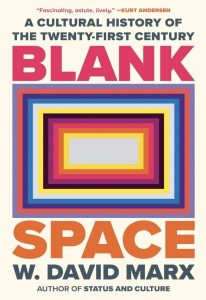
The book draws its title from the Taylor Swift song, but it should have been called Bad Space, because what Marx charts isn’t a lack of distinct cultural production, but a disposable, amoral culture led by “charlatans and reprobates,” as he puts it. “With creators no longer required to pursue artistic excellence, culture became a lowest-common-denominator battle for attention.” I’d go further, and argue that 21st-century culture is a product of the rise of a post-moral society, a civilization that lost its backbone, where shame, seriousness, and shared judgment have been replaced by nihilism, vanity, and greed.
Marx would rather tell you that the hellscape of the present is due to the abandonment by the creative class of the 1960s counterculture that spurred cultural innovation to new heights. “Artists reshaped the established symbolic core, tweaking human consciousness to reveal new ways to perceive the world,” he wrote, which led to “new styles, new goods, and new behaviors.” But in his telling, the pure artistic invention of the late 20th century was suffocated to death by — yes — neoliberalism, that inscrutable yet omnipotent bogey of Left liberals.
To make his point, Marx praises Pearl Jam’s modest refusal to sell out in the 1990s and compares it favorably to the Mount Rushmore of 21st-century cultural derailment: Kanye West, whose career has the dramatic arc of a Greek tragedy rewritten by TMZ; who first made his mark with the gospel-inflected single “Jesus Walks” and barely 20 years later wrote a rap ode in honor of Adolf Hitler. The book also traces the inglorious rise of proto-influencers Kim Kardashian and Paris Hilton and a trio of sleazeballs: pervy fashion photographer Terry Richardson, Vice editor-turned-Proud Boys founder Gavin McInnes, and Joe Francis of Girls Gone Wild, whose contribution to American culture is … well, exactly what you think it is. What ties these figures together, in Marx’s telling, is that they exemplify a society with no values left but market values.
Blank Space performs rhetorical parkour to avoid blaming liberals or progressives for any of it, instead dutifully blaming 21st-century cultural decay on conservatives. He’s half right when he gestures toward economics and wields phrases like “neoliberalism,” “late capitalism,” and “market incentives.” And he isn’t wrong to invoke the late Fredric Jameson, whose famous line from Postmodernism, or the Cultural Logic of Late Capitalism could serve as Blank Space’s thesis statement: “Aesthetic production today has become integrated into commodity production generally,” creating a frantic churn of “ever more novel-seeming goods” and obliterating the distinction between art and packaging. But the process described by Jameson is not simply the result of capitalism’s strength, but society’s weakening. Once the belief in non-market values collapses, culture becomes indistinguishable from advertising.
Marx argues for the revival of old norms, but he overlooks who was largely responsible for their demise in the first place. For most of the 20th century, flouting norms was a New Left pastime — from the counterculture to punk, queer avant-gardes, and the art world. The point was to Question Authority, mock propriety, scandalize the bourgeoisie, and liberate the individual. And they won. So decisively, in fact, that by the aughts, the bourgeois values were simply … gone. Outside of new social taboos created by the race-and-gender-obsessed professional-managerial classes, there was nothing left to rebel against. By rejecting moral language in the name of liberation, the Left ceded moral authority to the market, argues Ana María Cisneros in Damage Magazine. “We surrendered to the only morality the market recognizes: preference and purchase.”
The rot of the post-moral society goes beyond soulless or mediocre entertainment products. We may be in the midst of a mass amnesia event. In her 2004 book, Dark Age Ahead, Jane Jacobs — a patron saint of liberals — treated cultural collapse as a social and institutional problem. The existence of big cultural industries — newspapers, TV, and the internet — obscured the fact that we were on the brink of a neo-Dark Age, a term that, whatever its historical accuracy, aptly describes periods of cultural stagnation and mass-forgetting. Jacobs recognized that, in the West, we were losing family stability, real education, civic responsibility, and cultural memory, and that it was leading to the erosion of the institutions that reproduce the collective customs, practices, and rituals of the past.
The cultural byproduct of Dark Ages, Jacobs wrote, wasn’t empty. “It is not a blank; much is added to fill the vacuum. But the additions break from the past, and themselves reinforce a loss of the past.” Yet Marx makes the case that if we’re in a Dark Age, it’s because our artists are now conservative and lack a “genuine countercultural ethos.” Indeed, Blank Space makes the absurd claim that the early-aughts hipster era — the American Apparel, Vice, Williamsburg, Terry Richardson, “indie-sleaze” years — was Patient Zero of the new conservative culture.
His evidence is that the early-aughts hipster scene was snarky, cynical, and displayed a kind of libertine hedonism lacking utopian imagination, prefiguring the amoral MAGA-friendly art scene of post-Covid lower Manhattan (explored by UnHerd columnist Matt Gasda in his era-capturing play Dimes Square). Sure. But that makes the early aughts post-political, not conservative. Contra Marx, the hipster moment didn’t pave the way for Dimes Square conservatism, with its ironic trolling. Rather, hipsterism was a product of the vacuum of discernment and tradition created by anti-social libertarianism of both Left- and Right-wing varieties. And into that vacuum waddled the MAGA Right.
One has to read between the lines to realize that Blank Space is not just a cultural history, but an accidental sociology of a profoundly atomized society.
Marx’s argument that the market colonized culture overlooks the fact that culture collapsed alongside society, and that this collapse was accelerated by technology. We now live in “the anti-social century,” as The Atlantic’s Derek Thompson has argued: the moment when digital technology accelerated our retreat into hyper-individualized isolation. Concerts, clubs, civic centers, hangouts, bars, and churches withered, and Americans now spend less time with friends, neighbors, and communities than at any point in modern history. Bowling Alone led to scrolling alone. The result is the erasure of the social fabric that once made innovative culture possible.
Culture requires communities with shared expectations, peer pressure, reputational consequences, scenes, mentors, and traditions. Remove those, and all that’s left is audience metrics and the conditions of a new Dark Age. Blank Space recognizes this reality in some sense and calls for a renaissance. Marx wants artists to RETVRN to the 20th century and bring back creative ambition, and, likewise, for critics to rediscover discriminating taste, audiences to rediscover seriousness, and creative enclaves to redefine norms — something like Make America Creative Again. It’s accidentally the best conservative book of the year.

Join the discussion
Join like minded readers that support our journalism by becoming a paid subscriber
To join the discussion in the comments, become a paid subscriber.
Join like minded readers that support our journalism, read unlimited articles and enjoy other subscriber-only benefits.
Subscribe