




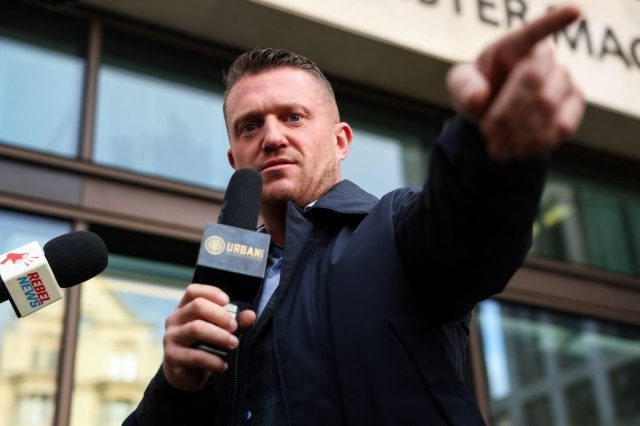
He's still welcome in church. Daniel Leal / AFP via Getty Images




Tommy Robinson is a far-Right activist who has served several terms in prison for assault, fraud, and contempt of court. He is infamous for his hostility to Islam and Muslim immigrants, and has been banned from Twitter, Facebook and Instagram for hate speech (though Musk reinstated him on X). Apart from sharing a birthday, and the fact that he calls himself a Christian, I have nothing in common with this man. Oh, and the fact that we are both organizing carol services.
Nonetheless, Robinson is welcome in church this Christmas. Everyone is welcome in church. If your pronouns are we/they; if you have spent time in prison; if your political views are to the right of Attila the Hun; if you love the EU or hate it; if you think Hamas are misunderstood; if you think the country is being invaded by immigrants. Even if you’re a Liberal Democrat — all are welcome.
The whole point of coming to church is that you sit alongside people you may not like, who hold very different, even (to you) repulsive political views. If Tommy Robinson were to come to church, he would have to sit with people of different colors and languages, and immigrants. He might even have to sit with Muslims who are there out of friendship with their Christian neighbors. The church is not a club for the right-minded, it has no ethnic base, it is not much interested in your nationality. We all sit under the judgment of God. “Outsiders welcome” is the strapline of the Church’s Christmas poster campaign.
I don’t expect the same capaciousness will be on offer at Tommy’s carol service this weekend. Advertised thus: “This event marks the beginning of a new Christian revival in the UK — a moment to reclaim and celebrate our heritage, culture and Christian identity.” It also marks Robinson’s own Christian revival — he seems to have converted during his most recent stint inside. Back in May, he emerged from HMP Woodhill in Milton Keynes, wearing an ostentatiously large cross over his T-shirt. He isn’t the first to have weaponized Christian symbols against others. There is a long and shameful history of Christian “culture” and “identity” being used as code for white or Western — which is all a bit ironic, really, given where Christianity came from. These days, the most common Anglican is a black woman, living somewhere like Nigeria. Without immigration, many churches in England would have closed. My congregation used to jokingly call my last church a Guinness church — predominantly black, with a little white leadership on top.
Yet attitudes towards immigration are complicated. A survey by Theos found that Christians in the UK are generally a little more hostile to immigration than the population as a whole. But — and this is the interesting bit — the results show something very different when disaggregated for actual church attendance. Practicing Christians are actually more welcoming towards migrants than the population as a whole, whereas cultural Christians — the sort who tick the religious box on a census form but don’t darken the door of the church (or only at Christmas) — are more hostile to immigration. For many of these people, the important part of being Christian is not the Trinity, or the forgiveness of sins, or “love your neighbor”. To them, being Christian is a way of referencing their own ethnic heritage without mentioning race. I generally want to resist the distinction between real Christians and Christians in name only, but when it comes to those who want to set some spurious thing called Christian identity against the teachings of the church, I am prepared to make an exception.
Unfortunately, the way we have come to celebrate Christmas — all that generic happy holidays nonsense — has made it easier for those who despise multiculturalism to claim that we have misplaced the core message of Christmas. The Tommy Robinson carol service has adopted the message of “putting Christ back into Christmas”. Do me a favor, “O Come, All Ye Faithful” it is not. Indeed, what carols could they possibly be singing?
Christmas offers little comfort to the Christian nationalist. The only references to the nation that I can find in Christmas carols have the word in the plural. “Joyful all ye nations rise”, or “Unto us a boy is born! King of all creation, Come into a world forlorn, The Lord of every nation”. At a huge stretch the first line of “God rest you merry gentlemen” could be read as some sort of reference to traditional and patriarchal British identity, but this is clearly undercut by the final verse: “Now to the Lord sing praises, All you within this place, And with true love and brotherhood, Each other now embrace, This holy tide of Christmas, All other doth efface.” Think about this last line. All other what are effaced? All other differences, of course. But that is precisely the message Robinson despises.
Frankly, I can’t think of a single carol the people designing this ridiculous service could use that doesn’t undermine their thuggish anti-immigrant intent. The irony meter would go into meltdown if they sang “It Came Upon the Midnight Clear” with those wonderful final words: “O hush the noise, ye men of strife, And hear the angels sing.”
Christmas also offers an unlikely cast for a British Christian nationalist. A Jewish boy is born to Jewish parents in the Middle East. Wise men come “from the East”, probably from Iran. To escape Herod’s “slaughter of the innocents”, Joseph and Mary with their child travel to seek asylum in Egypt. It is worth pointing out the obvious: all these people would look a lot more like the Syrian refugee than they would Tommy Robinson and his angry gym-bunny friends.
There is a key difference between the narrow Tommy Robinson Christian nationalist and Christians who love their country and their faith — which includes me. For the former the cross is a kind of club badge, an exclusive membership organization for people who look and sound and think like them, whereas for the latter, it is a message of hope and salvation offered to all. That’s why Robinson-style Christianity is not the same as, for instance, a large number of Christians who support Reform. Last weekend, a Guardian article explored the rise of the religious Right in UK politics and mentioned Tommy Robinson in the same piece as Reform MP Danny Kruger and Farage adviser James Orr. You may not like the politics of the latter two, but they are completely different from Tommy Robinson, and it is pretty shameful to elide those differences. Kruger and Orr are both serious, thoughtful Christians who have no truck with the kind of exclusive and frankly hateful yobbishness of Robinson and his cronies.
The Church’s new poster campaign was devised specifically to push back against Robinson’s carols and rightly emphasizes the inclusivity of Christmas: faith shouldn’t be exploited for political ends. I agree. But a poster campaign doesn’t go nearly far enough. If he came into my church, I would deny him holy communion. Yes, it’s a pretty extreme measure, but the sacraments can be refused for grave sin — which in my view includes Robinson’s style of race-baiting.
At Christmas, our churches resound with angels singing “Fear not”. In contrast, Robinson spreads fear. That is his political currency. But that is not the Christian message. And we will sing that in my church with gusto: “O hush the noise, ye men of strife, And hear the angels sing.”

Join the discussion
Join like minded readers that support our journalism by becoming a paid subscriber
To join the discussion in the comments, become a paid subscriber.
Join like minded readers that support our journalism, read unlimited articles and enjoy other subscriber-only benefits.
Subscribe